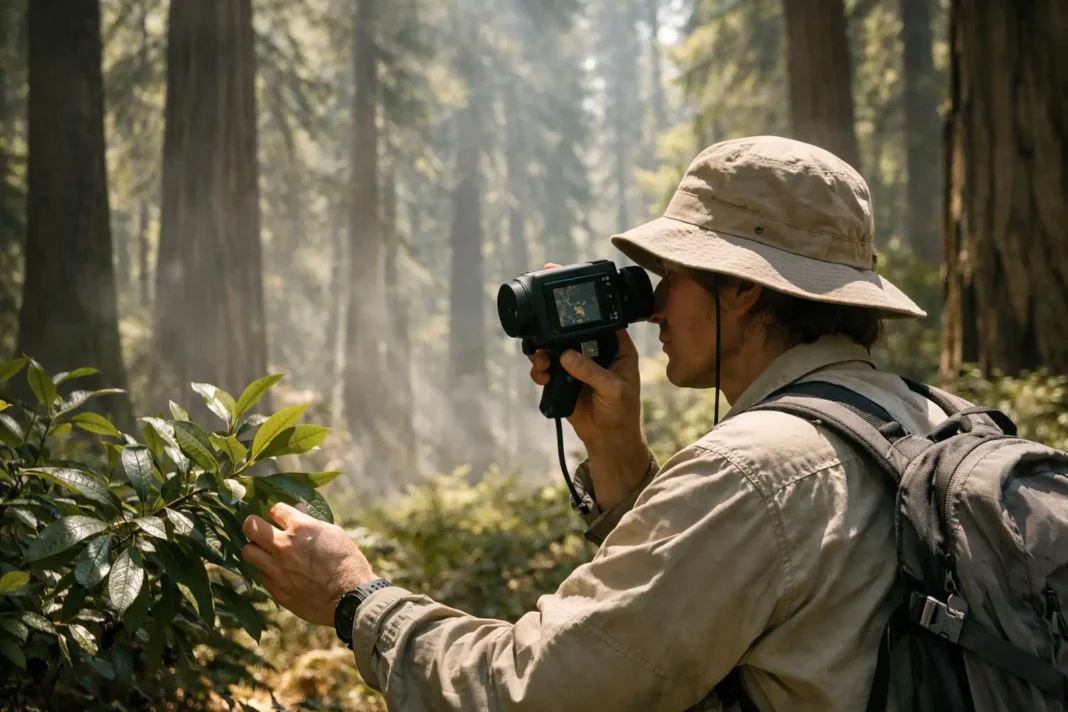

Redwoods slow photosynthesis under high temperatures, according to a recent study that combined field monitoring and laboratory tests. Between 2022 and 2024 researchers sampled leaves in the Garcia River Forest in Mendocino County to quantify how heat affects the ability of redwoods to convert sunlight into chemical energy. The results point to reduced carbon uptake during hot spells and raise questions about the resilience of these coastal forests as average temperatures climb.
The investigation used leaf fluorescence as a proxy for photosynthetic activity and compared leaves exposed to sunlight with leaves placed in darkness to estimate maximum capacity. Field teams measured samples once or twice monthly and observed that exposed leaves could be up to 10°C warmer than ambient air, an indication of thermal stress. The study was led by Lily Klinek (Lily Klinek) of University of California, Davis (University of California, Davis), who described stomatal responses and leaf overheating as central observations from the field work.
To separate water-stress effects from direct thermal limits, researchers returned leaves to the laboratory and maintained them in water while exposing them to a range of temperatures. Even with stomata held open by hydration, photosynthetic rates declined as temperature rose, indicating that heat imposes physiological constraints on the photosynthetic apparatus itself. The findings appear in JGR Biogeosciences (JGR Biogeosciences). Independent ecologists, including Lucy Rowland (University of Exeter), noted that the work documents direct heat effects on photosynthetic systems rather than effects mediated only by water loss.
The study has implications for carbon storage and the future distribution of these iconic trees in a warming world. Researchers caution that the thresholds at which heat damage becomes irreversible remain poorly defined and call for measurements that scale from leaf physiology to whole-tree and ecosystem responses. As climate change brings more frequent extreme heat, understanding these thresholds will be crucial to forecasting how California‘s coastal forests will function and store carbon over coming decades.