
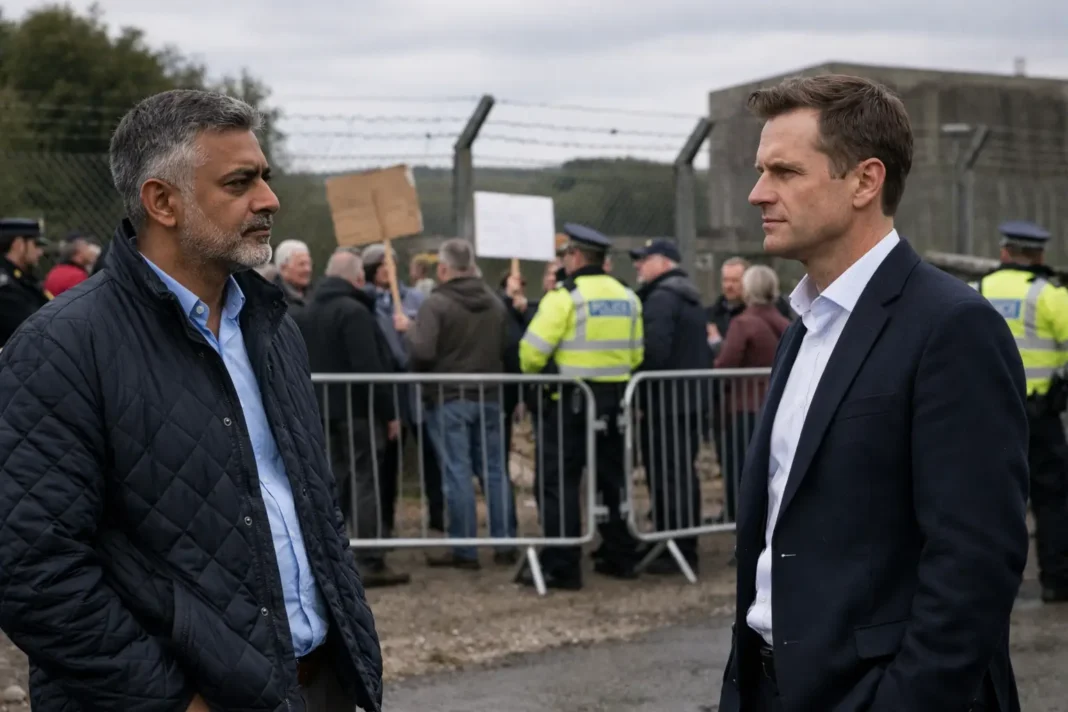

A confrontation in Piddington has exposed the increasingly tense politics surrounding immigration in the United Kingdom, after representatives from Reform UK and the Conservative Party clashed while speaking against the conversion of a former military site into accommodation for asylum seekers. The exchange involved Zia Yusuf, speaking for Reform, and Chris Philp, a Conservative spokesman, during an event focused on opposition to the proposed use of the site.
The disagreement was notable because both political figures were addressing the same underlying concern: resistance to turning the former military facility into asylum accommodation. Yet the public clash underlined how sharply the debate has shifted from a dispute over one location to a wider contest over political credibility on border control, public services and the management of the asylum system. For residents and campaigners, the immediate issue remains local; for national parties, it has become part of a broader argument over trust and competence.
Reform UK, whose official platform is promoted through Reform UK, has made immigration one of its central political themes. The Conservative Party, represented nationally through the Conservative Party, is also seeking to demonstrate a firm stance on asylum policy after years in which accommodation, processing delays and irregular migration have remained prominent issues in British politics. The clash between Yusuf and Philp illustrates the pressure on the Conservatives from the right, particularly in communities where proposed asylum facilities have become politically sensitive.
The use of former public, military or institutional sites for asylum accommodation has often generated opposition from local communities, with concerns typically focused on capacity, consultation and the suitability of facilities. Central government responsibility for asylum policy sits with the Home Office, but local disputes frequently draw in MPs, councillors, campaign groups and national party figures. Piddington now sits within that pattern, where planning, migration policy and electoral positioning converge around a single site.
The episode leaves unresolved the central practical question of whether the former military site will be converted for asylum use. What is already clear is that the politics around such proposals have become more fragmented and confrontational. Even where Reform and Conservative speakers oppose the same plan, the competition to define the strongest position on immigration can turn a shared platform into a flashpoint.





