
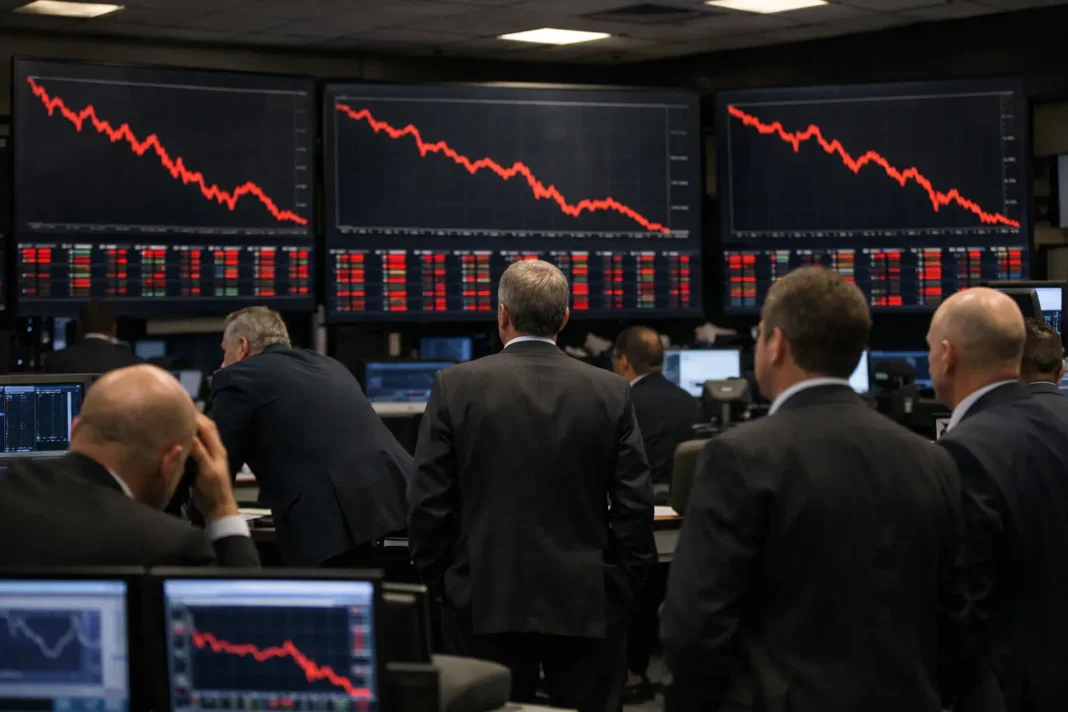

Technology shares led a renewed slide on Wall Street, weighing heavily on US markets as investors moved away from some of the sector’s most closely watched names. The pressure was broad enough to push both the S&P 500 and the Dow Jones Industrial Average into correction territory, a threshold commonly used to describe a decline of at least 10% from a recent peak. The move underscored how sensitive major benchmarks have become to shifts in sentiment around high-growth technology companies.
The sell-off was also marked by weakness in shares linked to Anthropic, the artificial intelligence company that has become one of the most prominent names in the sector. While the company is not a traditional publicly traded blue-chip stock, movements tied to its valuation and market exposure have attracted close attention because of the broader enthusiasm surrounding artificial intelligence. That attention has made AI-related assets a key barometer for risk appetite across the technology sector.
The slide in technology stocks carried wider consequences because major US indices are heavily influenced by large companies in software, semiconductors, cloud computing and artificial intelligence. When investor confidence weakens in those areas, the effect can quickly extend beyond individual names and affect diversified portfolios tracking the wider market. The correction label does not automatically indicate a prolonged downturn, but it is an important marker for institutional investors, pension funds and asset managers assessing market momentum.
For the S&P Dow Jones Indices, which oversees some of the best-known equity benchmarks, the latest moves place renewed focus on the concentration of market performance. Gains in recent periods have often depended on a relatively small group of large technology-related companies. When those areas weaken, the broader index can fall even if conditions in other sectors are more stable. That dynamic has become a central feature of market analysis as investors evaluate whether growth expectations remain aligned with current valuations.
The latest downturn highlights the fragile balance between confidence in artificial intelligence and concern over stretched technology valuations. Investors continue to weigh the long-term potential of AI against the risk that prices have moved faster than earnings, commercial adoption or broader economic conditions can justify. With the S&P 500 and Dow now in correction territory, attention is likely to remain fixed on whether technology shares can stabilize or whether pressure in the sector continues to define the direction of US equities.






