
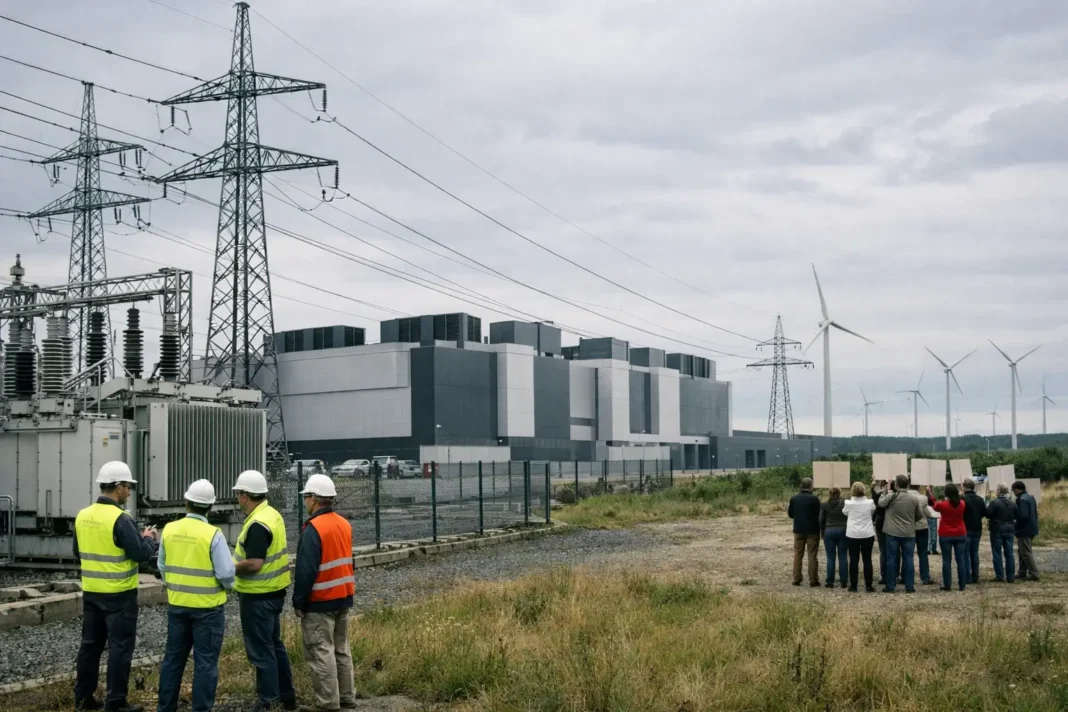

Europe’s AI buildout is colliding with a constraint that political declarations cannot remove: electricity. Governments and companies want more data centers to support advanced computing, cloud services and artificial intelligence, but the physical systems needed to power them are already under pressure. The debate is becoming central to Europe’s effort to strengthen technological sovereignty, because digital capacity depends not only on chips and software, but also on grids, permits and public consent.
Data centers require stable, high-volume power connections and, in some designs, significant cooling infrastructure. That demand is arriving as Europe is also electrifying transport, heating and industry while integrating more renewable generation. Grid operators must manage congestion, reinforce local networks and connect new users without weakening reliability for households and existing businesses. The challenge is not simply whether new facilities can be built, but whether they can be placed, powered and operated in ways that fit an already crowded energy system.
Local resistance is becoming part of the equation. Communities increasingly question the land use, electricity demand and environmental footprint of large computing sites, particularly when promised economic benefits appear limited or when grid capacity is scarce. This puts public authorities in a difficult position: they want investment in strategic digital infrastructure, yet they must also defend affordability, resilience and fair access to power. The European Commission, through its official digital strategy work on AI, has framed technological capacity as a strategic priority via the European Commission, but implementation falls heavily on national and local systems.
A more credible path will require fewer headline targets and more practical use of existing resources. That includes improving the efficiency of data centers, locating facilities where grid conditions are stronger, reusing waste heat where feasible, and coordinating planning with transmission and distribution operators from the start. Institutions such as ENTSO-E, the European network of transmission system operators, are central to understanding the limits and needs of the power system through ENTSO-E. Europe’s AI ambitions remain significant, but their success will be measured by whether digital policy and energy planning can move together rather than compete for the same constrained infrastructure.







