
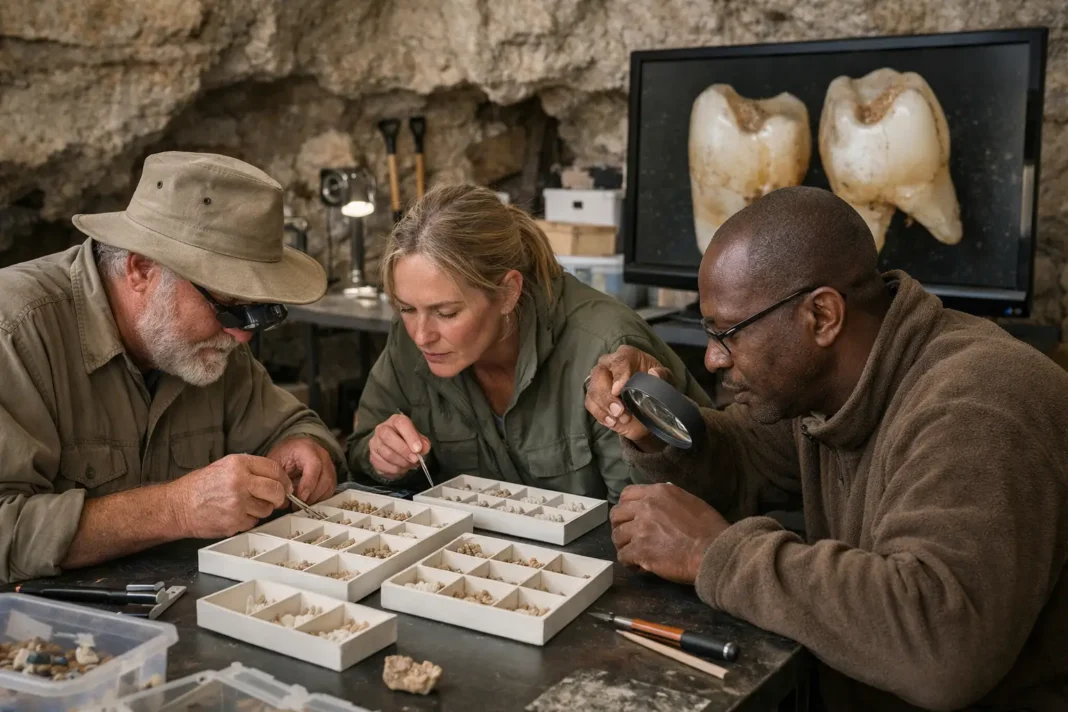

A cave in South Africa has added a new and unusual question to the study of human evolution: why do the known remains under examination appear to lack males? Scientists studying ancient proteins preserved in the teeth of Homo naledi, an extinct human relative, found no male-specific markers among at least 20 individuals. The result points to the possibility that the site, more than 240,000 years old, may have contained an all-female group.
The finding matters because sex identification in very ancient fossils is often difficult. Bones can be fragmented, incomplete or too altered to offer reliable anatomical clues. Proteins trapped in dental enamel can survive for long periods and may preserve biological signals that DNA no longer does. In this case, the absence of male-specific markers in the sampled teeth gives researchers a new line of evidence in a fossil assemblage that has been debated since its discovery.
South Africa has become one of the central regions for research into early human relatives, and Homo naledi occupies a particularly complex place in that story. The species combined traits that researchers associate with different stages of human evolution, making it difficult to fit neatly into older models of how human relatives looked and behaved. Background material from the Smithsonian National Museum of Natural History describes Homo naledi as one of the more recent additions to the human family tree, with fossils that have continued to reshape discussion of extinct hominins.
The possibility of an all-female burial site remains significant but must be read carefully. The protein evidence does not by itself explain how the individuals came to be in the cave, nor does it prove a deliberate social practice. It does, however, sharpen a mystery that has remained open for more than a decade: whether the location reflects chance preservation, selective deposition or behaviour more complex than once expected from a small-brained human relative.
For archaeology and palaeoanthropology, the central consequence is methodological as much as historical. Ancient protein analysis can add biological detail where traditional fossil study reaches its limits. If further testing confirms the absence of males across a broader sample, the cave could become a key case in understanding how extinct human relatives used space, treated the dead and formed groups long before the emergence of modern humans.





