



[ad_1]
More than a quarter of Israeli families, including every third child, struggle to access enough food as the country’s two-year war against the Hamas terror group and a rising cost of living deepen economic hardship, according to a survey released Monday, on the eve of Rosh Hashanah, the Jewish New Year.
The survey carried out in July by Latet, a non-profit organization working to combat poverty and nutritional insecurity, showed a worrying increase of Israelis suffering from food insecurity over the past year. Some 2.8 million people, or 32.1 percent of Israelis, including 1.3 million children, live with food insecurity, up from 24.9% in 2024, according to the findings.
Food insecurity has been defined as the inability to ensure a constant supply of food that contains all nutritional elements necessary for proper development and health. While it can lead to malnutrition, it is not the same thing. Indeed, it is a prime cause of obesity and is closely linked to disease and increased vulnerability to illnesses such as COVID-19.
“Almost two years since the October 7th onslaught, the economic crisis is deepening and the repercussions of the war are showing their mark, directly harming household incomes and the ability of many families to provide for the basic needs necessary for a dignified existence,” said Latet CEO Eran Weintrob.
“The sharp rise in food insecurity rates is reflected in macro data, with the toll spreading also to the lower middle class, which in turn has led to a dramatic increase in demand for assistance from food aid organizations, who are unable to respond to all applicants, as there is a decline in donations due to the diversion of philanthropic resources to war-related needs.”
Israel is ranked in fourth place in cost of living in the Organisation for Economic Co-operation and Development (OECD) list of developed countries with the highest comparable prices. The country’s high cost of living continues to reduce welfare and spur social tensions when Israelis are contending with the economic repercussions of an ongoing two-year war on multiple fronts.
Israel’s economy contracted in the April to June quarter, with gross domestic product shrinking 4% as the 12-day war with Iran in June led to a shutdown of many businesses and hurt consumer spending, exports, and investment.
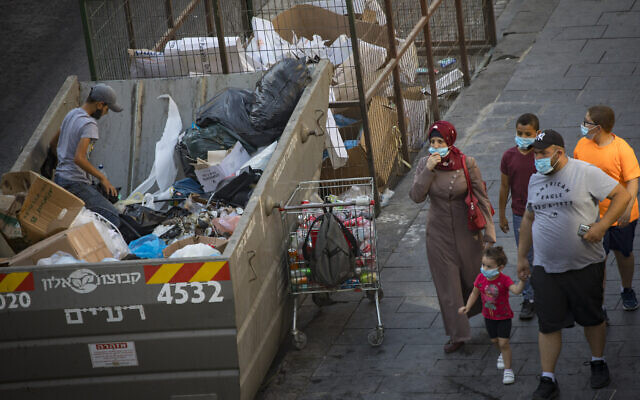
A teenager search for cans through a garbage container in the center of Jerusalem on September 2, 2020. (Nati Shohat/Flash90)
Among families, some 867,256, or 26.6% live in food insecurity, up from 21.1% in 2024, according to the survey. The increase was attributed to the entry of new households from the lower middle class into the cycle of food insecurity, partly due to damage to small businesses, some of whose owners have been called up for reserve duty to serve in the ongoing war.
“This is a serious red warning, which requires systemic attention, to avert a socio-economic collapse of disadvantaged populations in Israel,” Weintrob cautioned.
Latet President Gilles Darmon called on the government to provide a comprehensive response to the food security problem by establishing a national authority for the fight against poverty, as a necessary condition of rebuilding Israeli society.
Work to develop a food security policy began almost two years ago, at the initiative of the National Security Council’s climate adviser, Victor Weiss. But it was turbocharged by the war in Gaza, which exposed the limits of the state’s growing reliance on food imports over recent years.

[ad_2]
Source link


