
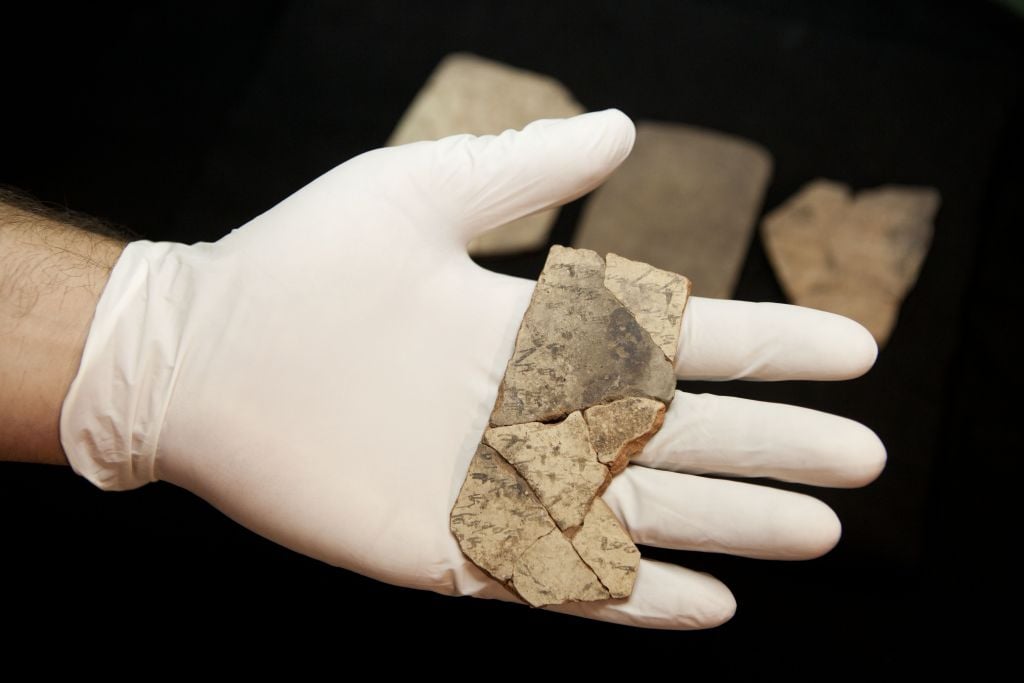

Some 2,600 years ago, soldiers stationed at a modest military outpost on the southern border of the Kingdom of Judah relied on a sophisticated calendar system to track and manage their supplies, according to a new study of about 100 inscribed pottery sherds (ostraca) unearthed at Tel Arad in the 1960s.
Israeli archaeologists Dr. Amir Gorzalczany of the Israel Antiquities Authority (IAA) and independent researcher Dr. Baruch Rosen reanalyzed the trove of ancient correspondence, focusing on the numerical data — an element they argue had been largely overlooked in previous research.
Their findings were recently published in the 2025 volume of the Jerusalem Journal of Archaeology, a peer-reviewed publication launched in 2021 by the Hebrew University of Jerusalem’s Institute of Archaeology.
“While Biblical Hebrew literacy has been widely studied, numeracy — the cognitive ability to understand and manipulate numbers — remains a largely overlooked, underexplored domain,” Gorzalczany and Rosen write in the paper. “This article addresses this gap by examining the Arad Ostraca.”
“These texts were produced in the early 6th century BCE and concern routine administrative operations, including issuing, receiving, and recording goods such as wine, bread, and grain,” they add. “We pay close attention to timekeeping systems, including references to days, months, and a single regnal year.”
Analyzing the dates recorded in the inscriptions — which contain six or seven references to the word month (hodesh) and nine to day (y[o]m in the ancient Hebrew script) — Gorzalczany and Rosen propose that the soldiers followed a 30-day calendar divided into six-day intervals to regulate their supply cycle.
Inscriptions in ancient Hebrew dating back 2,600 years discovered near Arad. (Tel Aviv University/Michael Kordonsky, Israel Antiquities Authority)
The people of the shard
The Arad ostraca served as everyday correspondence among military supply officers and were largely addressed to a man named Elyashiv, believed to have been the fortress quartermaster around the time of the Babylonian conquest — the early 6th century BCE, the close of the period known as the Iron Age or First Temple Period (1200-586 BCE).
In the past decade, scholars have revisited these artifacts using advanced imaging technologies, uncovering previously invisible texts and analyzing handwriting to determine the number of scribes involved. Their findings reveal that, despite the outpost’s small garrison of just 20 to 30 soldiers, multiple scribes were at work, indicating a far higher level of literacy in biblical Judah than previously assumed.
“We’re looking at a working outpost where goods were received and distributed, and one of the key ways they kept time — like many ancient cultures — was by following the moon,” Rosen told The Times of Israel in a phone interview. “When the moon appears, a new month begins; when it disappears, the month ends. Counting months by the moon is straightforward, and we see the word ‘month’ appear seven times in the ostraca.”
“The day, too, is relatively easy to track, from dawn to sundown or dawn to dawn,” he added. “At Arad, food rations were distributed according to specific days, and the quartermaster seems to have followed a set schedule for these allocations.”
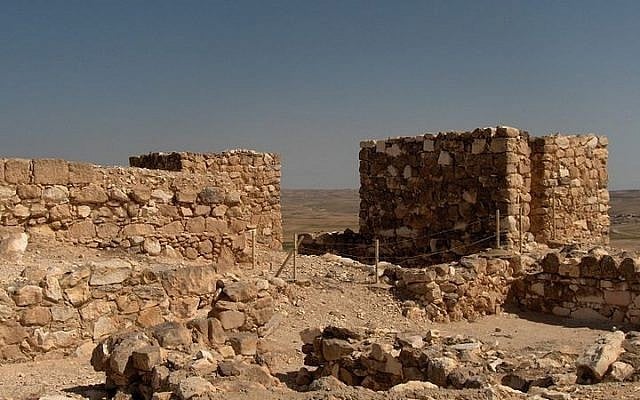
Excavations at Tel Arad in the Negev Desert were seen on March 16, 2006. (CC BY-SA Wikimedia commons)
According to Rosen, the ability to manipulate numbers at that point in history was quite remarkable.
“On the twenty-fourth of the month, Nahum gave oil,” reads Ostracon 17.
“…for the tenth of the month… until the sixth of the month… and write on the second…” reads Ostracon 7.
Drawing on the days recorded in the inscriptions, Gorzalczany and Rosen suggest that the month was further subdivided into distinct time intervals.
“If a seven-day week existed in Arad, it was possibly replaced by a six-day cycle, which divided the 30-day month into five segments, facilitating foodstuffs calculations,” the researchers write in the paper. “Such a calendrical system would have enabled both storekeepers (e.g., Eliashib) and recipients (e.g., the Kittiyim) to plan and manage provisions more effectively by distinguishing, for example, between perishable.”
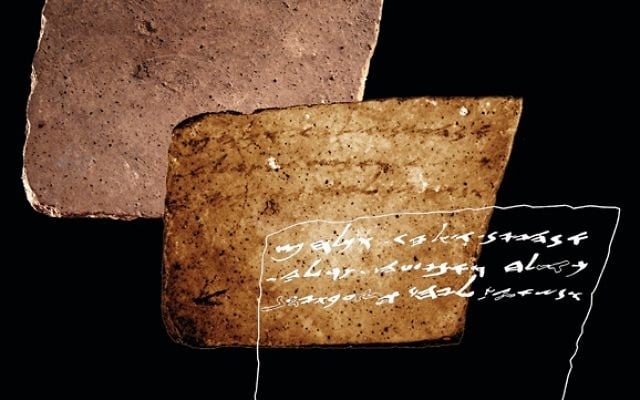
A collage including the verso of Arad Ostracon No. 16. (A) color (RGB) image; (B) MS image corresponding to 890 nm; (C) manual drawing (facsimile) of the proposed reading. Hollow shapes represent conjectured characters. (Courtesy Tel Aviv University)
An administrative year of 360 days divided into 12 (30-day) months was employed in ancient Mesopotamia for governmental and organizational purposes.
Time is relative
According to Tel Aviv University’s Prof. Jonathan Ben-Dov, an expert on ancient calendars who was not involved in the study, a comparable schematic calendar was likewise used in First Temple Period Judah, coexisting with the traditional luni-solar calendar for other functions.
“It’s a bit like how banks today calculate interest using 30-day months, even when a month actually has 31 days,” he explained in a phone interview with The Times of Israel.

Prof. Jonathan Ben-Dov from Tel Aviv University. (Courtesy)
In a 2021 study, Ben-Dov proposed that Iron Age Judeans adopted a 360-day year made up of 12 (30-day) months, further divided into 10-day “weeks.”
His theory draws on biblical references — particularly the frequent use of the term “asor” (a block of 10 days) — as well as archaeological evidence, including nine perforated plaques discovered at several Judean sites dating to the middle part of the Iron Age. Most of these plaques feature three rows of 10 holes each, which Ben-Dov argued served as calendar tools for tracking the passage of time.
“I was not aware of the idea of six-day units. It sounds interesting,” Ben-Dov said. “However, evidence for that remains tentative. The time references on the ostraca are often fragmentary, and as I understand it, the authors themselves present it only as a possibility rather than a firm conclusion.”
At the same time, Ben-Dov noted that while the schematic calendar may have been used for administrative needs during the Iron Age, Israelites and Judeans followed the a luni-solar calendar to mark their spiritual and civil year — a practice that did not set them apart from their neighbors.
“During the Iron Age, Israelites and Judeans were using a luni-solar calendar based on moon observation,” he said. “But this was nothing revolutionary. If the Babylonians were already using such a system in 3000 BCE, then the Judeans could certainly have done so by 700 BCE.”
Today, Jews continue to follow a luni-solar calendar, but no longer rely on direct observation of the moon, thanks to a calculation system developed as early as the 4th century CE, according to some scholars, or later during the Middle Ages, according to others.
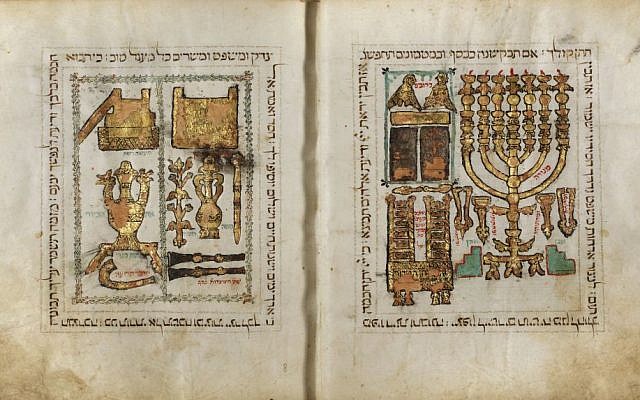
Illustrative: An illuminated manuscript of the Mishnah, part of the Palatina Library’s De Rossi collection, dated to the 11th century. (Courtesy: National Library of Israel)
Ben-Dov explained that during the Iron Age, the calendar had not yet become a defining feature of Jewish identity — a role it would assume later, beginning in the Roman period from the 1st century BCE onward.
“When you look at later Judaism, in the time of the Mishnah [compiled in the first centuries CE]the calendar and how it functioned is a major focus,” he said. “Back then, Jews emphasized that they used a lunar calendar, in contrast to the Romans’ solar calendar. During the Iron Age, it simply wasn’t a big deal; Israelites and Judeans were doing much the same as their neighbors.”
“Biblical sources don’t specify what type of calendar was used,” he added. “To me, that indicates it was purely a technical matter, not a basis for identity. Later [as seen in the discussions on Rosh Hashana, the Jewish New Year]the Mishnah elevates the calendar to a core principle of faith.”