
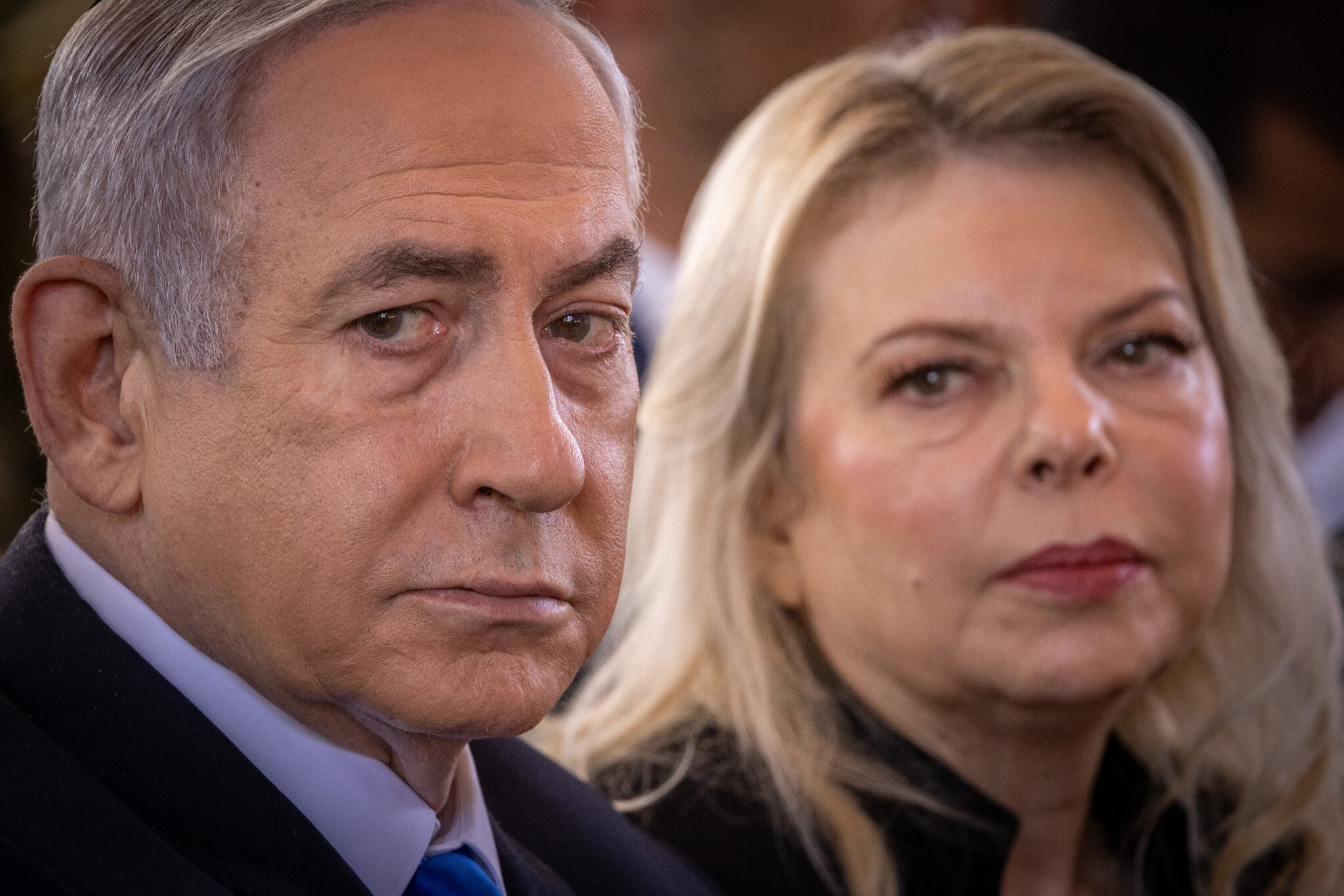

Prime Minister Benjamin Netanyahu, in the first days after the October 7, 2023, Hamas attack, was afraid that his political allies would replace him, with sources in his own party predicting that the government would soon fall, Haaretz reported on Friday, detailing a series of actions the premier took to salvage his leadership and prevent early elections.
Netanyahu reportedly embarked on an aggressive, internal political effort — including the immediate creation of a unity government, and subsequent meetings with ministers to convince them not to resign — in order to secure his premiership.
According to the report, “in the days after the massacre, reports began to accumulate in Netanyahu’s circle” that several ministers and lawmakers were planning a constructive vote of no confidence — a move to dissolve the government and approve a replacement at the same time.
“The fear was that the government was about to be replaced in short order, maybe a week, that they would pick a new prime minister to manage the war,” the newspaper quoted an unnamed source in the Prime Minister’s Office as saying. “I think that process didn’t happen only because they couldn’t agree on Netanyahu’s replacement, and principally because they recognized [Benny] Gantz wasn’t on board.”
Though the newspaper did not confirm that any such plan was actually being made, a senior source in the opposition told Haaretz that “even Likud members were starting to talk about toppling the government,” adding: “The MKs we spoke to thought it was over. But it wasn’t over, and [that effort] just blew up. They got half a year of quiet, and everything got normalized.”
Already on the morning of October 7, Justice Minister Yariv Levin reached out to National Unity party leader Gantz and to Opposition Leader Yair Lapid and invited them to join a wartime unity government. Levin did not inform Netanyahu before making the calls, according to Haaretz.
Prime Minister Benjamin Netanyahu (l) speaks at a joint press conference with Defense Minister Yoav Gallant (c) and head of the National Unity party Benny Gantz listening, at the Defense Ministry in Tel Aviv. October 28, 2023. (Dana Kopel/Pool)
After Gantz immediately accepted the invitation, Netanyahu — who was informed about the conversation that afternoon — went to work to set up the partnership. The unity government was formed on October 11, four days after the start of the thousands-strong Hamas invasion. This provided Netanyahu some “breathing room,” according to the report.
The premier also went to work preventing his own ministers from resigning by holding small, sometimes one-on-one meetings, in which he made them feel they had critical input on security issues — even if they were not actually influential — and made the point that to destabilize the government would be reckless.
“He would call them to the room, show them a map of the Middle East on the wall, and say, ‘Look, our forces are here and here, the terrorists are there. Here we attacked, there we found a hostage. Were you in the south? What did you see? What was here, what was there.’ And then at the end — ‘How can you talk about resigning now, and toppling the government?’” said one person who attended such a meeting.
Once the emergency government was formed — it lasted until June 2024, when Gantz quit, carrying Netanyahu through the first eight months of the war — the premier also went to work driving a wedge between members of the opposition, and making the case that while the failures of October 7 would have to be thoroughly investigated, the time to do so wouldn’t come until after the war was over and won.
Opposition feared getting divisive during wartime
Throughout these efforts, people close to Netanyahu said, the opposition hardly put up any fight, partly due to concerns about the appropriateness of political campaigning during wartime.
“On the one hand, soldiers were being killed, and we couldn’t create more division during wartime; on the other hand, every day that these people are in power is bloodshed in vain,” said a source in Lapid’s Yesh Atid party. “Months into the war, there weren’t even protests. In the party, and definitely in the opposition generally, there were things we were not willing to do at that moment.”
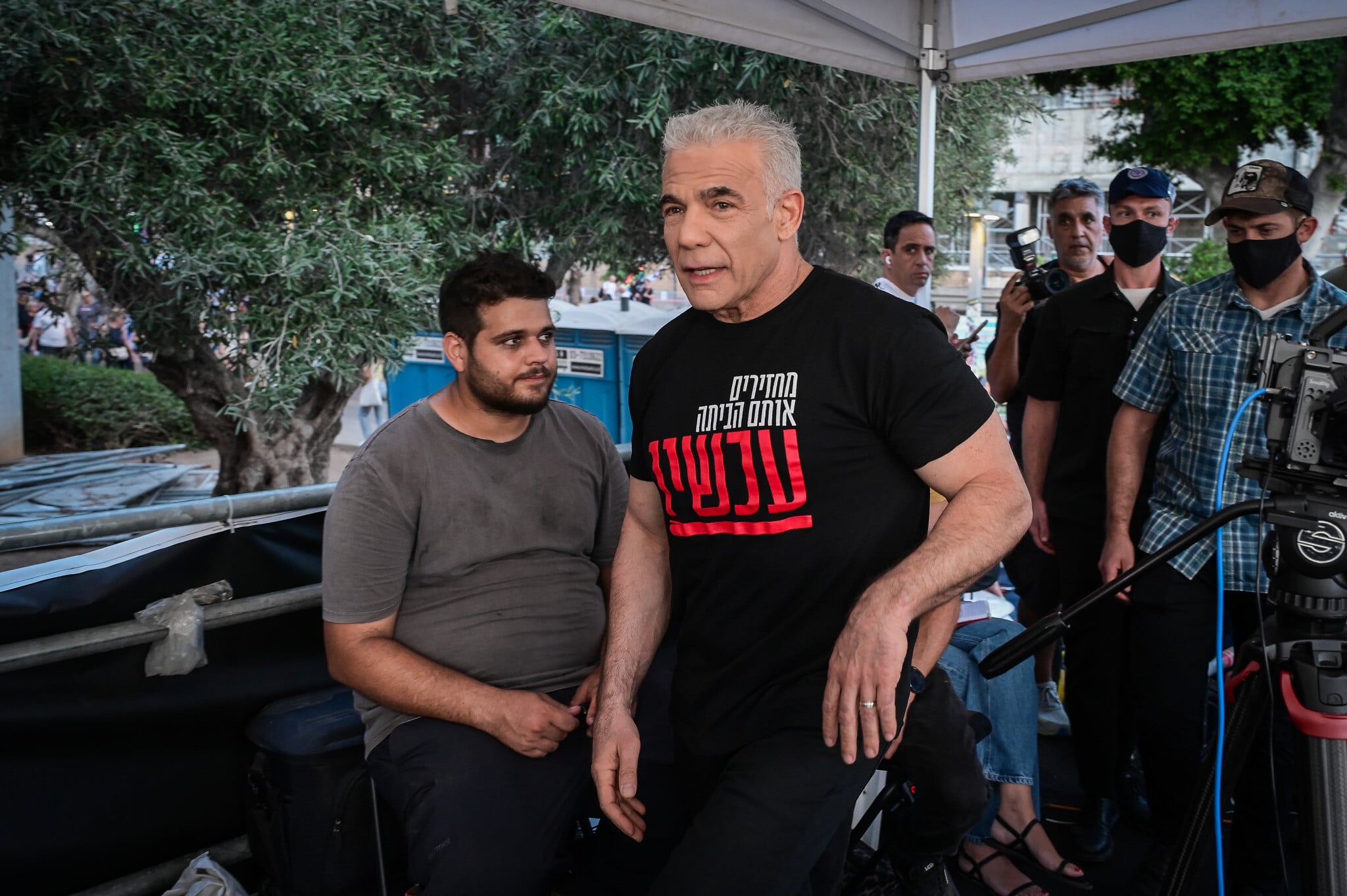
MK Yair Lapid arrives to Hostage Square in Tel Aviv ahead of a rally calling for the release of hostages held in Gaza, August 17, 2025 (Avshalom Sassoni/Flash90)
A source in Netanyahu’s Likud party asserted that the opposition had been too cooperative and that, had the roles been reversed, Likud would have been more aggressive.
“I don’t know what we would do differently, but it’s possible to both support the government during a war and also make clear to it that it should go home,” the source said. “The opposition wasn’t doing anything. It gave us full backing. They didn’t miss an opportunity to miss an opportunity. For example, after the first hostage deal collapsed, they could have said, ‘You can’t bring all the hostages back.’ I just think that about what Bibi would have done. He would have said, ‘There, you proved you can’t [do it.]’”
Though Netanyahu struggled in polls in the wake of the October 7 onslaught, he has gradually won back ground over the course of the war. In May 2024, Netanyahu first overtook Gantz as the public’s preferred choice for premier, and in August of that year, Likud polled as the largest party if elections had been held.
Today, many polls predict that while the prime minister’s political bloc won’t be able to form a government after the next election, it will hold sufficient power to stop any alternative government from being formed, given the breakdown of alliances. The next election is currently scheduled for October 2026, but could come earlier if the coalition falls apart or if the government calls an early election.