
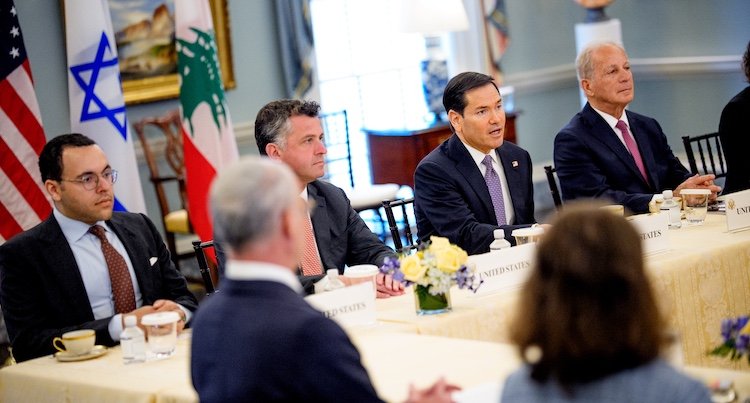

Today’s meeting between the Israeli and Lebanese ambassadors in Washington was historic, despite the lack of fanfare. Facilitated by Marco Rubio and his State Department team, Beirut and Jerusalem held their first face-to-face talks in decades and agreed to continue meeting. The Trump administration appears to realize the importance of this breakthrough, if the official statement from Foggy Bottom is any indication:
“The United States congratulated the two countries on this historic milestone and expressed its support for further talks, and for the Government of Lebanon’s plans to restore the monopoly of force and to end Iran’s overbearing influence. The United States expressed its hope that talks can exceed the scope of the 2024 agreement and bring about a comprehensive peace deal. The United States expressed its support for Israel’s right to defend itself from Hizballah’s continued attacks. The United States affirmed that any agreement to cease hostilities must be reached between the two governments, brokered by the United States, and not through any separate track.”
That last sentence is another encouraging sign. Iran does not get to speak for Lebanon; it must watch from the sidelines as Israel and Lebanon discuss ousting Tehran’s proxies from sovereign Lebanese territory.
Israeli Ambassador Yechiel Leiter praised his Lebanese counterpart, Nada Hamadeh Moawad, after the meeting: “We discovered today that we’re on the same side of the equation. That’s the most positive thing we could have come away with. We are both united in liberating Lebanon from the occupation power dominated by Iran called Hezbollah.”
Lebanon’s participation in this means that the Trump administration offered it attractive incentives to be involved and almost surely convinced Beirut that U.S. forces will not cut and run from the Gulf, even as the administration negotiates a cease-fire with Iran.
As I wrote last June: “Even if Syria and Lebanon don’t join the Abraham Accords, the fact that the Abraham Accords were in place when Iran’s imperial tide receded means that there is already a new regional structure to replace the old one.”
Israel and Lebanon don’t have diplomatic relations—officially, anyway. But that hardly seems to matter. The Abraham Accords altered the region’s diplomatic status quo and gave Arab countries a new path forward. Today’s meeting suggests that Lebanon is willing to follow down that path. It is incumbent upon the U.S. to ensure that Lebanon doesn’t come to regret it.
The last major reordering of the Middle East was the Obama administration’s efforts to cement Iran as regional hegemon over the loud protestations of our Arab allies. Trump reversed that, and Joe Biden solidified that reversal, giving the current status quo bipartisan credibility and backing. The result is a strengthened regional alliance including both Israel and the Arab states. The war with Iran broadened that coalition to include Ukraine, whose Jewish president was recently warmly welcomed by Syria’s Islamist president and who has come to the aid of the Gulf Arab states targeted by Iranian missiles and drones.
Despite the fever dreams about Israel supposedly controlling American policy, the Saudis appear to have been the most enthusiastic cheerleader of the manhandling of Iran’s criminal regime. The other Gulf Arab states have reportedly also been encouraging the president to finish the job. This makes sense: Israel has the capability to continue hitting Iran when necessary, but the Arab states are dependent on the Western alliance to keep Iran down.
And the U.S. should reward their trust in us. Lebanon, for example, is among the weakest central governments in this crew. It is also now the most vulnerable to Iran if the U.S. doesn’t follow through, because Hezbollah is far from dead.
It would be catastrophic to coax Lebanon into a public anti-Iran stance and diplomatic engagement with Israel only to later cut them loose. Yet the president will be under some pressure to do exactly that: by the French, who maintain a colonial mindset toward the Levant but take none of the responsibility for it; by some Democrats in Congress and right-wing pundits who don’t want Trump to notch any kind of political “win” related to the Iran war; perhaps by mediating states such as Pakistan that think Lebanon is useful only as a bargaining chip in the larger negotiations.
The president should ignore those voices. Having the Arab states look West instead of East is a strategic boon that is worth American commitment. It’s also the right thing to do.
Source:
www.commentary.org




