
In the traditional architecture of statecraft, a “firewall” once existed between domestic and foreign audiences. A government could broadcast one narrative to its citizens and another to foreign capitals. That world has vanished.
Today, we live in an era of light-speed “Inside–Outside” communications, enabled by technology so that whatever happens inside a country is immediately visible to the outside world. This new Domestic-Foreign Blur phenomenon, where a tweet from a prime minister is read by a local constituent and a foreign adversary simultaneously, creates a dramatic new reality that directly affects our national security from multiple vantage points.
The government has partially recognized this shift. Recently, under the leadership of the Foreign Minister Gideon Sa’ar, and with the blessings of the prime minister, the decision to take a significant step of allocating a substantial budget to our international public diplomacy efforts was made. This critical move demonstrates a clear commitment to protecting Israel’s global standing.
However, money is only half the battle. In a borderless world, digital connectivity has rendered old-school information firewalls physically impossible to maintain. What good does millions of shekels invested in a campaign to demonstrate Israel is prosecuting a just and ethical war in Gaza, if a former IDF General looking to score electoral points makes a statement on Israeli TV?
On Channel 11, this general stated that “Israel is on the way to becoming a pariah state, like South Africa was, if we don’t return to acting like a sane country. A sane country does not fight against civilians, does not kill babies as a hobby, and does not set itself the aim of expelling populations.”
To fully realize the value of these new investments in public diplomacy, we need to rethink systemic domestic issues as well, and we must evolve our architecture now. This issue must be prioritized, brought to the Foreign Affairs and Defense Committee, and turned into law for the sake of future generations.
The Bismuth opportunity
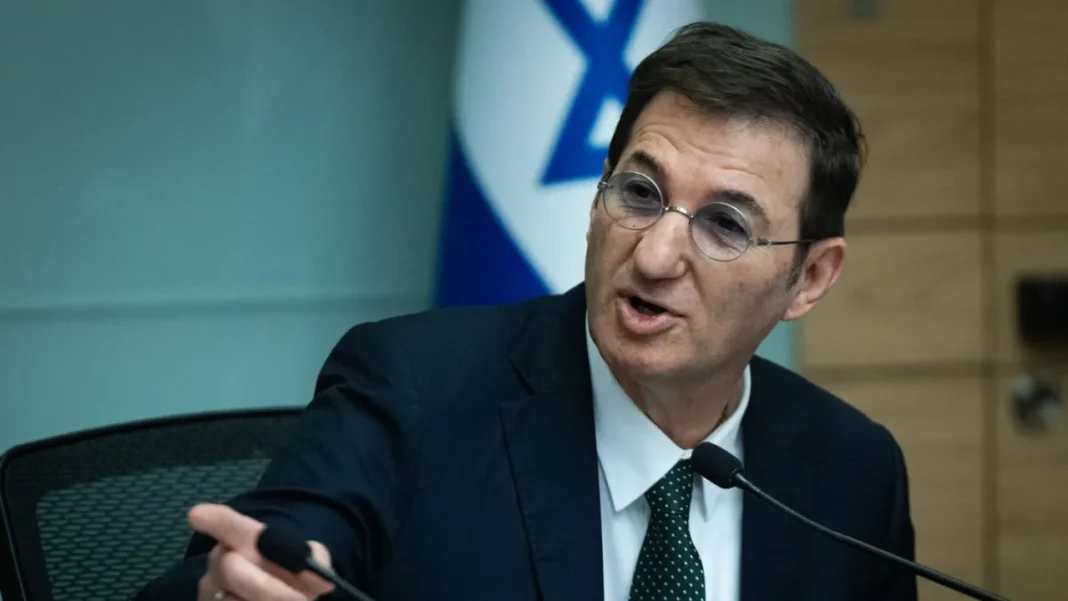
We are at a unique crossroads. The current chairman of the committee, Boaz Bismuth, represents a historic opportunity to lead this evolution. Unlike the traditional security-first pedigree of past chairs, Bismuth brings professional media and communications experience that is unparalleled in the committee’s history.
As a former editor-in-chief of a major daily and a veteran foreign correspondent, Bismuth understands that “communications is the new battlefield.” He possesses the unique public diplomacy lens necessary to see how Israel is perceived abroad – not just through military doctrine, but through the prism of strategic narrative.
Chairman Bismuth, we look to your expertise to help refine how Israel approaches this new world.
Beyond the “Reactive” Model
The challenge we face is systemic: the “Rational-Reactive” model of communication. Historically, democracies have waited for crises to observe narrative shifts before attempting to defend the facts. But in a borderless world, by the time we explain why an action was taken, the emotional narrative has often been set by viral, unvetted content.
When internal divisions are broadcast globally in real-time, they become primary data points for foreign perception. Adversaries can amplify these divisions to weaken international standing. To counter this, we must empower our own citizens, our most powerful potential diplomats, to engage in organic advocacy that carries more credibility than any official PR.
A three-year roadmap for Israel (2026–2029)
To move from a reactive defender position to a global leader in public diplomacy, the committee can lead a transition toward strategic positioning. This roadmap is a constructive path forward:
Step 1: Shift to radical transparency.
We should consider establishing a professional, independent National Public Diplomacy Authority, a body led by experts, in addition to the important internationally focused efforts that will be led and managed by the Ministry of Foreign Affairs.
The mandate of this new authority would be to take a holistic point of view as to the laws, enforcement, and education needed domestically to make public engagement in public diplomacy an asset and not a liability. This authority would coordinate, from all the related government organizations, the release of journalistically pure raw data and context in real-time, establishing information sovereignty by being the first to report on national events, even when they are challenging.
Step 2: Bridge the Domestic-Foreign Blur.
Public diplomacy must be an inclusive, national effort. A national education campaign needs to be established to inform the public of the importance of the role that it can play and to avoid partisan extremism in messaging that can and does only hurt us all.
We should empower civil society, NGOs, and diverse sectors, including Liberal and Conservative as well as Arab-Israeli voices, to tell their own stories. Success is found when a diverse group of citizens shares their reality on digital platforms, creating a narrative-action alignment that is inherently credible.
Step 3: The contributor narrative.
We must modernize our digital tools, using AI and data, and supercharge with intelligence-based unique content to address specific gaps in international understanding. One of our goals should be to shift the global brand from a country in perpetual conflict to a global hub for technology cooperation, stretching from climate, health, and responsible AI tools to cyber solutions. We want to be perceived as an indispensable asset to the world.
The role of Parliament and the public
Is an op-ed the right tool for this? History suggests it is.
The power of a public appeal to trigger parliamentary action is a hallmark of integrated public diplomacy. In both the US and Israel, high-profile pieces have recently served as the catalyst for important reviews and the passage of specific laws.
In the US, appeals for AI safety standards galvanized a bipartisan coalition that resulted in federal law. In Israel, the October Council used op-eds to demand transparent inquiries, eventually invoking the 40-signature rule to force mandatory debates. These examples show that when the public is aware and involved, policy improves.
A constructive call to action
Chairman Bismuth, you have the professional background to lead this transformation. The government has already provided the financial foundation. Now we need structural innovation to ensure those resources are used effectively.
We call on the Foreign Affairs and Defense Committee to:
Convene a review of Israel’s public diplomacy infrastructure to ensure it is optimized for a borderless world. A recent State Comptroller report described the foreign-policy apparatus as underfunded and uncoordinated, noting that more than 35 government bodies were involved in international activity, often without proper coordination.Evaluate legislation for a professional, independent National Public Diplomacy Authority that can act with the agility of a tech firm.Continue prioritizing the Information War with a strategy monitored by the Knesset that reflects the existential nature of modern information threats, both domestic and international.
The Domestic-Foreign Blur is our new reality. By involving the public and building a transparent, professional architecture, we can ensure that Israel’s story is told with the strength and authenticity it deserves. Chairman Bismuth, you understand the power of communication. We ask you to help turn that understanding into a lasting national asset.
The author is an experienced global strategist for the public and private sectors. globalstrategist2020@gmail.com.
Source:
www.jpost.com