

For every new “Euphoria” season, creator Sam Levinson and cinematographer Marcell Rév have reinvented the visual language of their hit HBO series.
“Our approach has always been evolve or die,” said Levinson on an upcoming episode of the Filmmaker Toolkit podcast. “Even if something’s worked, we don’t want to repeat ourselves.”
Added Rév, “We don’t want to get bored.”
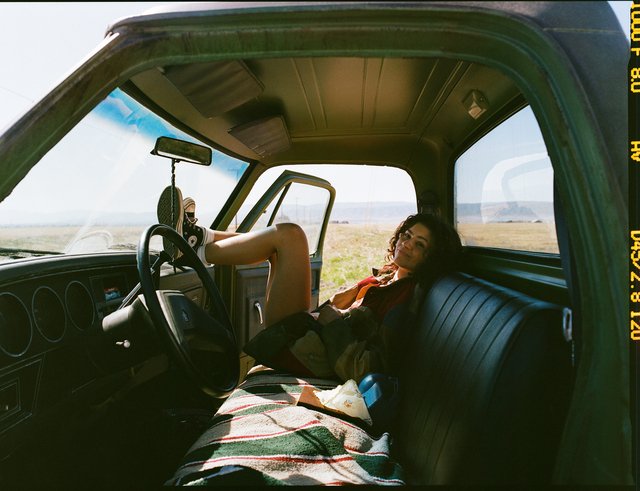
From the makeup to the neon lighting, there was a raw electricity to how “Euphoria” Season 1 was shot. That transitioned into a far more reflective, the-party ’s-over approach to Season 2, as Levinson and Rév’s switched to Ektachrome film stock.
“The move from digital to film, we had an idea and a concept: We wanted it to feel like a memory, like there’s something fading away about that particular season,” said Levinson about the Season 1 to 2 transition. “And in [Season 3], we wanted to do something that was a little bit more objective as opposed to the truly subjective camera work that we were doing in Seasons 1 and 2. We wanted to take a step back to have wider frames, and to feel our characters inside of the wider world.”
While on the podcast, the two collaborators talked about reaching for a more classical approach to the visual language, which meant reaching for more patient camera compositions, the feel of tungsten lights, and collaborating with Kodak on new film stock that behaved more like older film stocks in how it rendered color and skin tone.
“We wanted to feel a bit more like an old Hollywood film,” said Levinson. “It’s the growth of the show, but it also mirrors our own growth as filmmakers.”
Evident in the first sequence, one of the most obvious connections to Old Hollywood is how Season 3 leans into westerns. Levinson and Rév first dabbled with the language of westerns in the no dialogue, camera-driven storytelling gas station scene between Fez (Angus Cloud), Lexi (Maude Apatow), and Cal (Eric Dane) in Season 2, Episode 2 (you can watch below). But in watching and rewatching films like “Rio Bravo” and “Last Train from Gun Hill,” and the TV series “Have Gun — Will Travel,” Levinson started to sense a thematic connection as well.
“[The western] merged with where our characters would be at this time,” said Levinson of Season 3’s storylines. “They’re out in the big, bad world, and they have total freedom. They can choose who they want to be. They can decide to follow whatever ambition or desire they want, but at the same time, they have to deal with the consequences of it. And so there was something that felt very potent about it [leaning into the genre].”
There’s an outlaw aspect to many of the characters’ arcs in Season 3. In the first sequence, as we’re introduced to Rue’s (Zendaya) new life as a border crossing drug mule, we get wide compositions in which the “Euphoria” star is framed against the vast western landscape. It’s some of the most stunning imagery we’ve ever seen in television; it’s also the first time a TV series has been shot on 65mm film stock, which, according to Rév, wasn’t how it was originally conceived.
While prepping, the director and cinematographer had planned to shoot 35mm anamorphic, but were testing large-format celluloid for a specific (unidentified, likely yet-to-air) sequence in Season 3. The results led to them expanding its usage.
“We had talked to HBO about just doing the wide shots on 65mm, and so we were able to carry a camera body with us,” said Levinson. “And after the first couple of days, we sort of go, ‘Well, why don’t we shoot this closeup with the 65mm?’ And we just started shooting more and more with the 65.”
“Euphoria” Season 3, Episode 2 airs Sunday, April 19 at 9 p.m. EST.
To hear Levinson and Rév‘s full interview, publishing April 27, subscribe to the Filmmaker Toolkit podcast on Apple, Spotify, or your favorite podcast platform.
Source:
www.indiewire.com




