
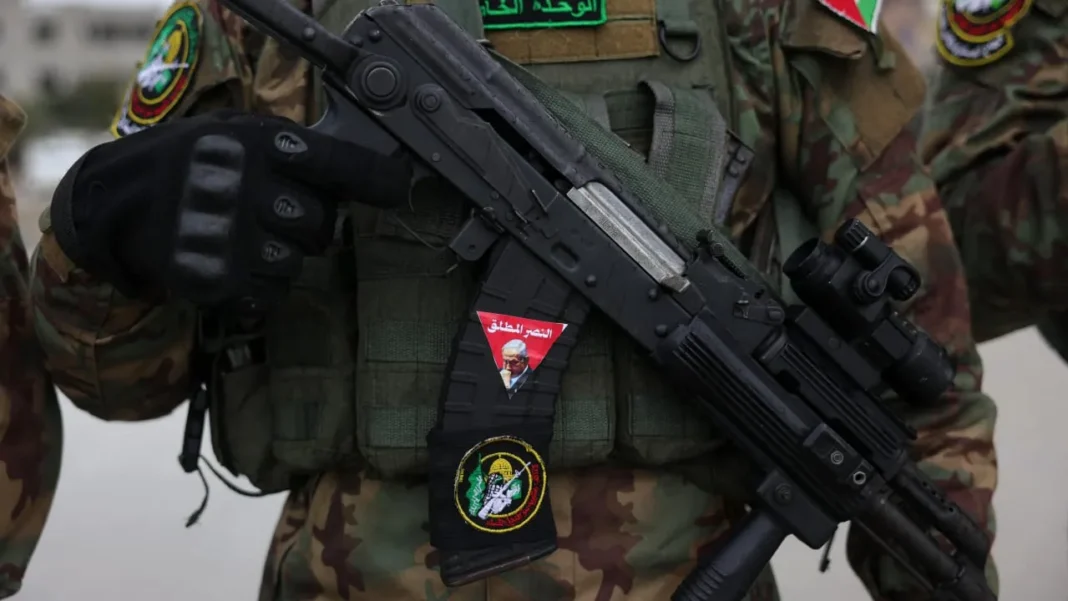

The recent report in The New York Times that Hamas officials are prepared to hand over weapons from their police and internal security forces has been widely interpreted as a partial and insufficient concession. Measured against the maximal demand for full and immediate disarmament, that reading is understandable.
It is also incomplete.
What is unfolding is not a symbolic gesture. It is the first credible opening for a structured transition in Gaza – from armed factional control to institutional governance capable of enforcing disarmament. The key is not the number of rifles Hamas is willing to surrender. It is the scope of authority it is signaling readiness to transfer.
According to the report, Hamas is prepared to hand over not only weapons tied to internal security, but the broader machinery of governance to the National Committee for the Administration of Gaza (NCAG): ministries, revenues, taxation systems, administrative structures, and human resources – including the police and internal security services with their equipment and assets. Most importantly, this includes the authority to enforce the law. That is the breakthrough.
Hamas has not declared that it will disarm its military wing. But it is, in effect, opening the door for another authority to do what it cannot publicly concede: impose a “one authority, one law, one weapon” reality in Gaza.
Armed groups rarely give away weapons voluntarily
In every conflict transition – from Northern Ireland to parts of Latin America – enforcement authority has preceded full disarmament, not followed it. Armed groups rarely begin by surrendering everything voluntarily. They begin by allowing a legitimate authority to emerge – one that can gradually, systematically, and credibly consolidate control.
This is precisely what is now on the table. Those rejecting this step as insufficient should ask a simple question: what is the realistic alternative?
If the expectation is that Hamas will gather every weapon in Gaza, raise white flags, and dismantle itself in advance, this is not a strategy. It is a slogan.
Even states with full sovereignty struggle to eliminate all armed actors. Prime Minister Benjamin Netanyahu himself presides over a country where organized crime groups remain armed despite sustained enforcement efforts. In the West Bank, Israel has not succeeded in fully disarming all militant networks.
Why, then, is Gaza expected to achieve instantly what no other context has achieved under far more stable conditions? A process is required. And processes begin with enforceable steps.
The second overlooked dimension is internal. Transferring power in Gaza is not a technical maneuver. It is a profound disruption of a governing ecosystem that has existed for nearly two decades.
Thousands of officials – some ideological, many technocratic – have built careers, influence, and livelihoods within this system. Resistance to change is natural and expected. Yet the Hamas leadership inside Gaza is signaling that preparations for a full handover have already been completed. That is not a trivial statement. It suggests internal consolidation, discipline, and – crucially – a recognition that the current model has reached its limits.
There is also a third issue that cannot be avoided: debt. The Hamas-run administration has accumulated an estimated $6 billion in internal obligations – to banks, businesses, suppliers, and public sector employees. Some negotiators may hope that a new governing authority can start with a clean slate.
It cannot. This is not external debt that can be renegotiated or written off through diplomacy. It is embedded within Gaza’s social fabric. It represents salaries unpaid, services delivered, and economic relationships that sustain daily life. Any authority that seeks legitimacy must assume responsibility for it – not as a concession to Hamas, but as a duty to Gaza’s people.
Finally, there is the internal political dynamic within Hamas itself. The officials quoted in the report are likely part of a newly emerging leadership inside Gaza, following internal elections that have not yet fully concluded outside the Strip.
This matters. Because there remains a gap between those operating within Gaza’s reality and those speaking from abroad. Some external figures still operate under outdated assumptions of political leverage and regional positioning.
But those inside Gaza are confronting a different reality – one defined by devastation, exhaustion, and the urgent need for a viable path forward. A serious international response to this opening could strengthen pragmatic forces within the movement and accelerate internal alignment. Ignoring it may do the opposite.
This is not about legitimizing Hamas. It is about creating the conditions under which Hamas becomes irrelevant as a governing force.
As a Palestinian who has spent decades in public life working toward a better shared future, I opposed Hamas’s actions on October 7 and said so clearly and publicly. I have also witnessed, with grief, the suffering of my people in Gaza throughout this war.
Yet I have felt a personal moral responsibility to engage with the pain on all sides – including reaching out to Israeli victims in moments of profound loss. It is precisely because of this that I say: this moment matters.
The proposal on the table is not perfect. It is not complete. But it is real. And in a conflict where missed opportunities have defined the past, dismissing a real opening because it does not meet maximal expectations is a familiar and dangerous mistake.
The task now is clear: deploy the NCAG on the ground, establish enforcement authority, support a phased and verifiable disarmament process, and stabilize Gaza’s economy and institutions. If we say no to this, we are not holding the line – we are gambling with the lives of Palestinians and Israelis alike.
History will not judge us by the demands we made, but by the opportunities we recognized – and the ones we chose to ignore.
The writer is a Fatah political leader from Jerusalem, calling for Palestinian reforms, democracy, dialogue, and coexistence with Israel.
Source:
www.jpost.com




