
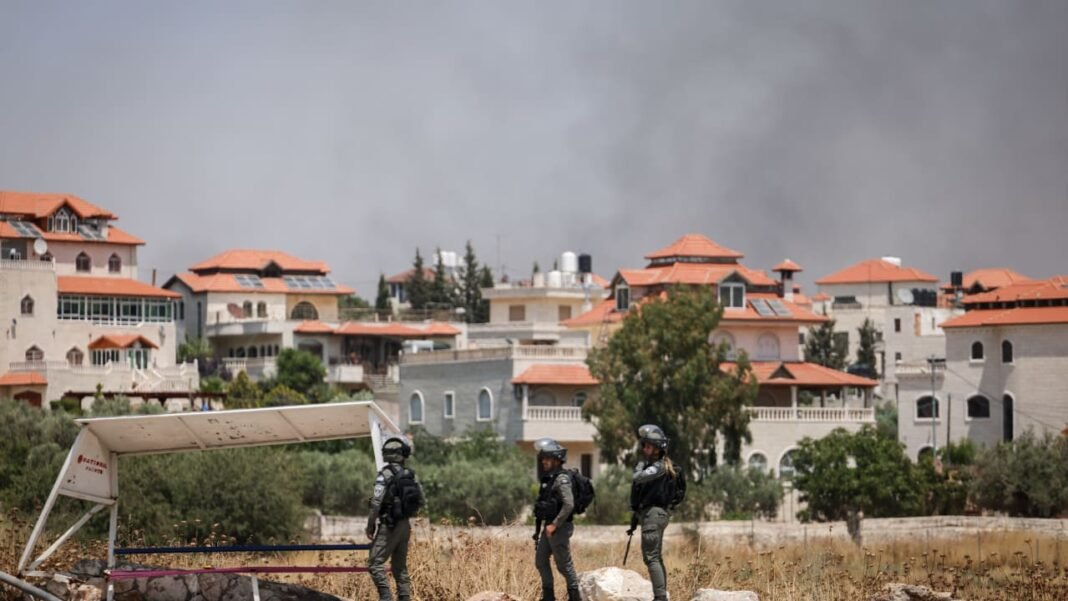

Turmus Aiya, a Palestinian Authority-controlled village in the Binyamin region of Judea, has made headlines far too often in recent months, with wildly divergent accounts of violence in and around the village.
Since many residents of Turmus Aiya also hold US citizenship, incidents there often receive outsized attention in American media, making inaccurate or one-sided reporting not just more problematic, but more consequential.
The latest episode is a case in point: both Israeli and international outlets misreported the stone-throwing reports on Route 60, just outside Turmus Aiya. Initial coverage described Israeli hilltop youths stoning cars on the highway in an act of settler violence. The facts tell a different story.
Last Monday, Turmus Aiya dedicated a park in memory of Amar Rabi, a local terrorist killed last year by IDF soldiers while carrying out a terrorist attack on Israeli motorists. Ahead of the ceremony, the village council requested IDF protection, expressing concern that “violent settlers” might try to disrupt the proceedings. The IDF complied. According to Arabic-language reports, the US Embassy was also notified in advance.
At the same time, residents of the neighboring Israeli communities warned the IDF that Turmus Aiya’s social media channels were actively promoting the event and calling on participants to carry out stone-throwing attacks afterward. Despite these warnings, the event proceeded as planned – as did the violence.
Israeli vehicles were pelted with stones on Route 60 immediately afterward. Arabic media later circulated reports that “occupation forces have flooded the village” and called upon residents of Turmus Aiya to disable security cameras and erase footage to help the attackers evade the IDF dragnet.
Despite the advance intel, the real-time IDF presence, documented incitement, calls to obstruct justice on digital platforms, official IDF investigation and arrest of the perpetrators, prominent journalists misreported the event, attributing the stone-throwing to Israeli hilltop youths and bemoaning settler violence.
By the time retractions or corrections trickled in, they were too little, too late: the story of settler violence against the peaceful village of Turmus Aiya on their day of mourning had already taken hold.
Unfortunately, this pattern is neither incidental nor unique.
Turmus Aiya is often portrayed as a moderate community seeking coexistence that is repeatedly attacked by violent settlers from nearby Israeli communities. But recent footage tells a more complicated story.
At a wedding of one of the village’s residents held in Memphis, Tennessee, guests danced to songs that called for submachine guns to “decorate the hills” and others glorifying attacks carried out by fedayeen fighters, including references to the 1965 Eilabun Tunnel attack, widely regarded as the founding operation of Fatah, an internationally sanctioned terrorist organization responsible for the murder of countless Israelis.
The date of the Eilabun attack, 1/1/1965, is celebrated annually as a Revolution Day by Fatah supporters – in Memphis, in Turmus Aiya, and throughout the areas under the Palestinian Authority jurisdiction. Despite their American citizenship and fantastically privileged standard of living, the villagers of Turmus Aiya make no secret of their support for Fatah and for anti-Israel terrorism.
While this certainly does not justify violence against them, it does demand clarity, and at the very least, a degree of skepticism toward the sources of incident reports.
Journalists publishing unverivied claims
When journalists rush to publish unverified claims that align with trendy narratives, they do more than get a story wrong. They shape international perception, influence policy debates, and risk amplifying distortions in a time of war that carry real-world consequences.
The narrative war is not a sideshow. It is a battlefield in its own right. At a minimum, reporting should be grounded in verifiable facts – not assumptions, not social media echo chambers, and not the pressure to conform to a preferred storyline. Accuracy is not a luxury – it is a responsibility.
The writer is the director of the International Division of Regavim, an Israeli think tank dedicated to the preservation of Israel’s land resources and sovereignty.
Source:
www.jpost.com




