
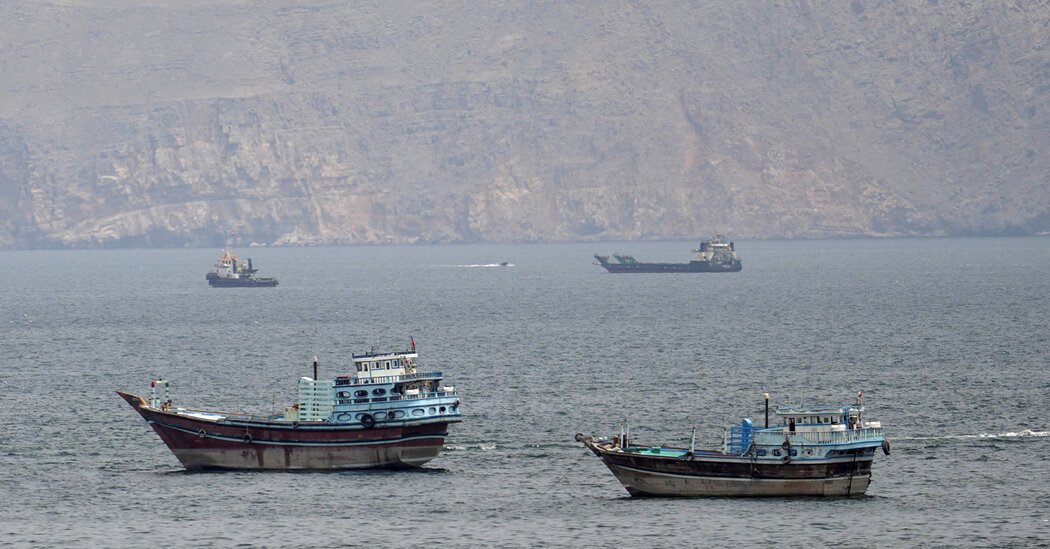

Defense Secretary Pete Hegseth said Friday morning that American forces would maintain a blockade of the Strait of Hormuz “for as long as it takes.”
The day before, a senior Iranian official declared on social media that its fighters had been hiding in sea caves in the strait to “devastate the aggressors.”
Both the United States and Iran have sought to exert control over the Strait of Hormuz since they agreed to a cease-fire. Iran says only ships that have permission from the country’s Islamic Revolutionary Guards Corps will be allowed to pass. The United States Navy says it is intercepting all ships coming from or traveling to Iranian ports.
In short, it is impossible to know who controls this vital shipping route at the mouth of the Persian Gulf. What’s certain is that the fate of the strait has become a critical issue not only for a resolution to the Iran-U.S. conflict but for the world economy.
Here is what we know about what’s happening in the narrow waterway.
Most ships aren’t moving.
Iranian forces said they seized two cargo ships near the strait on Wednesday, while the U.S. military said Friday that it had stopped and turned around 34 vessels since it started blockading Iran’s ports.
Shipping companies and their insurers fear that Iran has mined the main channels and may attack commercial vessels. That has deterred most of the hundreds of ships bottled up in the Persian Gulf from trying to leave.
Still, Iran has been letting some ships, its own vessels included, pass through the strait, using a route that runs close to Iran’s coastline and can involve docking at Iranian ports. At least 150 ships have passed through the strait since the cease-fire was first announced on April 7, according to data from Kpler, a global ship-tracking firm.
Daily traffic in the strait is still well below prewar levels, though. In normal times, about a fifth of the world’s oil supply and a significant share of its natural gas went through the strait on ships. Tensions in the waterway have jolted global energy markets, with oil trading around $100 a barrel again.
Kpler’s data showed that between Wednesday and Thursday, 17 vessels crossed the waterway.
Even without a navy, Iran can block most commercial traffic.
Even though much of the regular Iranian Navy was destroyed by Israeli and American attacks early in the conflict, the Islamic Revolutionary Guards Corps still deploys small, speedy boats to disrupt shipping. Known as the “mosquito fleet,” it is designed to harass shipping, often through missiles and drones.
The Iranians also said they had laid sea mines in the part of the strait where before the war there were two well-established passages for ships to pass, one for ships entering the Persian Gulf and one for those leaving. That has forced ships into a passage closer to Iran that is easier for its forces to control.
Tehran has recently imposed rules for passing through the waterway, including securing permits for preapproved routes. Iranian officials also have introduced legislation in their Parliament to charge tolls to ships wishing to go through the strait.
U.S. Navy says nothing is getting through its net.
President Trump has said the U.S. Navy will maintain a blockade until Iran and the United States agree to a durable peace deal. Iran has made lifting the blockade a condition for resuming talks.
With plenty of air support and a flotilla of warships prowling the Gulf of Oman and Arabian Sea southeast of the strait, the U.S. Navy has been tracking commercial vessels leaving Iranian ports and confronting those that make it through, forcing them to turn back or face being boarded.
Mr. Hegseth said on Friday that 34 ships had been intercepted and turned around. One cargo ship, the Iranian-flagged Touska, tried to evade the U.S. blockade on Sunday and was disabled by Navy gunfire and taken into U.S. custody in the Arabian Sea, along with its crew. Iran denounced the seizure as piracy.
Even though the U.S. military has said no Iranian ships have gotten through its net, Lloyd’s List’s analysts say at least seven with links to Iran have managed to pass through the Strait of Hormuz and the wider blockade since April 13.
Some ships have managed to evade the blockade by typing in a false origin or destination and pretending to be piloting another ship altogether. Vessels can also temporarily turn off their transponders, seeming to disappear in one place and reappear in another.
John Ismay, Helene Cooper, Peter Eavis, Jenny Gross contributed reporting.
Source:
www.nytimes.com




