

Q-Factor, Israel’s newest quantum developer, revealed early this week a $24 million in seed funding to innovate in the field of neutral-atom quantum computing, with Intel Capital as one of the funding investors.
The company was founded by researchers from the Technion – Israel Institute of Technology and the Weizmann Institute of Science, with both institutions being shareholders after their labs were used in the development of the project.
“The quantum computing industry needs a revolution, not an evolution,” said Professor Ofer Firstenberg, co-founder and chief scientist of Q-Factor. “Current systems are too small to deliver on the promise of quantum computing, and incremental improvements alone aren’t going to close that gap. We’ve developed an architecture designed for continuous scalability, a Moore’s Law-like trajectory that can take neutral atom systems from thousands of qubits to millions and beyond.”
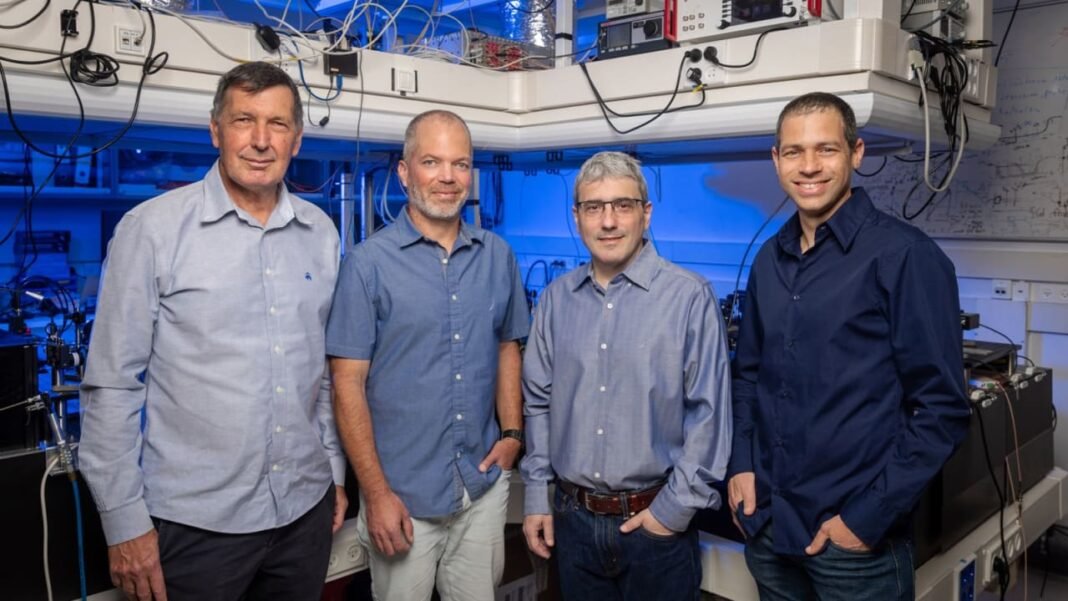
To achieve this, Q-Factor combined the technical expertise of three lead researchers at Technion and the Weizmann Institute’s labs, such as Prof. Nir Davidson, Prof. Ofer Firstenberg, and Prof. Yoav Sagi, with a professional entrepreneur in the world of deep tech, such as Dr. Guy Raz.
The company focuses on developing systems using neutral atoms, which can hold quantum information for extended periods without requiring extreme cooling or complex wiring and are controllable with light.
The company’s funding round comes as they managed to transform decades of foundational research in atomic physics and quantum computing conducted by the Technion and the Weizmann Institute into a commercial product.
The round was led by NFX and TPY Capital, with participation from Intel Capital, Korea Investment Partners, Deep33, and the Matias family, along with a grant from the Israel Innovation Authority.
Importance of academia in Israel’s startup ecosystem
Q-Factor emerged as another example of the importance of academia in Israel’s startup ecosystem, where the universities and research centers play a key role in the discovery of innovations that are later translated to the business world.
According to PitchBook’s 2025 ranking of leading universities for entrepreneurs, Tel Aviv is Israel’s leading university and among the seven most important for entrepreneurs worldwide, while Technion ranked tenth.
“Since its founding, the Technion has made it its mission to combine basic science with applied research,” Technion President Prof. Uri Sivan said last year, when the ranking was unveiled. “Technion alumni are the main economic engine of the State of Israel and are largely responsible for the creation of Israel’s ‘Startup Nation,’” Sivan added.
There are many examples of key companies that emerged from Israeli academia, the best-known being Rafael Advanced Defense Systems, founded by Technion alumni.
Q-Factor’s team leads the academic world in quantum computing
The Q-Factor team has a mix of academic and commercial experts, with Gigi Levy-Weiss, partner at NFX, saying that “it’s rare to find a team with this combination of scientific authority and commercial instinct.”
“Four Talpiot graduates with hundreds of published papers in the fields directly underlying this technology, and real experience bringing deep science to market. They are uniquely positioned to execute on one of the most ambitious goals in quantum computing,” he added.
Prof. Davidson is a world-renowned authority in ultracold atoms and the former dean of physics at the Weizmann Institute of Science; Prof. Firstenberg leads a lab in the Weizmann Institute, and is a former Harvard and MIT researcher; Prof. Sagi is the leading authority in neutral-atom manipulation of the Technion, and a former researcher of JILA and the University of Colorado; and Dr. Guy Raz is a physicist with 20 years of technical leadership for multiple deep tech startups.
“Neutral atoms are emerging as the leading modality for scalable quantum computing, and Q-Factor is entering the race with a distinct architectural advantage,” said Dekel Persi, partner at TPY Capital. Lisa Cohen, investment director at Intel Capital, also commented on Q-Factor: “They’ve watched the field evolve, learned from the challenges others have encountered, and assembled the right expertise to tackle the hardest remaining problem in quantum computing: scale.”
Source:
www.jpost.com




