

While Israel and Lebanon are engaged in a pretend cease-fire, a French soldier serving with the UN peacekeepers was reportedly killed by a Hezbollah terrorist. And that is the Israel-Lebanon conflict in a nutshell.
So let’s crack the shell open, shall we.
There are three state actors involved here and two nonstate actors. The states: Israel, Lebanon, France. The nonstates: Hezbollah and the United Nations Interim Force in Lebanon (UNIFIL).
But it’s not even that simple, because Lebanon hovers on the border between state and nonstate. Hezbollah, a nonstate actor, has for a long time controlled Lebanon while backed by its masters in Iran. Hezbollah, Iran, Assadist Syria (which is no more), and the Palestinian movement have all conspired to prevent Lebanon from fully becoming a state.
France is the former colonial steward whose mishandling of that responsibility has created the lion’s share of the mess we see today. Israel, which liberated its Jews and Arabs from colonial domination by Britain, would like to see Lebanon similarly liberated. France seems satisfied as long as Lebanon is unfree and miserable.
So you can guess who Europe and the media have designated as the bad guy in all this. Yep, Israel.
But every so often there comes a possible wake-up call. France has worked tirelessly to prevent Israel from clearing Hezbollah out of Lebanon. UNIFIL, which is tasked with at least some level of policing of Hezbollah’s rearmament for its permanent war machine, has not only spectacularly failed but has been coopted by Hezbollah itself—collaborating with the terrorist group in past conflicts and keeping silent while Hezbollah has built tunnels under UN observation posts in recent years.
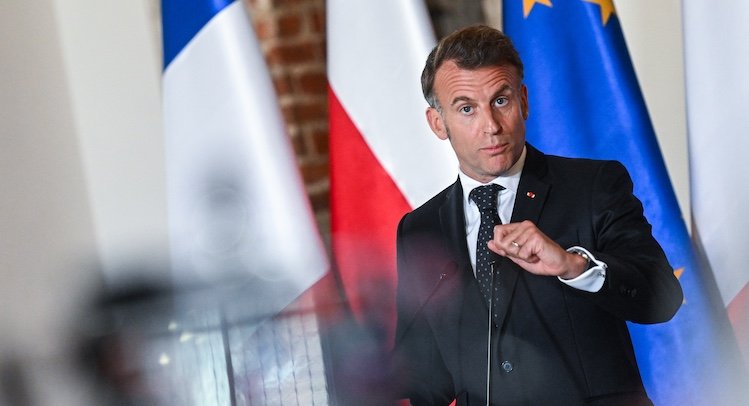
So the killing of a French UNIFIL soldier makes clear the danger of letting Hezbollah fester in someone else’s country. French President Emmanuel Macron has been calling for Israel and Lebanon to hit the brakes on their recent attempts to defeat Hezbollah and reassert Lebanese sovereignty, but perhaps this will inspire a change of heart?
Probably not. Here was Macron’s statement on Saturday:
“Everything suggests that responsibility for this attack lies with Hezbollah. France demands that the Lebanese authorities immediately arrest the perpetrators and take their responsibilities alongside UNIFIL.”
France apparently wants to know how Lebanon could have let something like this happen. After all, Lebanon has a responsibility to police its territory and maintain its monopoly on the state use of force.
When Hezbollah kills French citizens, anyway. The attitude is quite different when Hezbollah is busy killing Israelis. Or Jews anywhere in the world, including on European soil. In that case, the impatience is with Israel not Lebanon.
Hypocrisy at this level is a talent. France is a peerless practitioner of narcissism in foreign policy. Everyone has something they’re good at. This is what Macron’s France is good at. So it permeates every utterance out of Paris.
Perhaps France should lend a hand at disarming and disbanding Hezbollah? Or would that be too much to ask? Relatedly, there is a possibility that Israel will be the one to bring justice to the murderer of the French soldier. If that happens, Macron will no doubt criticize Israel for violating a cease-fire.
Of course, the current Israel-Lebanon negotiations have nothing to do with France, because the Trump administration sidelined Paris and then immediately brought Israel and Lebanon closer to mutual recognition than they’ve been in decades, maybe ever. That is no coincidence: France does not desire peace in the Levant. Instead, it desires a running scapegoat for all its manifold failures in the region and the bloodshed that its malign incompetence has wrought. That scapegoat is Israel.
Just over a century ago, France played a role in the birth of Palestinian Arab nationalism by using force to keep Syria from establishing an independent kingdom. The Arabs of Palestine anticipated being part of Greater Syria; their nationalism, to the extent it was coherent, was Syrian. Arab leaders had until that point been receptive to some form of Jewish self-determination in the land, which they publicly and readily admitted was the historic Jewish homeland. Now, thanks to the French, they turned their nationalist fervor to the cause of anti-Zionism.
Plus ça change, as Macron might say.
Source:
www.commentary.org




