
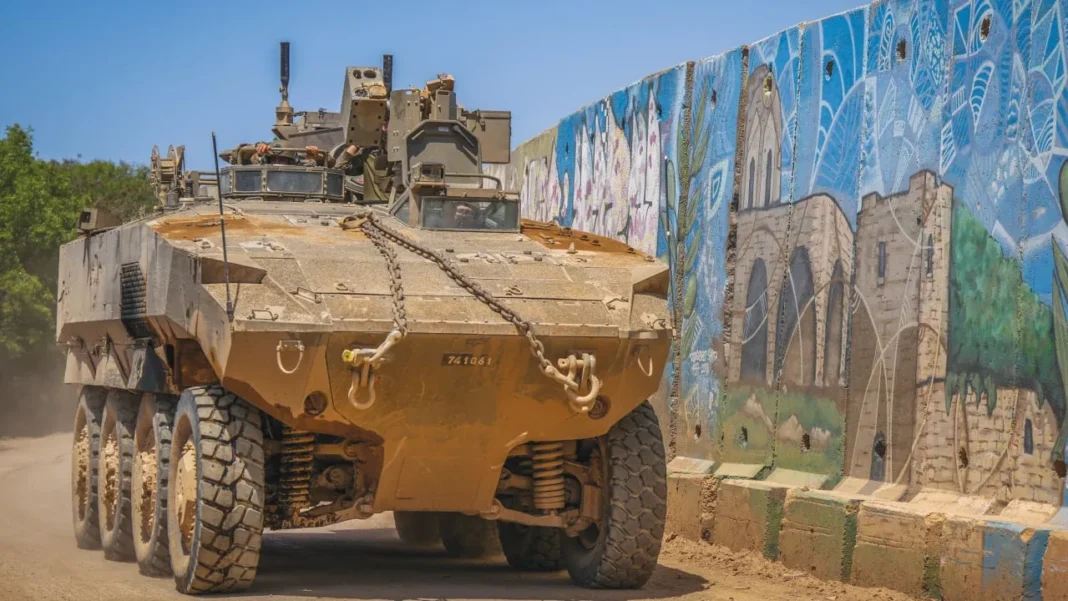

What are we doing in Lebanon? Do we know what we want to accomplish there, and does it make sense? Can what we are trying to do make the North safe for our Israeli brethren living there? Frankly, from the perspective of an average normal citizen of Israel, being there makes no sense.
Specifically, our government says that it wants to create a buffer zone in southern Lebanon from the Litani River to the northern border of Israel. That is a clear objective, but for what purpose? To stop attacks on the North of the country? Is that a realistic outcome of the buffer zone?
Does our vaunted military really believe that separating Israel from population centers in Lebanon by 30 kilometers will protect us from anything? Do our people understand the realities of modern warfare? That 30-km. stretch of land protects the North from nothing.
Drones can still be launched from inside Lebanon and have the capacity to span those 30 km. with ease. Missiles large and small can certainly be launched from north of the Litani River and reach most of Israel within minutes. So, what’s the point of a buffer zone?
Of course, we would like to destroy Hezbollah’s capability to attack us – that is the ultimate objective. But has anyone looked recently at our history of incursions into Lebanon? Have any of those successfully eliminated the capability of the enemy there to inflict damage on Israel?
Israel’s history of incursions into Lebanon
To remind everyone, we have conducted numerous military incursions into Lebanon since 1948, primarily targeting Palestinian militant groups and later Hezbollah, to secure our northern border. Key invasions include in 1978 (Operation Litani), 1982 (full-scale invasion up to and including Beirut), 2006 (July War), and 2024, alongside an 18-year occupation of southern Lebanon (1982-2000).
But that’s not even all of it.
1948: Israeli forces entered southern Lebanon during the first Arab-Israeli war.
1968-1970s: Frequent Israeli raids in response to PLO (Palestine Liberation Organization) activity. In 1972, a 36-hour occupation occurred.
1978 (Operation Litani): Israel invaded Lebanon up to the Litani River to push back the PLO, leading to the creation of the almost worthless UNIFIL “peacekeeping” mission.
1982 (Operation Peace for Galilee, known as the First Lebanon War): A massive Israeli invasion reaching Beirut aimed at dismantling the PLO, resulting in our long-term occupation of southern Lebanon.
1985-2000: Israel maintained a self-declared “Security Zone” in southern Lebanon, fighting against Hezbollah, which was formed to resist the occupation.
1993 (Operation Accountability) and 1996 (Operation Grapes of Wrath): We mounted large-scale offensives against Hezbollah targets to pressure them.
2006 (Second Lebanon War): Following a Hezbollah cross-border raid, Israel launched a 34-day war involving heavy airstrikes and ground incursions.
2023-2024: Following the escalation of the conflict by Hezbollah after October 7, the IDF initiated intense bombing and ground incursions in late 2024, resulting in the killing of Hezbollah leader Hassan Nasrallah and significant displacement.
After all of that, even after our amazing cellphone and pager attacks, we are back again, once more talking about a buffer zone to protect the North – one that, even if successfully achieved, will not protect the North. It is clearly something everyone knows but is loath to admit it.
By the way, what has this series of failures cost us? Israeli casualties in Lebanon since 1948 include over 1,400 IDF soldiers killed, along with the death of roughly 200 civilians. Major losses occurred in the 1982-1985 war (over 1,200 deaths) and the 2006 Second Lebanon War (around 160 casualties). Ongoing, low-intensity conflicts, including the 2023-2024 violence, have added to these numbers, with many deaths from Hezbollah rocket fire.
We have had good reasons to invade Lebanon. Throughout our history, we have cited cross-border attacks, such as rocket fire and guerrilla raids by the PLO or Hezbollah, as justification for these interventions. No honest observer can dispute these claims.
Nevertheless, at the end of the day, Hezbollah remains a threat, our citizens in the North cannot live quiet lives, and, short of never-ending war, our government provides no other tangible solution to the problem on the northern border.
Finding an alternative to continual war
Therefore, if all that is written here is true, is there an alternative to continual war with Lebanon? The answer is a simple yes, but the process to getting to yes is challenging.
For the first time in decades, the legitimate elected government of Lebanon seems genuinely interested in concluding a peace agreement with Israel. Representatives of both governments have already held preliminary discussions in Washington under the sponsorship of the US Department of State. Peace between the two governments is an achievable goal whose only obstacle seems to be the continued existence of Hezbollah.
Egypt was faced with a similar challenge when it sought to make peace with Israel, given the existence of the Muslim Brotherhood, which was dead set against any peace agreement with Israel.
Egypt attempted unsuccessfully to work with the Brotherhood as a part of the government. Yet it proved not to be a workable framework, and the Brotherhood was ultimately outlawed officially in a proclamation to that effect on September 23, 2013. It is important to note that no civil war erupted in Egypt as a result.
In Lebanon’s case, the government there needs to bite the bullet and outlaw Hezbollah while ensuring that Iran can no longer supply these insurgents, which should be relatively easy as Iran itself is facing its own potential collapse.
As part of this approach, Israel should cooperate fully with the Lebanese government in quashing any Hezbollah activity by making any of our technology that would help in this regard fully available to the Lebanese. We both have a significant stake in the success of this effort.
A unique period in time is open to us now to make an agreement with Lebanon that could end, once and for all, our having to live with an enemy on our northern border. This would “finish the job,” as the residents of the North are demanding of our government, and put in place a framework that could provide peace and tranquility for Israel with yet another of its neighbors. Sounds idyllic, but it is possible if the leadership has the commitment to make it happen.
Winston Churchill said: “A pessimist sees the difficulty in every opportunity; an optimist sees the opportunity in every difficulty.” We desperately need our leadership to see this opportunity and act on it.
Following decades of conflict between Egypt and Israel, then-president Anwar Sadat announced in the late 1970s that it was time to end the cycle of violence, famously stating, “Enough of war. It is time for peace.” And, indeed, it was and remains so today – 47 years later. Let’s just do it. We will have only ourselves to blame if we fail to try.
The writer, a 42-year resident of Jerusalem, is a former national president of the Association of Americans and Canadians in Israel, a past chairperson of the board of the Pardes Institute of Jewish Studies, and a board member of the Israel-America Chamber of Commerce (AMCHAM).
Source:
www.jpost.com




