
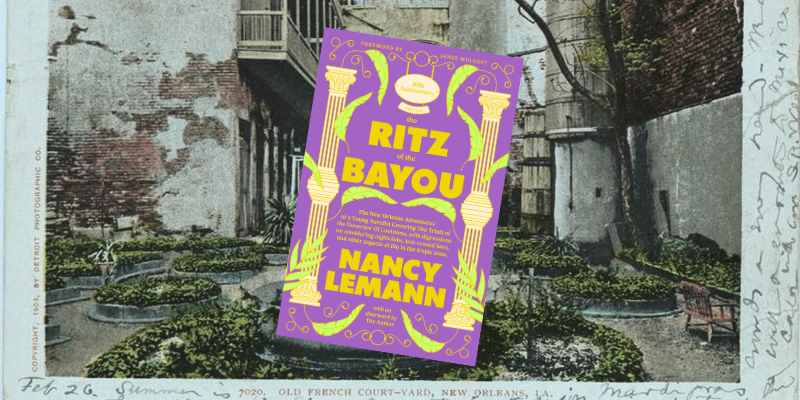

This April, a jewel of the American South is experiencing an overdue literary renaissance. Nancy Lemann, bard of New Orleans and stylist nonpareil, has gotten a glow-up—and in some corners, there’s already been much rejoicing.
In this week’s New Yorker, for instance, Brandy Jensen praised Lemann’s singular voice. In novels like Lives of the Saints and The Oyster Diaries—both recently reissued from NYRB—the author has proven “capable of crystalline insights into the miscreants and oddballs of the American South and great bursts of unrestrained sentiment. Sort of like if Charles Portis listened to a lot of Joni Mitchell.”
In Oxford American, Snowden Wright called Saints nothing short of “miraculous,“ and compared Lemann’s fictional sensibility to a poet’s. Other critics have praised the author’s smooth sentencing, her Balzacian grip on social problems, and her wet wit.
Frankly, I’m one of the converted. But I’m here today to ring a particular bell: for Lemann’s non-fiction. Specifically, The Ritz of the Bayou, reissued this month by Hub City Press, the happy result of a botched reporting assignment.
In 1985, Lemann was commissioned to write a piece for Vanity Fair covering the trial of debauched Louisiana governor Edwin Edwards, who had been charged with bribery and racketeering. While Tina Brown ultimately rejected Lemann’s copy—for its lack of pertinent details about the case, which didn’t grip her—the author’s account of the trial was published as a standalone book 40 years ago before falling out of print.
Again, I’m a full throated Lemann fiction fan, here for those swinging sentences and winningly delulu narrators. But for my money, it’s a special treat to hear this brazen voice collide with the “real” world. Specifically, the real of the author’s native city, New Orleans.
Vignettes in The Ritz form a montage of a blessed and blighted place. Sitting bench side at the trial, we meet a murderer’s row of charismatic crooks, drunks, and philosophers. All of them so specifically rendered that you feel they must be real.
As Adrian Van Young put it in the Southwest Review, the book’s draw is stealthily structural. It’s in the “nesting-doll characterizations of the city of New Orleans, in the state of Louisiana, in the realms of the unreal American South.” Lemann writes out of a New Journalist tradition, but unlike certain peers in the profession (cough, Joan Didion) you can always feel a fondness for the subject, and a humility in the voice.
She makes categorical pronouncements (“The Southerners are jaded and cynical, for this is a region accustomed to intrigue, and to an old defeat”). But doesn’t try to obfuscate the ‘I’ handing them down (“Ordinarily I don’t spent quite a lot of time looking at the dark side”).
And though we’re literally on trial, judgment feels beside the point. As Van Young observes, the crooked governor here is a symptom, not a symbol. So while descriptions accumulate, they never draw down to a sentence.
As Lemann writes in the opening pages, “politics is not the place to look for saints…but it holds a certain fascination. There is a connection, between the dark side and the light.” Everywhere in this report, that tension is felt.
Incidentally, I was in New Orleans—my favorite American city—a few weeks back. And reading The Ritz right after a visit, with the town fresh in my head, I was able to marvel at the integrity of Lemann’s textural details. In his intro to this reissue, Geoff Dyer called Lemann a mistress of vibes. And it’s true; she nailed these—forty years ago.
Characters glimpsed through merry, maddening encounters—like the nephew who is a “fraud defendant by day, cocktail bar pianist by night,” or the “pint-sized philosopher” asking too many questions in the courtroom— felt airlifted from a Bywater dive bar in 2026. One where I sat days ago and heard a big band sing an intoxicating uptempo song about suicide, feeling all the joyful contradictions embedded in this town—the light, the dark—at once.
As a recurring tourist, I’ve found it’s sometimes hard to believe New Orleans is a real place once you’ve left it. But thank god we’ve got writers like this to remind us.
Though I urge you to stock up on all the work coming out of the Lemann-aissance, maybe put on the Ritz first.
Image via NYPL Digital Collections
Source:
lithub.com




