
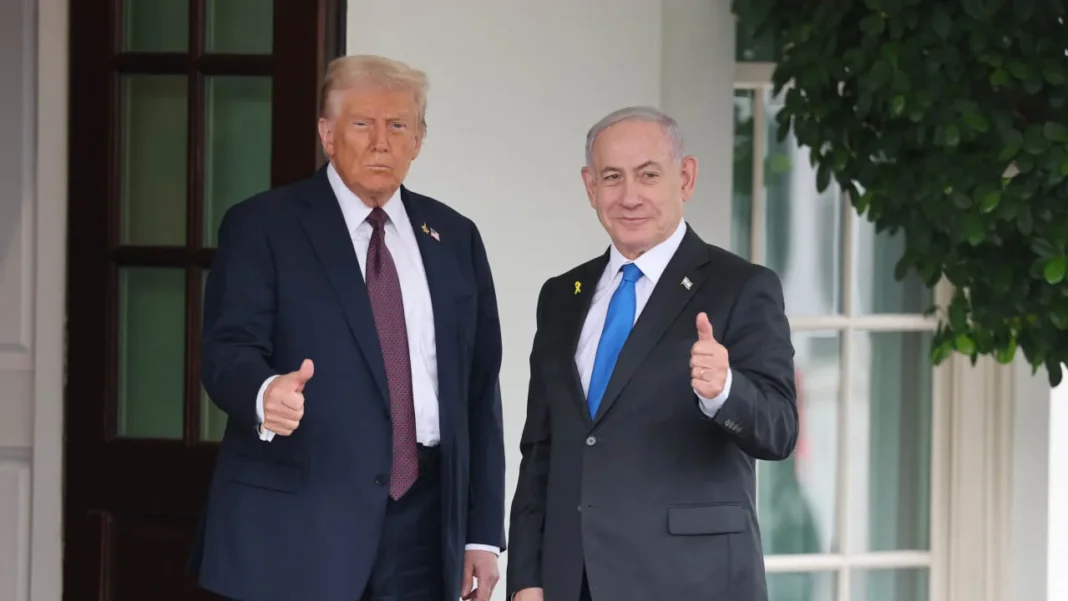

Following Prime Minister Benjamin Netanyahu’s assertion that the war with Iran continues, a pointed question arises: will Israel comply if Washington and Tehran reach a fragile ceasefire or genuine peace?
On April 21, 2026, US President Donald Trump extended the fragile two-week ceasefire as the deadline approached in Islamabad. Although White House sources indicated the extension would last merely three to five days, Washington’s words prove more fluid than the price of crude oil and equally volatile.
The world watches anxiously as Israeli-American brinkmanship with Iran reaches its crucible in the Strait of Hormuz. Jet fuel shortages are rising; even the world’s leading condom manufacturer is preparing price increases as the conflict destabilises supply chains.
Where do we stand with the imposed war on Iran?
White House spokeswoman Karoline Leavitt confirmed the ceasefire whilst emphasising that “Operation Economic Fury” continues, as “Iran needed it” amidst mounting domestic pressures. Yet it is Trump who appears increasingly out of control, with Fury backfiring on its architect. Levitt’s clarification that Trump has set no “definite and specific deadline” for ending the “undefined” ceasefire speaks volumes.
Iran escalates in the Strait of Hormuz
Trump’s extension came despite Iranian officials refusing to send delegates to Islamabad’s second round, insisting they would not negotiate until the naval blockade was fully lifted and normal traffic restored to the Strait of Hormuz.
Iran then escalated by seizing vessels in the Strait, as US Secretary of the Navy John C. Phelan stepped down. Iran holds more cards still; its proxies have yet to enter, but the naval war in the Persian Gulf is already exacting a visible toll on the Trump administration.
Beyond the bilateral table, a larger question looms over the Middle East: where does Israel stand in Trump’s “ultimate containment” of Iran?
This matters because, as The New York Times reported exclusively, Trump’s alignment with Netanyahu – and his inner circle’s failure to oppose it – has set the United States on a course towards war.
Netanyahu has now thrice convinced Trump to act against Iran: the unilateral withdrawal from the nuclear deal (May 2018), the 12-day war (June 2025), and the recent 2026 Iran War. The question of who drives this war – Netanyahu or Trump – is therefore valid. Will Jerusalem accept this half-hearted peace or unilaterally reignite conflict?
Strategically, Washington still calls the shots on Israeli military actions in the region – but a US-Iran deal preserving the current regime of Iran would be Israel’s nightmare. Having survived two joint strikes, the Islamic Republic of Iran intact will be more dangerous to Israeli perception than a collapsed one, making regime destabilization Jerusalem’s core strategic goal for years to come: an Iran in a state of failed state or even anarchy would be the objective.
This is precisely Mossad’s message to Trump. Outgoing chief David Barnea declared, “Our mission in Iran is not over until the regime falls.” Predecessor Yossi Cohen warned Washington: “No agreement will change Iran’s fundamental ambitions.” Jerusalem clearly fears a Tehran-Washington rapprochement.
Israel’s strongest dependence on the US is military and diplomatic. The economic link matters, but it is less ‘existential’ than the security bargain. US military assistance remains Israel’s largest external defence pillar.
The 2019 to 2028 memorandum fixes support at $3.8 billion a year and, according to INSS, this equals about 15% of Israel’s defence budget and roughly 0.5% of GDP. Diplomatically, Israel has long leaned on US cover in international forums, especially at the UN, where American vetoes have shielded it from adverse resolutions.
The most existential military component vis-à-vis Iran is the additional layer of missile defence: US-made THAAD interceptors. America has depleted at least half its THAAD inventory – missiles designed to intercept ballistic threats – during recent operations.
Interdependence cuts both ways.
The pro-Israel lobby exerts significant influence in US domestic politics, including elections for both Congress and the presidency. In turn, US policy on Iran under both Trump administrations has been strongly shaped by Israeli military-security perspectives and wish lists: withdrawal from the nuclear deal in 2018, a joint military attack on Iranian nuclear infrastructure in 2025, and the recent aerial strike on Iran.
That trajectory sits uneasily with the US National Security Strategy, which seeks a lighter US footprint in the Middle East. In short, the 2025 US National Security Strategy treats the Middle East as secondary to great-power competition with China and Russia.
In the military and security domain, Israel ultimately depends on the US’s final decisions. Three incidents illustrate the hierarchy. First, Netanyahu issued a public apology to Qatar after Israel’s strike in Doha.
Second, Trump successfully prohibited further Israeli bombing in Lebanon during the ceasefire. In interviews, Trump reiterated: “Israel has to stop. They can’t continue to blow buildings up. I am not gonna allow it,” signalling irritation with Netanyahu’s reluctance to fully halt operations against Hezbollah.
Third, the unilateral truce between Tehran and Washington caught Israel off guard amid ongoing operations, and it tied into broader US-Iran peace talks mediated in Islamabad, Pakistan. Washington, not Jerusalem, is in the driver’s seat. On that logic, Israel is unlikely to take kinetic action against Iran without Donald Trump’s approval.
A shortage of interceptors and missiles also appears to have pushed Washington towards an ‘indefinite’ ceasefire extension and a clearer political will for comprehensive talks in Islamabad. The naval blockade, meanwhile, is intended to ratchet up unprecedented economic pressure on Iran and force more conclusive negotiations.
Even a limited US-Iran clash, kept below the threshold of war in the coming days, could still escalate into renewed conflict. In that case, Israel would likely join the United States in a new round of aerial attacks on Iran.
There is another scenario: Washington enforces a naval blockade whilst, through division of labour, allowing Israel to light the fuse – then steps back to limit regional fallout. Tehran would reject such outsourcing and widen the war across the region. Iran seeks a central role in shaping Western Asia’s future security architecture, if not beyond.
That is why the conversation between Saudi Arabian Crown Prince Mohammed bin Salman – the de facto leader of the Arab world – and the Chinese President Xi Jinping is of paramount importance, as both leaders can press Washington to sustain the ceasefire and restore normal transit through the Strait of Hormuz.
Europe, the region’s former imperial power, is moving as well.
The recent French British initiative, which united more than 50 states behind a ‘strictly defensive’ yet proactive effort to secure free passage through the Strait of Hormuz, marks a strategic inflection point. A return to the pre-war order is illusory.
Stability now requires recognising Iran as an enduring geopolitical actor.
This shift compels a reassessment of maritime chokepoints, from Hormuz and Bab el Mandeb to the Strait of Malacca, in a more contested global order. For now, whoever controls Hormuz, meaning Goddess in Persian, exercises a near divine leverage over the years ahead.
The writer is a strategic Iran analyst at the Hague Institute for Geopolitics and lecturer at The Hague University.
Source:
www.jpost.com




