
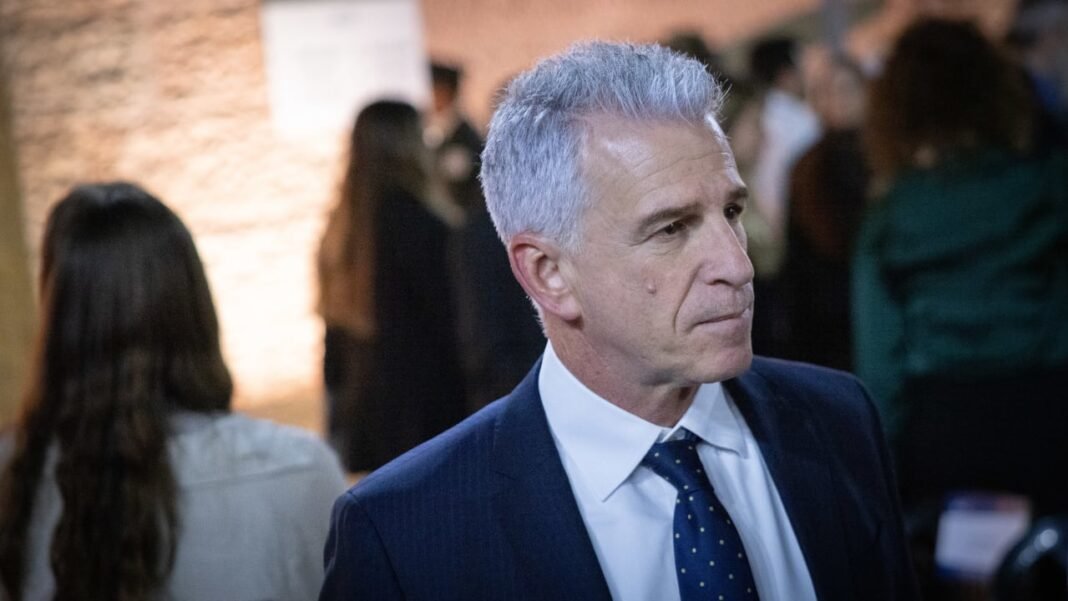

Last month, Prime Minister Benjamin Netanyahu appointed Maj. Gen. Roman Gofman as the next Mossad director, set to replace David Barnea on June 2. Barnea’s legacy is already sealed, and his name will remain tied to one of the most consequential phases in the long war against the Islamic terrorist regime ruling Tehran.
The Mossad has never been ambiguous about its mission: the Islamic Republic of Iran must never obtain nuclear weapons, under any circumstances, and at any cost. No intelligence service has studied the ideological DNA of Khomeinism with the same depth and clarity, and no serious observer can doubt what Tehran would do if it ever crossed that threshold. Had the regime possessed a nuclear weapon on October 7, 2023, it would have used it.
In the summer of 2025, Israel acted accordingly. The Mossad dismantled a critical pillar of Iran’s nuclear program in a preemptive strike that was not about diplomacy or symbolic deterrence, but about decisive necessity. That operation worked, but only temporarily, and it did not end the war.
Whether Netanyahu remains in power or not, whether Yossi Cohen ever transitions from intelligence leadership to political leadership, the central fact remains that Barnea pushed the boundaries of modern intelligence warfare with a level of precision and audacity rarely seen. Yet even that level of operational dominance does not equal victory, because the core reality has not changed: the Islamic Republic still exists.
No serious analyst believes the words of this regime, because deception is not a tactic for Tehran; it is its structure.
Its propaganda system, refined over decades, functions with an intensity that recalls the darkest models of the 20th century. Now, however, the regime is no longer projecting strength but revealing fracture. Iran is not gradually declining; it is entering a phase of unstable pre-collapse.
Questions over Iranian leadership
Ali Khamenei, the second dictator after Khomeini, is gone, and for months uncertainty has surrounded his fate, whether death, disappearance, or deliberate concealment. What matters is not the exact scenario but the visible outcome: a system incapable of even staging continuity.
Mojtaba Khamenei remains absent, silent, and without presence, while the country increasingly resembles a fractured, military-dominated structure drifting toward an internal power struggle. For the Iranian people, this succession question has already lost relevance.
Cohen had already pointed to this trajectory when he warned that Khamenei sought to transform the system into a hereditary dictatorship, a project that has now collapsed under the weight of its own corruption and structural weakness. During last June’s 12-day war, Khamenei himself stripped away the illusion of leadership, hiding underground while Israeli airpower established dominance over Tehran.
The mythology of martyrdom remained reserved for the population, while survival defined the ruler. That contradiction did not go unnoticed, and it marked a turning point in how the regime is perceived both internally and externally. What followed has only reinforced that shift, as coordinated intelligence pressure has removed key elements of that era from the political stage.
At the same time, the broader geopolitical landscape is being reshaped by the alignment of the United States and its allies, the counterweight of Russia and China, and the increasingly central roles of Israel and the Gulf states. Saudi Arabia and the United Arab Emirates are investing in growth, modernization, and stability, while the Abraham Accords continue to expand the framework for regional cooperation.
The Islamic Republic stands in direct contrast to this trajectory, remaining fixated on exporting its revolutionary ideology, sustaining transnational networks of militancy, and pursuing its long-standing objective of destroying Israel, even as its own population faces deepening poverty, systemic corruption, and environmental collapse.
Inside Iran, the regime has reverted to its most familiar tools: executions, intimidation, and fear, embodied by figures who echo the brutality of earlier revolutionary enforcers. Yet the conditions have changed, because a society pushed to this level of economic and social pressure is no longer easily controlled.
The survival of the regime is not a contained issue; it is directly tied to the security of Israel and the stability of the region. Leaving such a system weakened but intact is not a sustainable strategy, because a damaged structure driven by ideological hostility becomes more dangerous, not less.
Across the Gulf, there is a clear recognition of this reality, reflected in the persistent concern about the emergence of another dominant figure in Tehran. From both a strategic and a moral perspective, the logical endpoint is not containment but collapse.
The Mossad has already demonstrated a level of operational penetration inside Iran that goes beyond influence and enters the realm of sustained presence. Admissions from within the Iranian intelligence community itself confirm that even senior figures do not feel secure. This is not symbolic pressure; it is a condition of constant vulnerability imposed on the regime.
Yet, despite this, the system continues to stand, even as it moves closer to structural failure. Iran is facing converging crises in water resources, economic stability, and political cohesion. These pressures are not isolated but interconnected, accelerating the pace of internal decay.
The distinction between so-called reformists and hardliners remains largely performative, masking a unified interest in preserving the same power structure. For decades, the regime has functioned as a hybrid of ideological authority and organized coercion, capable of sustaining itself through repression while failing to deliver basic governance.
The Iranian population has challenged this system repeatedly, rising in waves of protest that have been met with force each time, yet the underlying conditions that drive these uprisings have only intensified.
Today, individuals are imprisoned, tortured, and in some cases executed under accusations of collaboration with Israel, while the deeper reality is that many Iranians no longer accept the regime’s narrative of enmity. This widening gap between state propaganda and public perception represents one of the most significant internal threats the system faces.
The name of the Mossad, in this context, functions not only as an operational entity but as a psychological factor that amplifies the regime’s internal insecurity. The pattern of targeted eliminations and deep infiltration has sent a consistent message that no layer of leadership is beyond reach, reinforcing a climate in which fear is directed inward as much as outward.
Recent confrontations have further exposed the fragility of the regime’s control mechanisms, revealing that the structure often described as a web is, under sufficient pressure, capable of tearing.
Moments in which internal crisis and external pressure converge at this level are rare, and history suggests they do not remain open indefinitely. Previous opportunities for fundamental change were constrained by hesitation, particularly at the level of international coordination, and those constraints carried consequences. The current moment presents a similar test, but with higher stakes and less margin for delay.
If figures such as Supreme Leader Mojtaba Khamenei or IRGC commander Ahmad Vahidi consolidate power, the underlying direction will not shift, because the ideology that defines the system will remain intact, along with its patterns of behavior. In contrast to regional actors who are investing in stability and development, the Islamic Republic continues to generate instability, making long-term balance in the region impossible without a decisive shift.
If the survival of Israel and the broader goal of regional stability are taken seriously, then the Islamic Republic must be understood as a threat that cannot be managed indefinitely. Systems defined by this level of ideological rigidity and expansionism do not evolve into moderation; they persist until they are forced to change or cease to exist.
The removal of this structure would not only address an immediate security challenge but would also open the possibility for a different relationship between Iran and the region, one that aligns with the emerging framework established by the Abraham Accords.
The opportunities presented during the 12-day war and the subsequent 40-day confrontation were significant but not fully realized. That does not erase their impact, but it does sharpen the question that now stands at the center of the strategic landscape: If another opportunity emerges, will it be recognized for what it is, and will it finally be taken to its conclusion?
The writer is a Middle East political analyst. His latest book, Tehran’s Dictator, examines the theocratic era of Ali Khamenei (1989-2026). @EQFard
Source:
www.jpost.com



