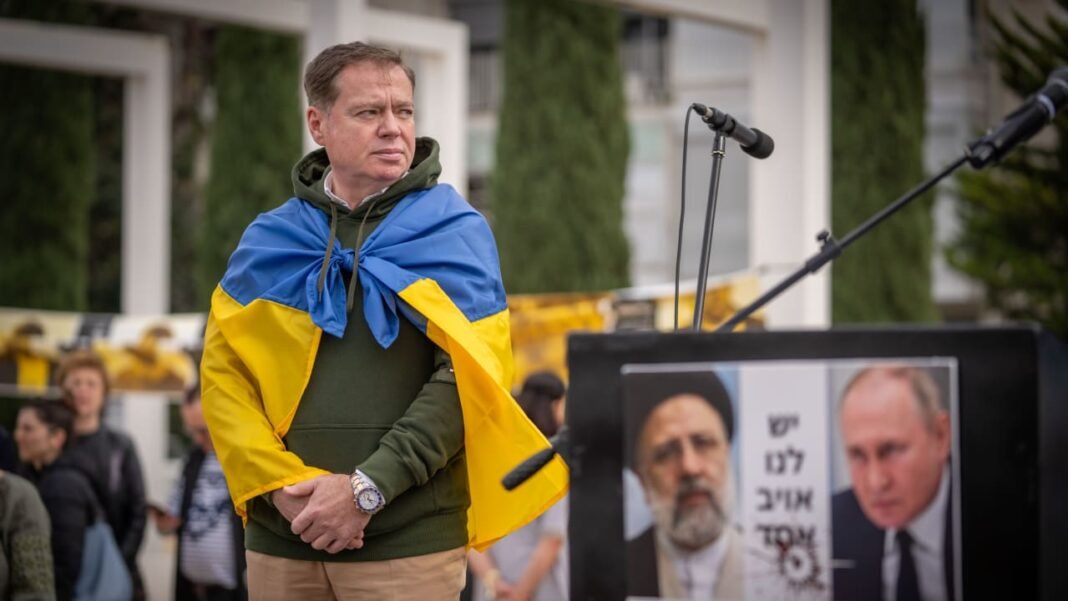

Ukraine’s Ambassador to Israel, Yevgen Korniychuk, laid out in a Tuesday interview with The Jerusalem Post Kyiv’s growing frustration over the alleged import of grain taken from Russian-occupied Ukrainian territories – and the diplomatic and legal battle now unfolding in Israel.
“We filed our complaint,” Korniychuk said, referring to a formal submission by the Ukrainian Embassy to Israeli police. “The aim is to open criminal proceedings against all possible parties involved – traders, exporters, and offshore entities that may have enabled breaches of Israeli law.”
The complaint centers on shipments of grain that Kyiv says were falsely labeled as Russian-origin. “The importer was supposed to know the certificate of origin was fake,” he argued, adding that the documents claim the grain came from Russia.
“That is simply not true. It came from Ukrainian territories occupied by Russia. How else can you explain cargo loaded in Sevastopol and Mariupol?” he asked, referencing Ukrainian ports currently under Russian control. “These are temporarily occupied territories. This grain is Ukrainian.”
While Israeli officials say insufficient evidence was presented to prove that the grain on the ship originated in Ukraine, the ambassador insists that Ukraine has provided satellite imagery and intelligence, including evidence of ships loading cargo in those ports. He also accused Russian actors of using sophisticated tactics to obscure the grain’s origin, including switching off vessel transponders and routing shipments through third countries.
Test to Ukraine-Israel relations
The issue has also tested the relationship between Jerusalem and Kyiv. Ukraine has submitted formal requests for assistance, including court orders to seize both the vessels and their cargo.
“At one point, the ship was still in Haifa,” Korniychuk said. “We asked: if you cannot arrest the vessel, why not stop the grain?”
He claims Israeli authorities declined, stating the cargo had already been distributed – an assertion he disputes. “We saw the contract. The port was obligated to store the grain for 10 days. They could have acted.”
The ambassador framed the dispute as part of a broader principle of international legal cooperation. “We cannot collect evidence in Ukrainian-occupied territories,” he said. “That’s exactly why we ask friendly countries to help. Instead, we are asked to provide details we physically cannot obtain during wartime.”
Throughout the conversation, Korniychuk returned to a central message: Israel should distinguish between legitimate trade and what Ukraine considers looted resources.
“You can buy grain from Ukraine. You can buy grain from Russia – if it is not from occupied territories,” he said. “But don’t buy stolen goods. That’s all we’re asking.”
While careful to avoid framing the issue as a bilateral crisis, the ambassador drew a sharper line when discussing Israel’s global standing.
“Israel calls itself the only democracy in the Middle East,” he said, responding to Israeli officials’ claims that Ukraine singled out Israel rather than other countries such as Turkey and Egypt, where allegedly stolen grain has also arrived. “So don’t put yourself on the same track as countries without a strong rule of law.”
He also invoked analogies closer to home for Israelis, referencing property disputes after World War II and even hypothetical scenarios involving looting after the October 7 attacks.
“How would you feel if stolen goods from Israeli homes were sold abroad?” he asked. “Isn’t that the same principle?”
Despite the criticism, Korniychuk emphasized that Kyiv is not targeting Israel as a state, but rather specific actors.
“We are not going against Israel,” he said. “We are going against those who knowingly engaged in this trade.”
“We received assurances from Brussels,” he added. “If Ukrainian sanctions were imposed on Israeli importers, the Europeans would follow. That changed the calculation.”
He described the situation as “a misunderstanding” that could still be resolved through cooperation, but warned that Ukraine is prepared to pursue legal avenues if necessary, including appeals in Israeli courts.
“The court will decide,” he said. “That is the strength of your system.”
For now, the case remains under review by Israeli authorities, with Ukraine signaling it is prepared for a prolonged legal and diplomatic fight.
Source:
www.jpost.com