
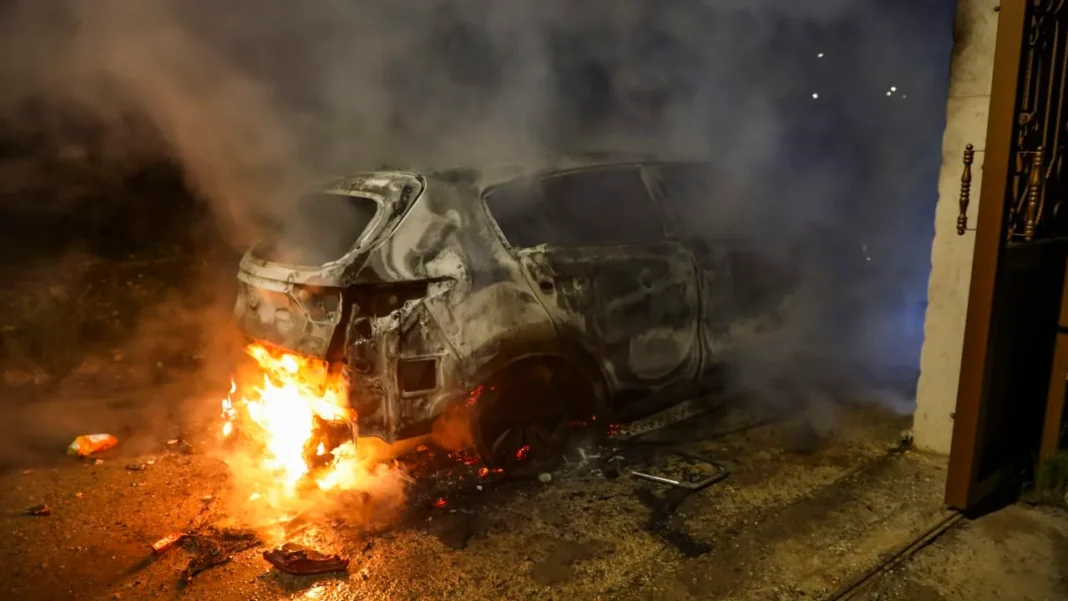

Jewish violence against Palestinians in Judea and Samaria (sometimes referred to as “terrorism,” “pogroms,” or simply “settler violence”) has been a spreading phenomenon, especially since the Hamas-led terrorist attacks on October 7, 2023.
The government prefers to call it a Jewish “nationalist crime,” and is averse to referring to it as “terrorism,” and those responsible for committing it “terrorists.” In his interview with Bret Baier of Fox News on December 31, 2025, Prime Minister Benjamin Netanyahu referred to it as “vigilantism.”
In the interview, which followed Netanyahu’s meeting with US President Donald Trump at Mar-a-Lago, Baier asked him about these events, which involve increasingly frequent attacks by Jews on small Palestinian communities in Area C and occasionally Area B. In these attacks, the assailants have set fire to Palestinian homes and other property, destroyed olive orchards, robbed or slaughtered Palestinian herds of sheep and/or goats, and wounded or occasionally killed random innocent civilians.
According to Netanyahu, the dimensions of the phenomenon are greatly exaggerated. “One is speaking of a handful of kids, about 70 kids, not from the West Bank [note that he used the term “West Bank”], teenagers who come from broken homes. They do things like chop down trees, and sometimes they try to burn a home. I can’t accept that – it’s vigilantism.” Not a word about several dozen Palestinians who were shot dead by these “vigilantes.”
This way of presenting the facts is generally accepted by many Jewish settlers in Judea and Samaria, who condemn the phenomenon as being counterproductive and even damaging to the Israeli official settlement policy and activities in these areas.
However, the number 70 is absurd. The numbers are much greater, and not only youths are involved. And who exactly are these juvenile delinquents? Are they of the same ilk as those who were involved in murdering the 21-year-old Ethiopian-Israeli Yemanu Binyamin Zelka in Petah Tikva, on Independence Day? And if they are, how did they end up as in “agricultural outposts and herd ranches”?
KKL-JNF and violence in the West Bank
PART OF THE answer is probably to be found in a news item that appeared last week to the effect that the Keren Kayemeth LeIsrael-Jewish National Fund had decided to stop funding programs for youth-at-risk in outpost ranches in the West Bank. The explanation given by the chairperson of the KKL-JNF was that inadvertently “we were helping dispossess Palestinians of their land.”
In 2023, KKL-JNF financed programs for professional training for youths in outpost ranches. Although these youths were supposed to return to their homes after the program ended, many decided to stay in the outposts and were then involved in violent incidents against Palestinians.
How did a glorious organization, which for 125 years has engaged in the reforestation of the Land of Israel, become involved in dubious projects for returning juvenile delinquents to the straight and narrow? And who exactly is responsible for organizing such programs and ensuring that their original goal is achieved?
Did it all begin after the current government came to power at the beginning of 2023, and Bezalel Smotrich became, in addition to being Finance Minister, a minister in the Defense Ministry responsible for Settlement Administration in Judea and Samaria, with powers relating to various aspects of Palestinian lives in these areas? And how influential is National Missions Minister Orit Strock (from Smotrich’s Religious Zionist Party) over such educational programs?
We know that the number of attacks on Palestinians have multiplied since October 7, 2023 – partly as revenge, but also as a hidden agenda to get Palestinians residents of Area C (and part of Area B) to leave their homes. We know that this is not an official government policy, but we also know that both Smotrich and Strock (as well as National Security Minister Itamar Ben-Gvir, who is in charge of the Border Police in Judea and Samaria) are opposed to the authorities taking effective measures against those Netanyahu refers to as vigilantes.
Pressure on Israel to stop settler violence
HOWEVER, PRESSURE on Israel to do something about the attacks against the Palestinians is growing. In early 2024, the Biden administration implemented “Executive Order 14115” – a policy designed to impose financial sanctions and travel bans on “extremist” Israeli settlers involved in violent attacks against Palestinians in the West Bank.
That year, on November 16, Netanyahu stated at the opening of the weekly government meeting, that the violent attacks in recent months against Palestinians and IDF forces in Judea and Samaria were the handiwork of a “minority, that entered Judea and Samaria, that does not represent the large public of settlers, who abide by the law and are loyal to the state. Against these riots… we shall act with full force, because we are a state governed by the rule of law…”
When US President Donald Trump returned to the White House in 2025, he rescinded Executive Order 14115. However, as the months went by, he and members of his team told Netanyahu that the attacks on Palestinians must stop.
In the middle of March, two weeks after the US-Israel attack on Iran began, Netanyahu convened a phone conversation with Defense Minister Israel Katz, Ben-Gvir, IDF Chief of Staff Eyal Zamir, and the new Shin Bet (Israel Security Agency) head David Zini, and demanded that they all act to prevent “nationalist crime,” since this diverts our attention from Iran to Judea and Samaria.
Several days later, Zamir repeated Netanyahu’s message during a visit to Judea and Samaria, where he stated that “it is impossible that during a multi-front war, the IDF must also contend with a threatening minority at home.” Other high-ranking officers have added that if the wanton attacks on Palestinians continue, there is a danger that a third intifada will break out.
Does all this mean that official Israel will at long last take effective measures against those who wantonly attack Palestinians in the West Bank? Not necessarily. Not everyone in the defense forces places such great importance on stopping the attacks.
For example, Zini considers settler and right-wing activist violence in Judea and Samaria against Palestinians as no more than “friction events” between Jews and Palestinians, and not the result of Jewish terror.
Additionally, the Jewish Division within the Shin Bet was greatly weakened in November 2024, after Israel Katz decided to stop using administrative detention orders against Jews in Judea and Samaria. It therefore made it virtually impossible to detain Jews suspected of participating in violent acts against Palestinians. It was further weakened because many of its more senior members decided to leave the division.
So, as is the case with many more issues, this issue will only be resolved if the next elections bring about a change of government and approach. In addition to all the factors already mentioned above, it will undoubtedly help repair Israel’s crumbling foreign relations.
The writer has written journalistic and academic articles, as well as several books, on international relations, Zionism, Israeli politics, and parliamentarism. From 1994 to 2010, she worked at the Knesset Library and the Knesset Research and Information Center.
Source:
www.jpost.com




