
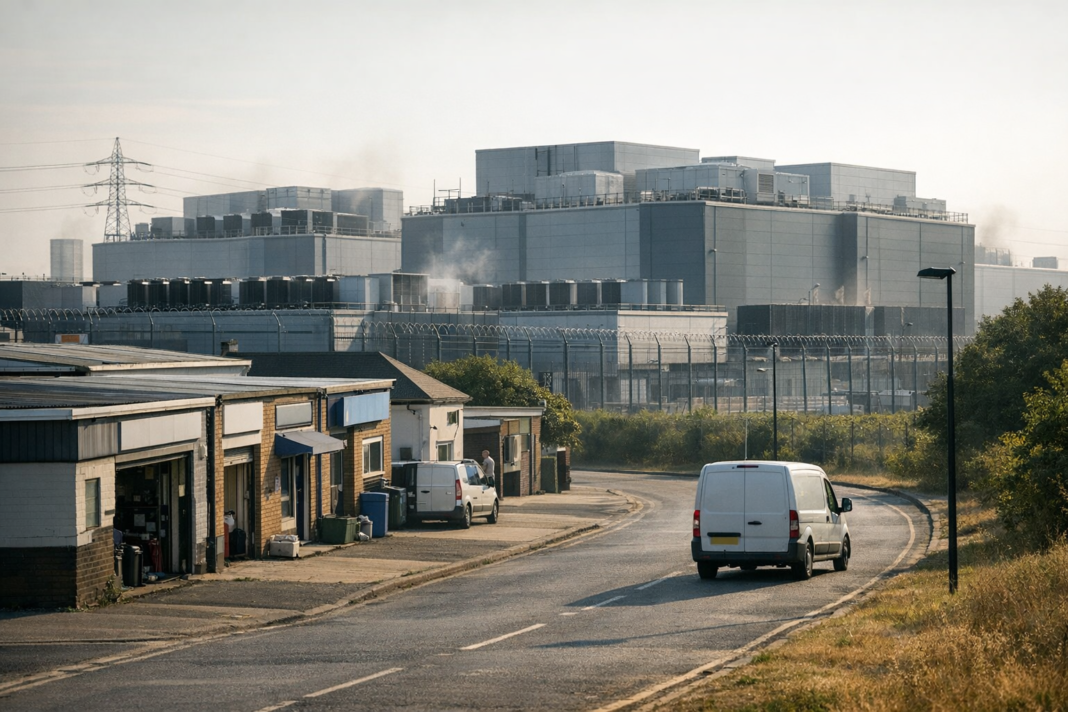

Slough’s industrial landscape is increasingly defined by the rapid growth of large computing facilities as the UK government pursues expanded capacity. Government proposals to increase datacentre numbers nationwide sit against recent months of high temperatures, drought in parts of the country and heightened scrutiny of infrastructure that consumes large volumes of electricity and water.
Slough Trading Estate now juxtaposes long-standing local firms such as Mr Clutch and Angling Direct with new, metal-clad datacentre buildings that have been compared to scenes from JG Ballard for their scale and industrial aesthetic. These sites have become prominent examples of the commercial demand driving construction of facilities designed to support more complex computing tasks, including workloads for artificial intelligence.
Operators and planners say such facilities are essential to maintain digital services and economic activity, but independent assessments and industry commentary note that datacentres require continuous power supply and significant cooling, which can translate into elevated local energy use and measurable water consumption for some cooling systems. Those requirements interact with local networks and resources, particularly during heatwaves or periods of restricted water availability.
Local authorities, utilities and community groups report a range of practical considerations: changes to land use, pressure on grid connections, planning applications for large electrical substations and concerns about landscape and noise from cooling infrastructure. These are matters for statutory planning processes, regulators and operators to address by assessing cumulative impacts, technical mitigation measures and siting criteria relevant to network capacity and environmental constraints.
The situation in Slough crystallises a policy choice faced by decision-makers: how to reconcile the need for expanded digital infrastructure with the protection of local services, homes and natural resources. The balance will depend on transparent planning decisions, rigorous assessment of resource implications and coordination between central and local government, regulators and industry to align infrastructure expansion with climate and community resilience objectives.






