
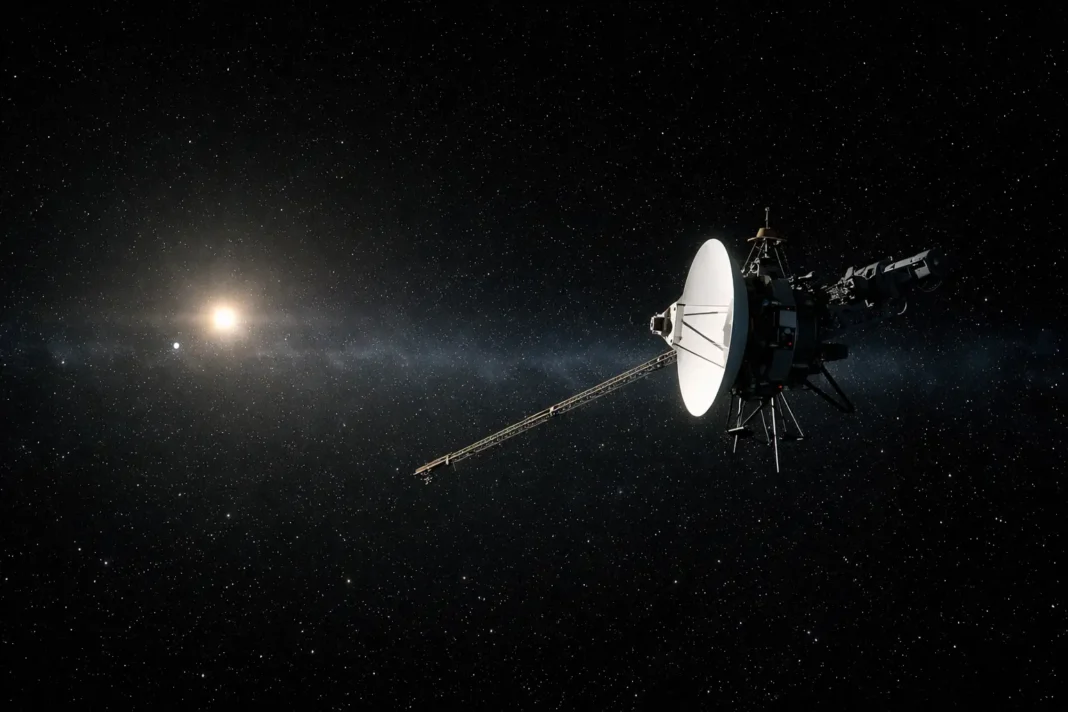

Voyager 1 has crossed another boundary in space exploration: the spacecraft is now one light-day from Earth. The milestone, reached on Nov. 18, means a radio signal traveling at light speed needs 24 hours to move between the probe and mission controllers on Earth. For NASA, the achievement is both symbolic and operational, because every instruction sent to the spacecraft now belongs to a two-day command-and-response cycle.
Launched in 1977, Voyager 1 is roughly 16.1 billion miles, or 25.9 billion kilometers, from the planet that built it. That distance makes routine engineering increasingly complex for a nearly 50-year-old probe, yet the mission remains scientifically active. Two instruments continue to collect data and are expected to remain powered into the 2030s, giving researchers a rare direct sample of conditions in interstellar space.
The spacecraft’s present role is the final chapter of a mission that reshaped planetary science. During its 1979 encounter with Jupiter, Voyager 1 revealed a far more dynamic giant planet than earlier observations had suggested. Its cameras also transformed understanding of the Jovian moons: on Io, the probe recorded the first volcanic eruption ever seen beyond Earth, while images of Callisto confirmed a heavily cratered, geologically inactive surface. A view of Jupiter backlit by the sun revealed the planet’s thin ring system.
At Saturn in November 1980, Voyager 1 produced images impossible from Earth, including views of the planet’s night side casting shadows across its rings. The flyby identified a previously unknown ring, detected five new moons and examined Titan closely enough to show that its dense, hazy atmosphere hid the surface from optical cameras. That encounter also placed the spacecraft on the trajectory that would eventually carry it out of the planetary plane and toward interstellar space.
Before its camera was switched off in 1990, Voyager 1 looked back and captured the solar system “family portrait,” a set of 64 images that included Venus, Earth, Jupiter, Saturn, Uranus and Neptune. The Earth frame became known as the “Pale Blue Dot.” In 2012, the probe crossed the heliopause, where the solar wind gives way to the interstellar medium. Voyager 2 followed in 2018 and is expected to reach its own light-day distance in 2035, while both probes continue to register the fading influence of the sun far beyond the planets.





