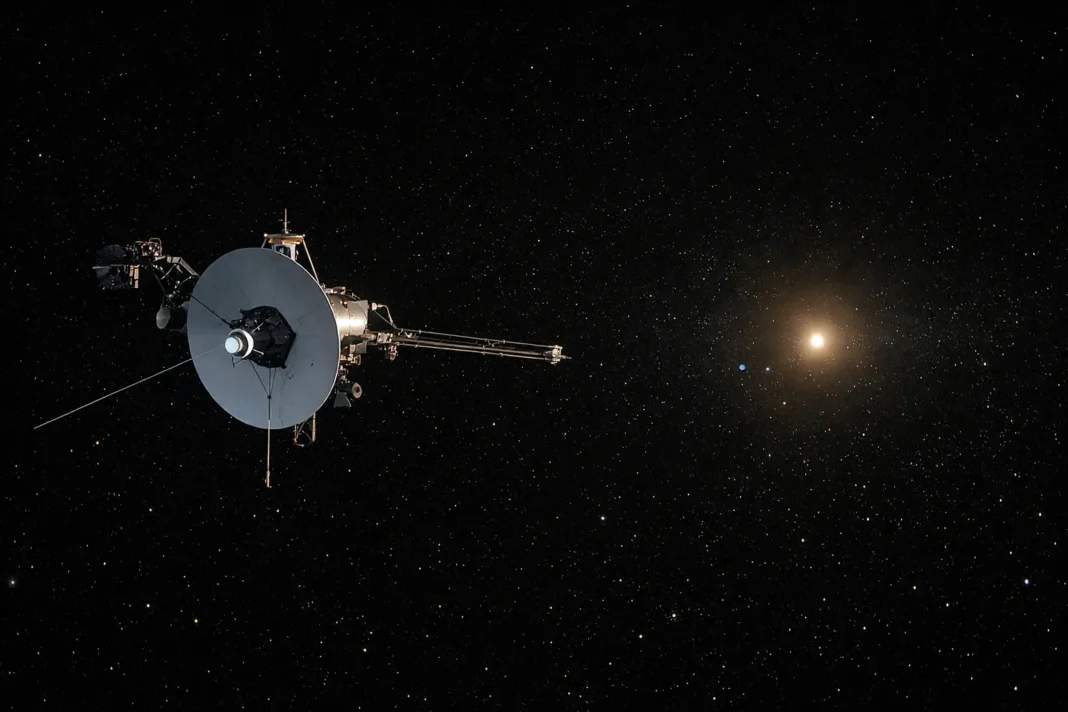

Voyager 1 is nearing a distance no human-made object has reached before: one light-day from Earth. On Nov. 18 at 5:16:07 a.m. ET, the spacecraft will be far enough away that light, and therefore radio signals, need 24 hours to travel between Earth and the probe. The milestone places Voyager 1 just under 16 billion miles, or about 26 billion kilometers, from home, while it continues moving through space at nearly 38,000 mph. For NASA, it is less a change in operations than a measure of the extraordinary scale now separating Earth from its most distant emissary.
Launched in September 1977 with its twin, Voyager 2, the probe was built for a planetary tour, not for nearly half a century of service. The two spacecraft used a rare alignment of the giant planets to cross the outer solar system, returning close-up observations that reshaped planetary science. Together, they helped identify 23 moons, revealed faint rings around Jupiter, documented active volcanoes on Io, and provided detailed views of worlds and atmospheres that had previously been little more than blurred points in telescopes. Their data also influenced later missions to Jupiter and Saturn, including Galileo and Cassini.
The new distance sharpens the practical challenge of communicating with the spacecraft. A command transmitted from Earth will take a full day to arrive; any response requires another full day to return. Those exchanges are handled through NASA’s deep-space communications infrastructure and the mission team at the Jet Propulsion Laboratory. The delay will continue to grow as Voyager 1 moves farther into interstellar space. Although the probe crossed the heliosphere’s boundary in 2012, it remains within the Sun’s broad gravitational domain and is still far from the Oort Cloud’s outer limits.
Power is now the mission’s defining constraint. Voyager 1 depends on electricity generated from the decay heat of plutonium, a supply that weakens over time. Engineers have gradually shut down nonessential systems and instruments to extend operations. Only two science instruments remain active on Voyager 1, while Voyager 2 has three. The magnetometer is expected to be kept running as the final scientific instrument for as long as possible. NASA has indicated that, even after science observations end, basic engineering data could continue until around 2036 if the spacecraft remains healthy.
Voyager 1’s significance will not end when contact is eventually lost. The probe will continue on its trajectory through deep space, carrying a Golden Record designed as a message from Earth, with sounds, images and greetings intended for any civilization capable of finding and playing it. The chance of interception is extremely small, but the object itself has become part of the history of space exploration: a durable artifact from a mission that turned distant planets into places of scientific detail and now measures humanity’s presence against interstellar distances.