
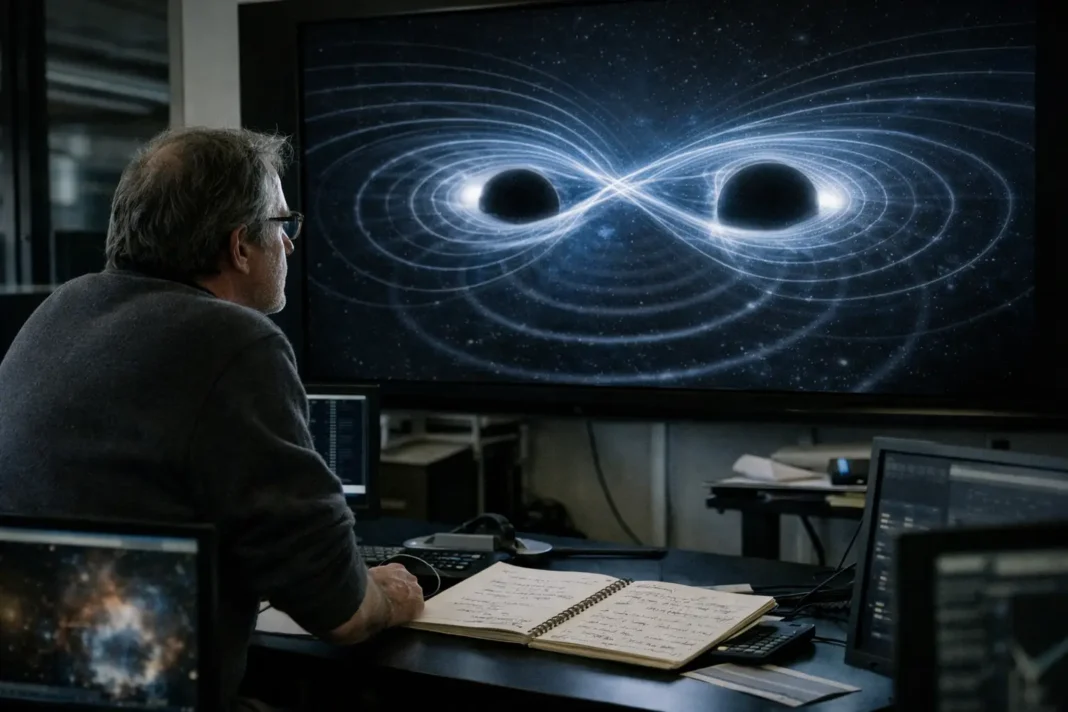

A new theoretical study suggests that gravity may undergo a process resembling magnetic reconnection, the mechanism that helps power violent solar flares. The work, developed within Einstein’s theory of general relativity, describes how sheet-like structures in a gravitational field could break and reconnect in a different configuration. The result does not introduce a new force or modify known physics; it draws a new consequence from equations that have shaped modern cosmology for more than a century.
The study was led by Luca Comisso, an astrophysicist at Columbia University, and Felipe Asenjo, a physicist at Adolfo Ibáñez University in Chile. Published on Oct. 28 in Physical Review D, the research uses the tetrad formulation of general relativity, a mathematical approach in which some aspects of gravity can be expressed through quantities similar to electric and magnetic fields. That formal similarity allowed the authors to ask whether gravity, like magnetism in plasma, can change its connections under specific conditions.
In plasma physics, magnetic field lines are usually carried along with electrically charged gas, stretching and twisting without being cut. When that rule fails, the lines can snap and rejoin, releasing stored energy. Comisso and Asenjo identify a gravitational counterpart: two-dimensional gravitational field sheets that normally preserve their connections but can, in certain cases, separate and reconnect. The study also distinguishes true reconnection from a weaker process in which the sheets merely slip relative to the flow around them while remaining intact through another flow.
The researchers derived equations describing how quickly this gravitational reconnection could proceed and how it would affect the local exchange of energy and momentum between matter and gravity. In general relativity, the combined energy and momentum of matter and gravity are conserved, but their local distribution can change. The reconnection process also alters gravitational helicity, the analogue of a quantity used to describe how magnetic field lines are twisted and linked. In this framework, reconnection can create or destroy that gravitational measure, whereas frozen-in sheets preserve it.
The natural settings in which the effect might arise remain uncertain. The authors point to extreme gravitational environments as possible candidates, including the regions associated with black holes, the merger of two black holes, and collisions involving neutron stars. Such events generate gravitational waves, the ripples in space-time observed by detectors such as LIGO. The next question is whether gravitational reconnection can influence how energy is transferred during these events or leave a recognizable imprint in gravitational-wave signals.






