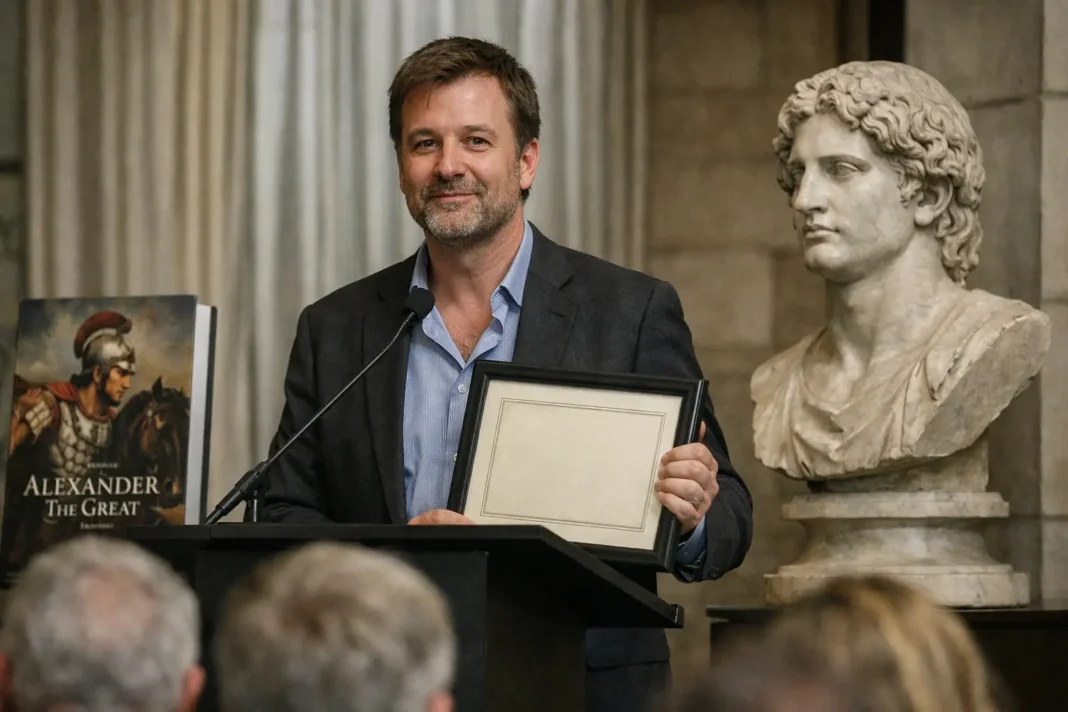

Alexander’s afterlife has gained fresh literary force with Edmund Richardson winning the £50,000 Baillie Gifford Prize for nonfiction for a new biography of Alexander the Great. The award places an ancient ruler, whose campaigns reshaped the known world more than two millennia ago, at the centre of a contemporary conversation about ambition, violence and the limits of command.
The choice is striking because Alexander’s story is often reduced to military brilliance and imperial reach. Richardson’s work returns attention to the cost of that ascent: a short, turbulent life, an empire pushed outward through repeated conflict, and a legacy that has remained contested since antiquity. Even the transmission of that life belongs to a brutal historical landscape, with Alexander’s first biographer remembered for having met a violent end. The result is not simply a portrait of conquest, but a study of how power narrates itself and how fragile those narratives can be.
Richardson, a professor of classics, has framed Alexander as a figure whose relevance is not confined to ancient history. His public remarks around the prize have stressed that wealth, authority and military success do not remove human limits. That perspective gives the biography a wider resonance at a time when political dominance, personal rule and public accountability remain central themes in global debate. The book’s success also underlines the continuing strength of nonfiction that connects deep historical research with questions still visible in modern public life.
For the Baillie Gifford Prize, one of the most prominent awards in English-language nonfiction, the win reinforces a recurring pattern: works rooted in scholarship can reach broad audiences when they illuminate current anxieties without forcing direct parallels. Alexander remains a familiar name, but Richardson’s recognition suggests that readers are still drawn to histories that complicate fame rather than merely celebrate it. In that sense, the prize does more than honour a biography; it renews attention to the enduring consequences of lives driven by conquest, charisma and unchecked ambition.