

A Mars mission is no longer discussed only as an engineering challenge. It is also a medical and human test whose risks remain difficult to measure. Interest in sending people to Mars continues to grow, but evidence from space medicine keeps underlining how hostile long-duration travel may be for the body, from exposure to cosmic radiation to the effects of microgravity on bones, muscles and other systems.
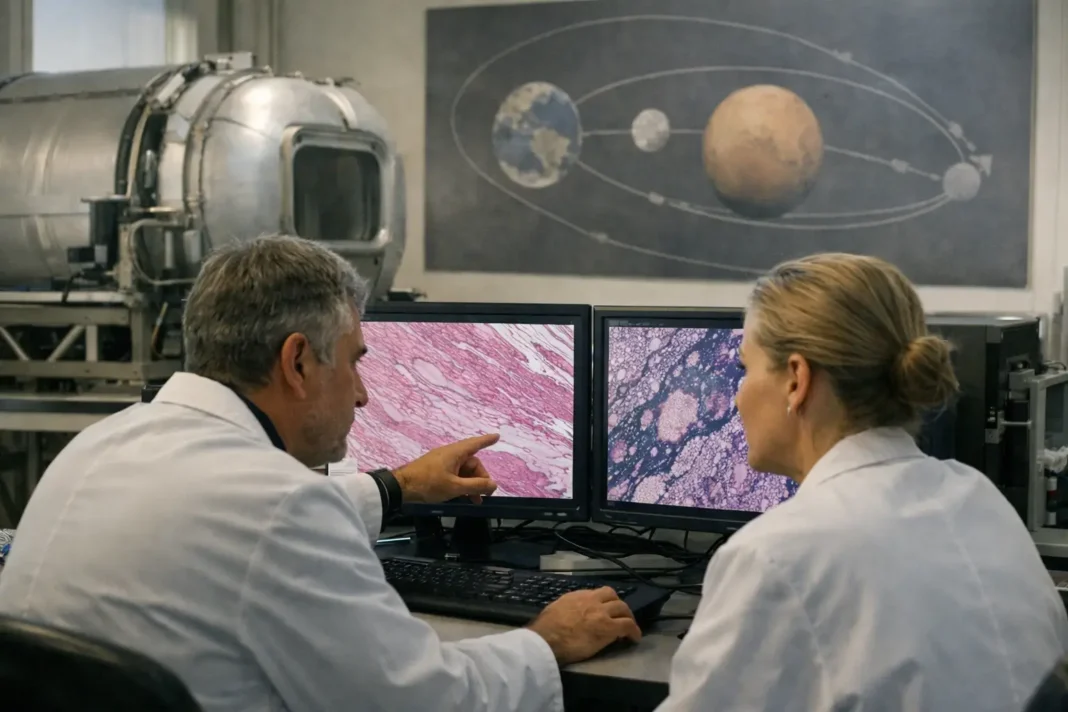
A recent study published in PLOS ONE added another concern. Rats exposed to radiation meant to resemble what astronauts could encounter during a journey to the Red Planet developed more scar tissue around small blood vessels in the heart than animals in a control group. The results have not been confirmed in humans, and animal findings cannot be directly transferred to crewed missions. Even so, the work contributes to a wider body of research examining how deep-space conditions may affect astronauts far beyond low Earth orbit.
The public response illustrates the tension between exploration and caution. In a reader poll conducted by Live Science, more than 240 participants answered a question about whether they would go to Mars despite potential health dangers. Sixty-five percent chose not to, saying the risks did not appear worth taking. That result points to a clear hesitation among readers when the idea of interplanetary travel is framed not as science fiction, but as a journey involving possible lasting harm, uncertain recovery and limited medical support.
The comments attached to the poll showed a less uniform picture. Some readers argued that exploration has always required people willing to accept danger, and that the more difficult decision would be choosing who should go. Others questioned whether human missions are the best use of resources, noting that robotic probes can survey planets, moons and other parts of the solar system without exposing crews to radiation, isolation or irreversible health consequences. This debate is central to modern space exploration: human presence can inspire and enable certain kinds of research, but robotic missions remain cheaper, safer and highly productive.
Beyond biology and cost, the discussion also raised the emotional burden of leaving Earth for a hostile environment. The prospect of confinement, distance from nature and prolonged uncertainty can be as significant as the physical hazards. The latest findings do not close the door on Mars travel, but they reinforce a practical reality for agencies and mission designers: before humans can safely make the journey, space health must become as central to planning as rockets, habitats and landing systems.





