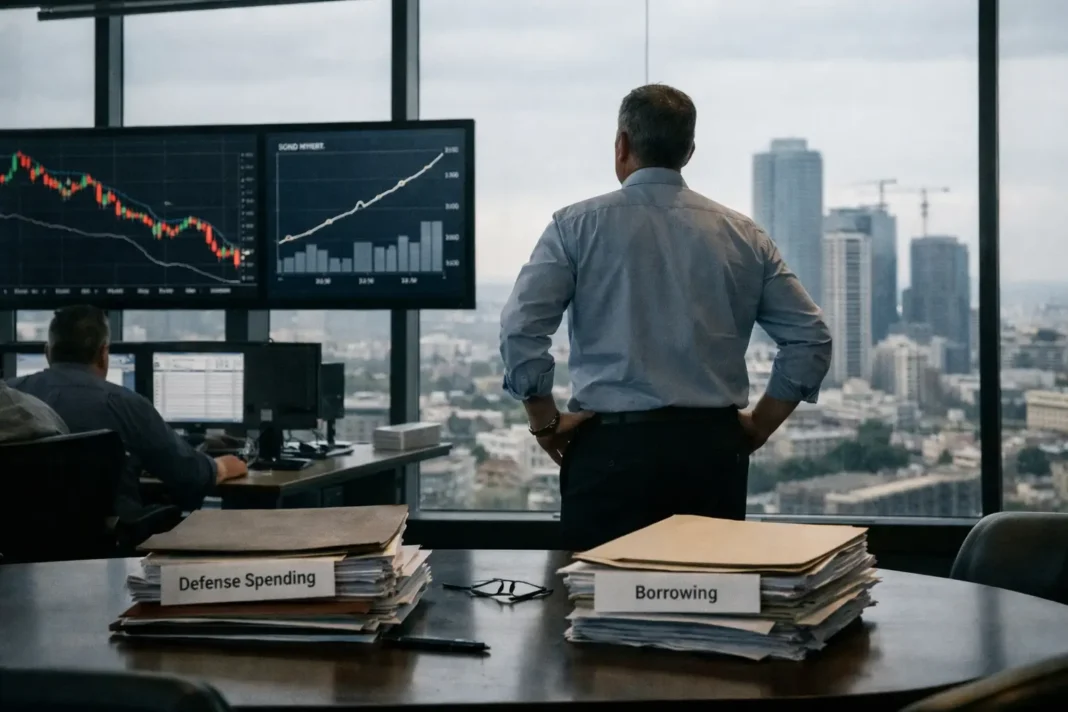

Israel’s headline indicators still suggest an economy able to absorb severe pressure. Shares have remained robust and the currency has appreciated, signals that can give the impression of financial confidence. Yet those market measures do not capture the full impact of three years of war on Israel’s productive base, public finances and investment climate.
The central strain lies in the shift from financial resilience to fiscal burden. Defence spending has risen sharply, requiring the state to allocate more resources to security and military needs. At the same time, government borrowing has increased, adding pressure to budgets that must also sustain civilian services and long-term economic commitments. Institutions such as the Ministry of Finance and the Bank of Israel remain central to how that balance is managed.
The more damaging signs are emerging beyond the trading floors. Falling output points to weaker economic activity, while reduced investment suggests that companies and households are holding back in the face of uncertainty. Investment is especially important because it shapes future capacity: when firms delay expansion, technology upgrades or hiring, the effects can persist well after immediate military spending begins to slow. That dynamic helps explain why a strong market performance can coexist with the risk of a prolonged recession.
War-related spending can temporarily lift parts of the economy, particularly sectors linked to defence procurement and public contracts. But it also redirects capital and labour away from civilian production, exposes the budget to higher financing needs and complicates planning for private investors. The result is a divided economic picture: financial assets may reflect confidence in institutions and liquidity, while the real economy absorbs costs through weaker output, lower investment and a heavier public financing burden.
The longer the conflict’s economic effects continue, the harder it becomes to separate short-term market strength from structural pressure. For Israel, the key issue is not whether markets can remain buoyant, but whether growth, investment and public finances can recover enough to prevent war costs from becoming a lasting drag. The contrast between appreciating financial indicators and deteriorating real-economy measures is now the clearest sign of that challenge.