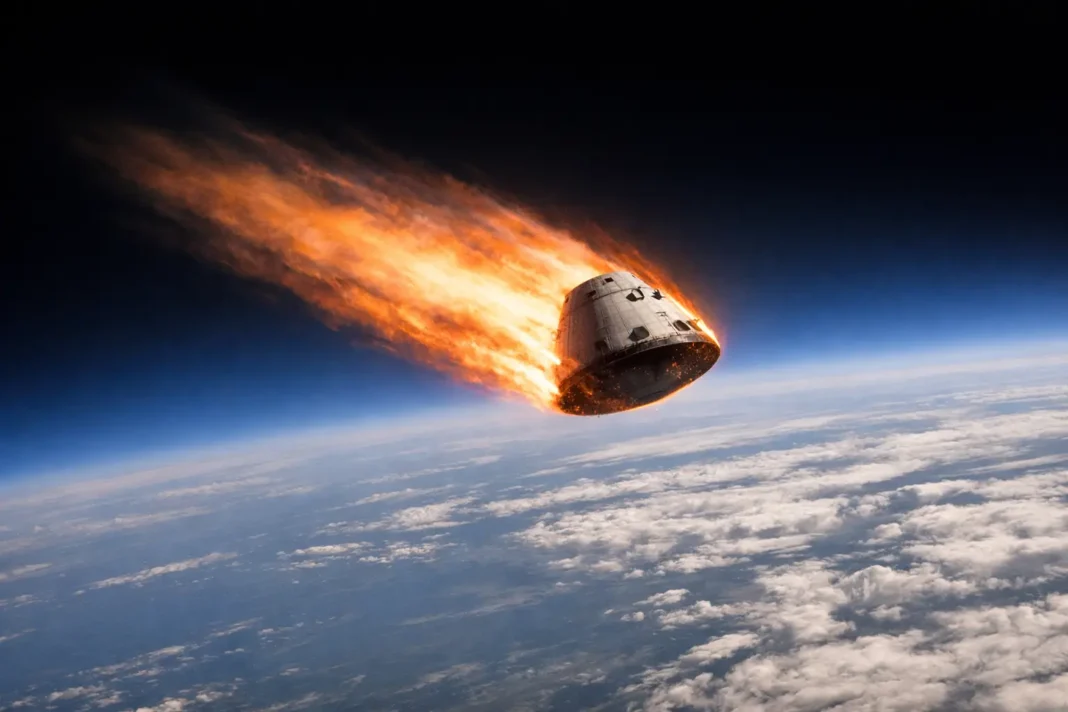

After nine days beyond Earth, the crew of Artemis II faced the decisive test of the mission: bringing the Orion capsule safely through the atmosphere and into the Pacific Ocean. The April 10, 2026 splashdown closed the first crewed journey to the Moon in more than half a century, a flight led by NASA with participation from the Canadian Space Agency. For mission specialist Jeremy Hansen, the only Canadian on board, the return was not an afterthought to the lunar flyby. It was the moment when engineering, training and risk converged at extreme speed.
Hansen recounts the descent in Earthrise: Inside Artemis II, the Groundbreaking Human Mission into Deep Space, written with John Larsen and published by Hanover Square Press. Before splashdown, the crew had travelled more than 250,000 miles, or about 400,000 kilometres, from Earth. The Orion spacecraft then began its final sequence: separating from the European Service Module, adjusting its trajectory with a short burn and entering the atmosphere at roughly 24,600 mph, or 39,600 km/h. Hansen describes a violent but expected environment, with plasma outside the windows, rising g-forces and a temporary loss of communications with Mission Control.
The episode underlines why re-entry remains one of the most critical phases of space exploration. Orion’s heat shield had to protect the crew from temperatures above 2,500°C as the spacecraft shed the enormous velocity gained during the outbound mission. Inside the capsule, the astronauts endured forces approaching four times normal gravity before communications were restored. Hansen’s account also gives the event a human dimension: while he trusted the spacecraft and the preparation, he was conscious that his wife and children were watching from Earth as the mission entered its highest-risk phase.
The danger did not end when the capsule emerged from the hottest part of descent. The parachute sequence still had to slow Orion from a high-speed fall to a survivable ocean landing. Drogue chutes deployed at about 7,100 metres, followed by the three main parachutes at roughly 1,500 metres above the Pacific. Their successful opening reduced the capsule’s speed to about 27 km/h before splashdown. All four crew members were recovered in good health, confirming a central objective for NASA, the Canadian Space Agency and the wider Artemis programme.
Beyond its dramatic detail, Hansen’s testimony captures the operational importance of Artemis II. The mission tested crewed deep-space procedures, Orion’s life-support systems and the full return profile needed for future lunar flights. Its successful splashdown strengthened the technical foundation for the next stages of the programme, which are intended to extend human activity around and eventually on the Moon. Hansen’s recollection makes clear that, even after a landmark journey through deep space, the final minutes back to Earth can be among the most consequential of all.