
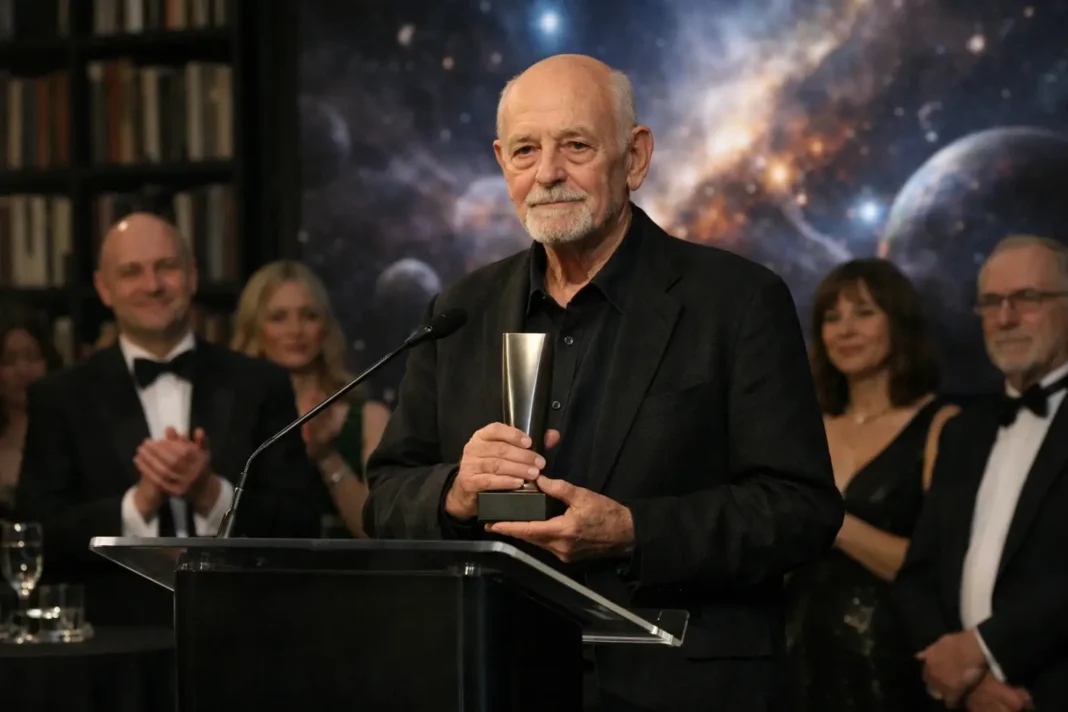

M John Harrison has entered a new chapter in an already formidable career, becoming the oldest writer to win the Booker Prize for fiction. The 81-year-old author was honoured for his 13th novel, The End of Everything, an apocalyptic work set on the Kent coast and centred on the unsettling arrival of non-human intelligence.
The award carries significance beyond one author’s late-career recognition. The End of Everything is described as the first science fiction novel to win the prize in its 58-year history, making the decision a notable moment for a field often treated as separate from the literary mainstream. Harrison, long regarded as a major figure in speculative writing, has consistently resisted such boundaries, arguing that genre labels can narrow the way readers and critics approach fiction.
That tension has followed much of his career. While admired by writers and dedicated readers of ambitious books, Harrison has often occupied a space between literary experiment and speculative imagination. His latest novel appears to have changed that balance, bringing his work to a broader audience while also challenging an old hierarchy in which science fiction has frequently been viewed as less serious than realist fiction.
The novel’s premise gives the prize a contemporary resonance. By focusing on a world destabilised by non-human intelligence, The End of Everything arrives at a time when questions about technology, consciousness and human control have moved from specialist debate into everyday life. Its setting on the Kent coast grounds the catastrophe in a recognisable landscape, turning a vast theme into a story with a distinctly local atmosphere.
For literature, the result may prove as important as it is symbolic. The Booker has often shaped reading lists, publishing priorities and international attention. By honouring M John Harrison, the prize has not simply recognised an individual novel; it has also acknowledged that speculative fiction can address the deepest anxieties of the present without surrendering literary ambition.






