HomeScienceVitamin C Model Points to a Possible Way to Limit Risky Stomach...

Vitamin C Model Points to a Possible Way to Limit Risky Stomach Chemistry

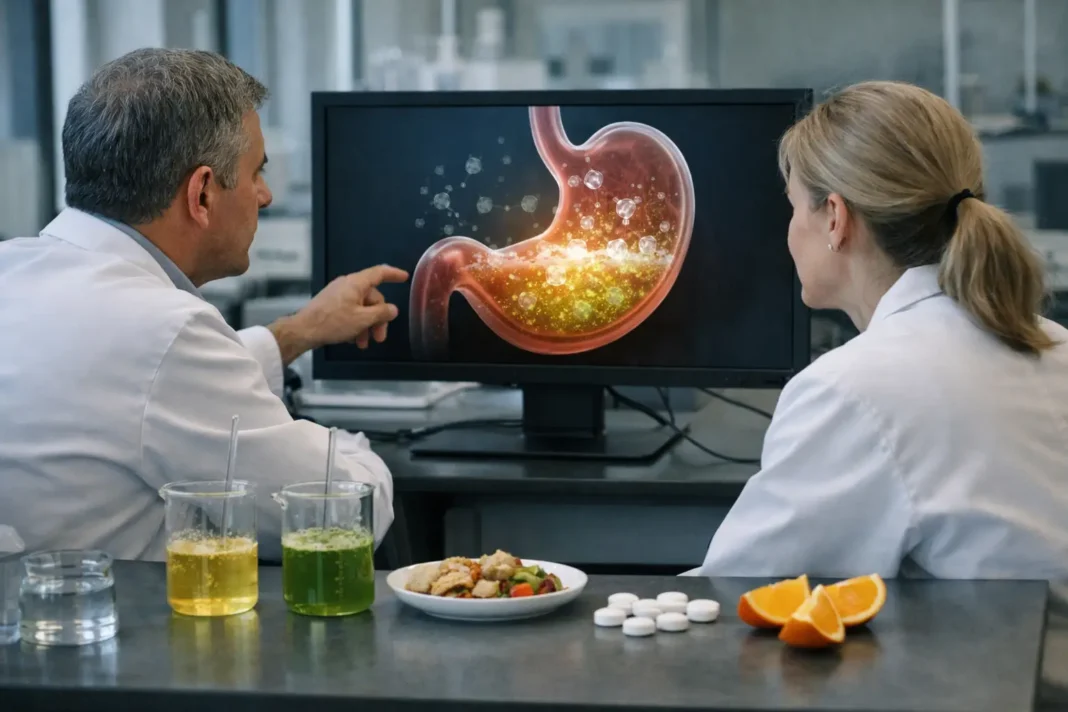
Vitamin C may help curb the formation of potentially harmful chemicals in the stomach after meals containing nitrates and nitrites, according to new scientific work based on a mathematical model. The finding points to a possible dietary strategy for reducing chemical reactions associated with cancer risk, while also underlining how much remains to be evaluated before practical health guidance can be defined.

The study focuses on what happens after foods containing nitrates or nitrites enter the stomach. These compounds are found in a range of foods and are also used in some processed products, particularly where preservation and color stability are important. Under acidic conditions, they can participate in reactions that produce N-nitroso compounds, a chemical family that has drawn attention because some members have been linked to cancer. The new model suggests that taking vitamin C after eating could reduce the likelihood of those reactions occurring.

The relevance of the work lies in its attempt to describe stomach chemistry with greater precision. Rather than testing a broad dietary pattern, the researchers used mathematical modelling to examine how vitamin C might interfere with chemical pathways triggered after a meal. Such models can help scientists identify mechanisms and refine future experiments, but they do not by themselves establish clinical outcomes. The result is therefore best understood as a step toward a clearer understanding of risk reduction, not as proof that a supplement prevents cancer.

Public health agencies already treat diet-related cancer risks as a complex field shaped by food composition, processing, overall eating habits and individual biology. The National Cancer Institute provides information on cancer prevention that emphasizes multiple risk factors rather than isolated nutrients, while the World Health Organization has long highlighted the importance of balanced diets in reducing noncommunicable disease risks. The new findings add a specific biochemical angle to that wider discussion on food safety and nutrition.

For consumers, the immediate takeaway is measured. The model suggests that vitamin C intake after meals containing nitrates and nitrites could limit the formation of certain undesirable compounds in the stomach, but it does not define an optimal dose, timing, or population-level recommendation. Further laboratory, dietary and clinical research would be needed to determine whether the predicted effect translates into a meaningful reduction in disease risk. Until then, the work strengthens scientific interest in how everyday nutrients can influence chemical processes that occur during digestion.


Advertisementspot_imgspot_img

Hot this week

Mexico’s Left Holds Its Ground as Latin America Tilts Right

Morena’s resilience in Mexico rests on redistribution, security messaging and pragmatic compromise amid a regional conservative shift.

Schools Weigh David Walliams Books as Allegations Prompt Library Reviews

Schools, libraries and parents face choices over David Walliams books after allegations led some institutions to remove titles.

Spain clash offers Tuchel a clear test of England’s lessons

England’s match against world champions Spain will show how far Thomas Tuchel has moved the team on from summer disappointment.

Zelensky Presses Washington and Musk Over Starlink Limits as Ukraine Faces Russian Strikes

Ukraine’s president says slower Starlink service hampers efforts to counter Russian attacks, urging the US and Elon Musk to act.

Fossil CO2 Is Set for a Rare Fall, but the Climate Ledger Still Worsens

A new Global Carbon Budget projects a 0.4% decline in fossil CO2 emissions, but total carbon output may still hit a record.

Voyager 1 Reaches a Light-Day From Earth, Extending Humanity’s Longest Journey

NASA’s Voyager 1 is set to reach one light-day from Earth, marking a symbolic milestone for the longest-running deep-space mission.

Sponge Test May Broaden Access to Cancer Checks for Persistent Indigestion

A capsule sponge test could allow more people with severe indigestion to be assessed in GP surgeries without hospital endoscopy.

Britain Seeks a Say, Not a Vote, in EU Food Rules Reset

Hamish Falconer says Britain would have influence, but no vote, over EU food rules under a new Brexit reset deal.

Zelensky Presses Washington and Musk Over Starlink Limits as Ukraine Faces Russian Strikes

Ukraine’s president says slower Starlink service hampers efforts to counter Russian attacks, urging the US and Elon Musk to act.

England’s Spain Statement Marries Control and Survival

England’s away win in Spain gave Thomas Tuchel his strongest statement yet, mixing an hour of control with a tense final spell.

Burnham Puts Youth Joblessness at the Centre of Welfare Debate

Andy Burnham links welfare reform and early intervention to the UK’s youth jobs crisis, with one million young people classed as Neet.

Seeded Players Fall as Beau Greaves Also Exits Grand Slam of Darts

Four seeded players exit the Grand Slam of Darts, while Beau Greaves is also eliminated despite winning on Sunday.

Grand Theft Auto VI Brings Rockstar’s Vast Crime Saga Back to Vice City

Rockstar’s GTA VI shifts the crime saga to Vice City, underlining the scale and cultural weight of one of gaming’s biggest projects.
Advertisementspot_img

Related Articles
