
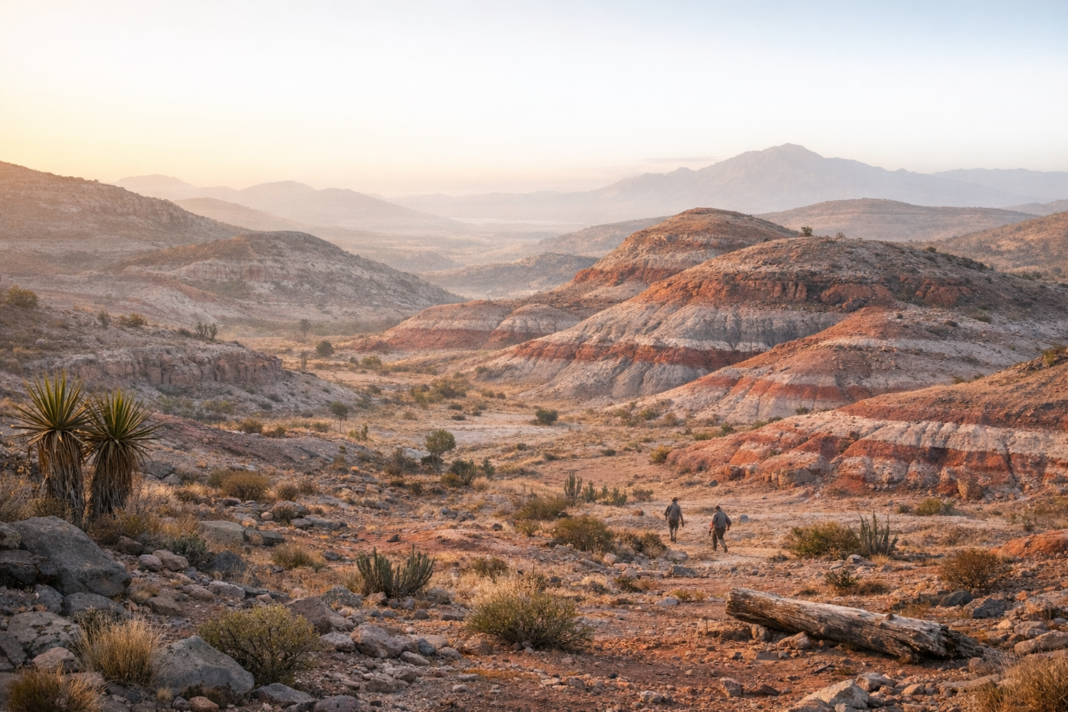

A 22-million-year-old eruption from the Lauca Caldera preserved a buried landscape that offers a rare window into how the Andes looked in their youth. Researchers examined a thick sheet of ignimbrite — the compacted deposit left by a sweeping pyroclastic flow — and used its geometry and patterns of river incision to infer the shape of the surface that lay beneath the volcanic blanket. The study reconstructs rolling foothills rather than steep peaks, indicating the mountain range was still in an early, gentle stage of uplift when the eruption occurred.
The team measured the original flow slope of the ignimbrite at about 1.5 degrees and analysed downstream incision by rivers such as the Lluta to estimate how much erosion and rock uplift have altered the buried terrain since deposition. Using those constraints, they calculated a regional uplift rate of roughly 0.16 mile (0.26 kilometre) per million years for the interval preserved beneath the deposit. The results are presented in a paper published on Sept. 11 in Science Advances, which outlines the techniques used to translate the shape of volcanic blankets into reconstructions of ancient landscapes.
Byron Adams, a geomorphologist who contributed to the research at University College London, emphasised that large volcanic deposits can act like time capsules, preserving the topology of a vanished surface. The study addresses a long-standing debate about Andean growth, offering evidence for a slow-and-steady uplift across a significant portion of the range’s middle history rather than a model dominated by very recent rapid rise. The approach complements mineral-based thermochronology previously used to date rock exhumation.
The authors note that the method can be applied beyond northern Chile and the Andes, providing a potential tool to reveal hidden stages of mountain-building in other orogens where extensive volcanic deposits have covered earlier topography. By combining deposit geometry, river incision, and erosion modelling, the work connects volcanic events to broader tectonic processes driven by the subduction of the Nazca Plate, improving our ability to read preserved snapshots of Earth’s evolving surface.







