
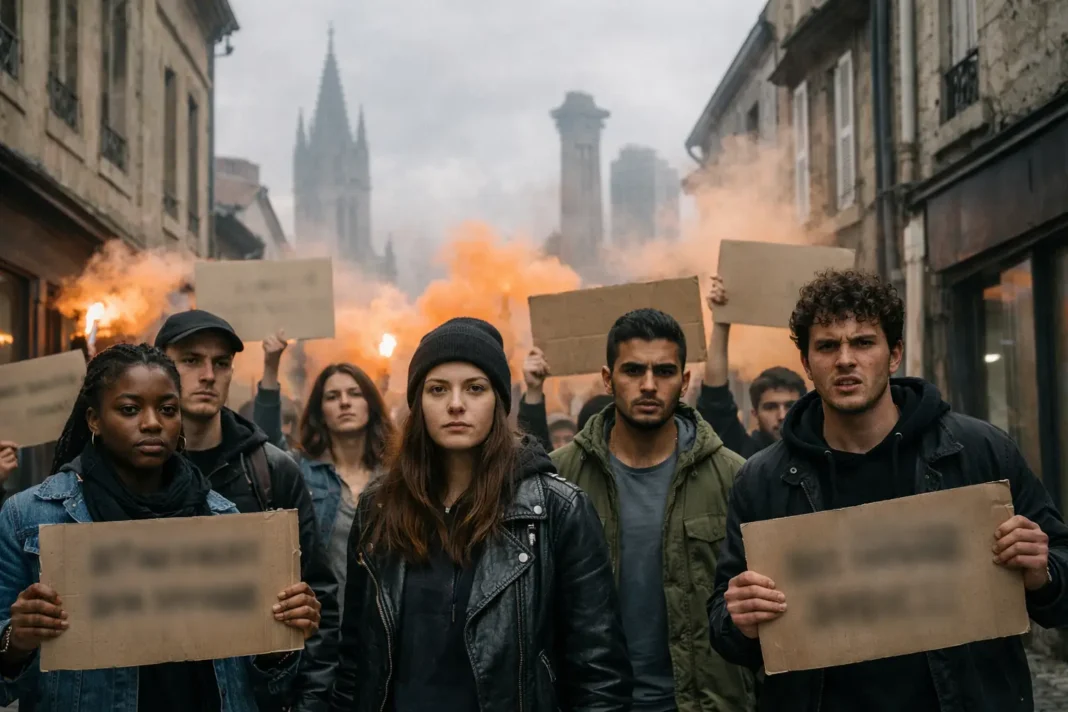

Images of flames at the Limoges town hall have circulated widely since the recent disturbances, becoming a touchstone for competing explanations about unrest in France and beyond. The photograph of a municipal building ablaze crystallises public attention, but it does not by itself explain why students and young people took to the streets in different places, nor what demands animate those protests.
Responses to the scenes vary sharply. Some commentators have presented the events as evidence of a single, pan-European youth revolt sweeping through Europe. That interpretation treats disparate mobilisations—from school strikes to demonstrations over living costs and social protections—as parts of one uniform crisis, rather than as locally rooted episodes shaped by national politics, institutional responses and specific policy grievances.
Certain external actors and high-profile figures have seized on the unrest to bolster broader narratives. Donald Trump and Vladimir Putin have framed the turmoil in terms of migration, identity and the decline of Western institutions, while the Mayor of Limoges attributed the municipal fire to the involvement of the ultra-left. These reframings repurpose images of disorder to support strategic arguments about borders, governance and cultural change.
Conflating distinct protests into a single continental phenomenon risks obscuring the issues that drove people to the streets—such as educational policy, economic pressures and social-security concerns—and can complicate effective policy responses. Treating local unrest primarily as proof of systemic collapse may also amplify polarisation and provide fodder for external narratives that prioritise geopolitical advantage over constructive engagement with demonstrators’ demands.
Policymakers and media outlets face a dual task: address the concrete grievances prompting protests, and avoid simplifying imagery into sweeping explanations that do not fit the facts on the ground. Close listening to demonstrators, clear communication about measures under consideration, and targeted responses adapted to national contexts are necessary steps to move from spectacle to solution.






