
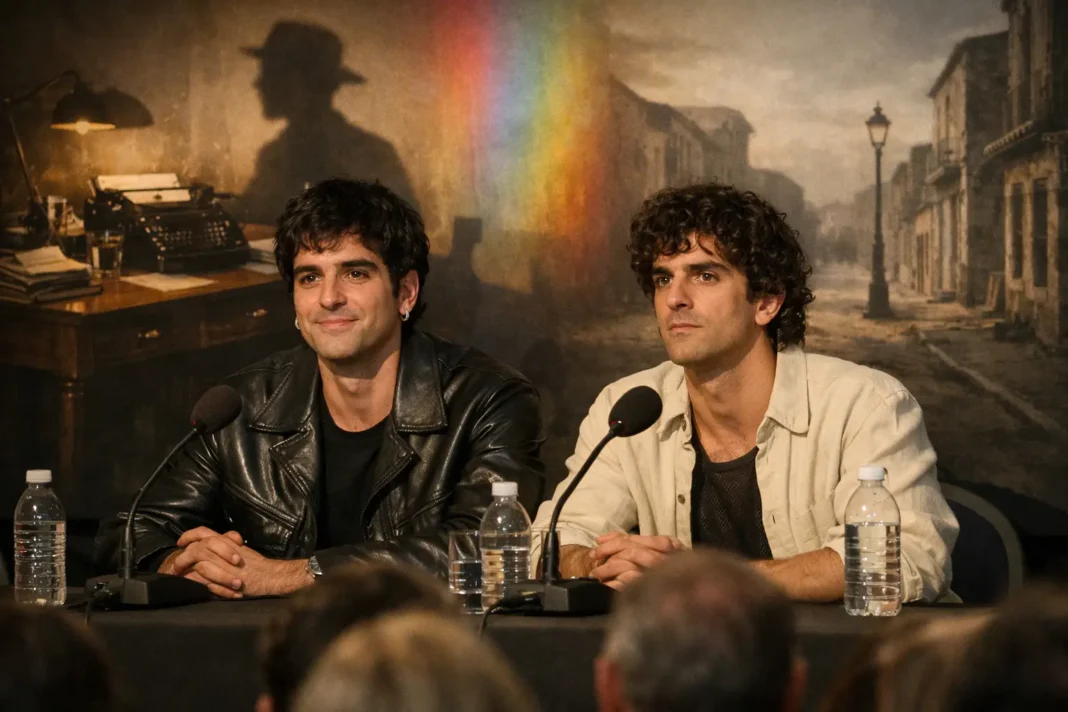

La Bola Negra arrives with the confidence of a film designed to look far beyond the margins. The new work by Spanish directing duo Javier Ambrossi and Javier Calvo, widely known in Spain as Los Javis, has become one of the most visible titles in this year’s international awards conversation. With Penélope Cruz appearing in a blond wig and Glenn Close performing in Spanish, the film brings star power to a project that places queer experience at the centre of a broad historical canvas.
The film’s profile rose sharply at the Festival de Cannes, where Ambrossi and Calvo shared the best director prize with Paweł Pawlikowski for his Thomas Mann road movie Fatherland. That recognition has helped position La Bola Negra as a serious contender ahead of the Academy Awards, particularly in the major categories. Its emergence also underlines the growing space for ambitious queer cinema within the most competitive areas of international film culture.
Rather than treating LGBTQ+ lives as a small-scale subject, the film expands them into a multi-period drama about prejudice, conflict and memory. Its narrative moves between three moments in Spain: 1932, when a young man is denied access to an exclusive casino because of suspicions about his sexuality; 1937, during the Spanish conflict, when a nationalist soldier develops feelings for a wounded republican prisoner; and 2017, when a queer historian receives an unfinished story by Federico García Lorca. That inherited text gives the film its title and connects its separate timelines.
The presence of Lorca is central to the film’s cultural weight. His name evokes a history in which art, political violence and sexual identity cannot be easily separated, and La Bola Negra uses that legacy as a bridge between private desire and public repression. Ambrossi has described the project as a deliberate move away from the idea that LGBTQ+ stories must remain niche, and the film’s scale reflects that ambition. It is framed not as a specialized drama but as a sweeping work about how societies police identity across generations.
For Los Javis, who have built a reputation in Spain through work that mixes pop sensibility, emotional directness and queer themes, La Bola Negra represents a significant escalation in scope. Its blend of war story, historical inquiry and maximalist visual style gives it an unusual place in the current awards season. Whether or not its momentum continues through Oscar night, the film has already shifted the conversation around what a large-scale prestige drama centred on queer lives can look like.





