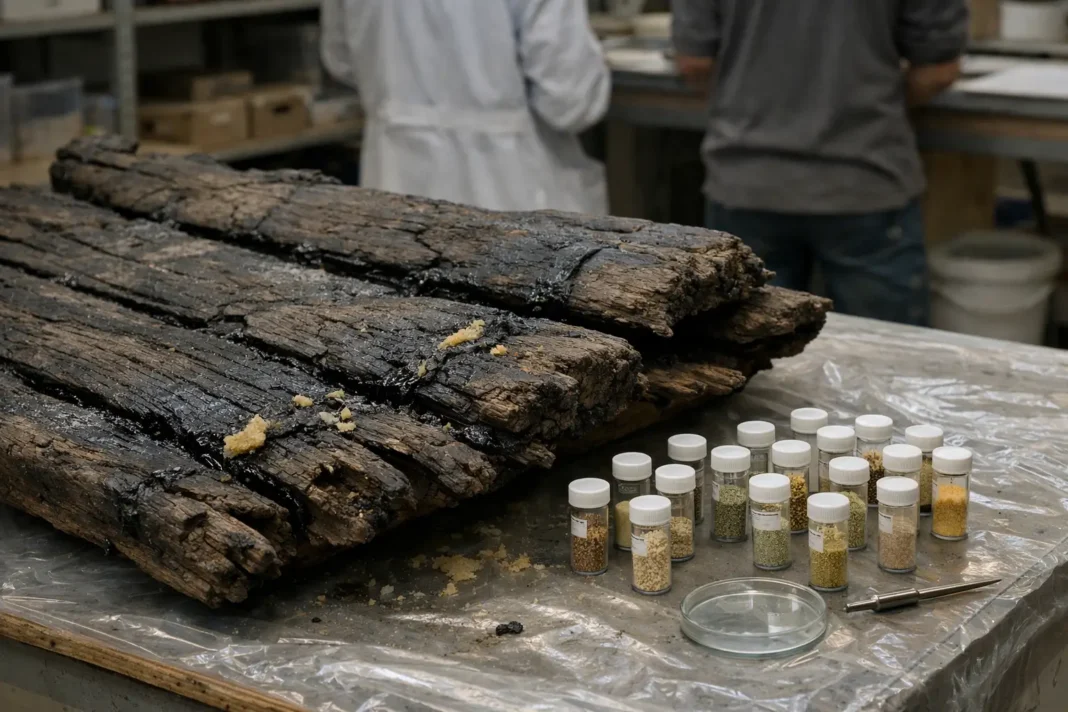

A Roman shipwreck dating back roughly 2,200 years has offered a rare look at the practical technologies that helped ancient vessels survive repeated exposure to seawater. The discovery centers on traces of pine tar and beeswax used as waterproofing materials, a combination that points to a deliberate and technically informed approach to protecting wooden hulls. For researchers studying archaeology and maritime history, the find adds physical evidence to a long-standing understanding that ancient shipbuilding depended not only on carpentry but also on chemical treatments designed to slow decay and leakage.
The coating preserved on the wreck is especially valuable because it does more than reveal a maintenance technique. Microscopic pollen grains became trapped inside the ancient sealant, creating a kind of environmental record embedded in the hull’s protective layer. Those traces can help scientists assess where the vessel may have sailed or where repairs were carried out, since pollen can reflect plants present in particular landscapes. In this case, the material evidence connects the ship not simply to construction methods, but to movement, upkeep and the practical demands of navigation more than two millennia ago.
Pine tar and beeswax would have served complementary purposes. Tar derived from pine is sticky, water-resistant and durable, while beeswax can create a sealing layer that helps repel moisture. Their use together suggests an effort to improve protection against the marine environment, where saltwater, microorganisms and constant wetting posed serious risks to wooden structures. The remains of the coating therefore provide a direct clue to the everyday engineering behind Ancient Rome’s maritime activity, a field often reconstructed through cargoes, anchors, amphorae and harbor remains rather than surviving traces of surface treatments.
The significance of the wreck lies in the combination of craftsmanship and microscopic evidence. A Roman shipwreck can preserve information that written sources rarely recorded: when a hull was patched, what substances were applied, and how a vessel was kept working over time. Pollen analysis adds another layer, allowing researchers to compare biological residues with ancient environments and possible repair locations. That does not produce a complete itinerary on its own, but it gives scholars a more precise set of clues than the ship’s structure alone could provide.
Finds of this kind underline how modern scientific methods are reshaping the study of ancient transport. Materials once seen mainly as residue are now examined as archives of technology, environment and human decision-making. The waterproofing on this 2,200-year-old wreck shows that Roman maritime practice relied on adaptable solutions and regular maintenance, not only on large-scale shipbuilding skill. In the small particles preserved in tar and wax, researchers are finding evidence of routes, repairs and the practical intelligence that kept ancient ships at sea.