HomeOpinionBig Tech’s Trump Bet Meets a Local Backlash Over AI Infrastructure

Big Tech’s Trump Bet Meets a Local Backlash Over AI Infrastructure

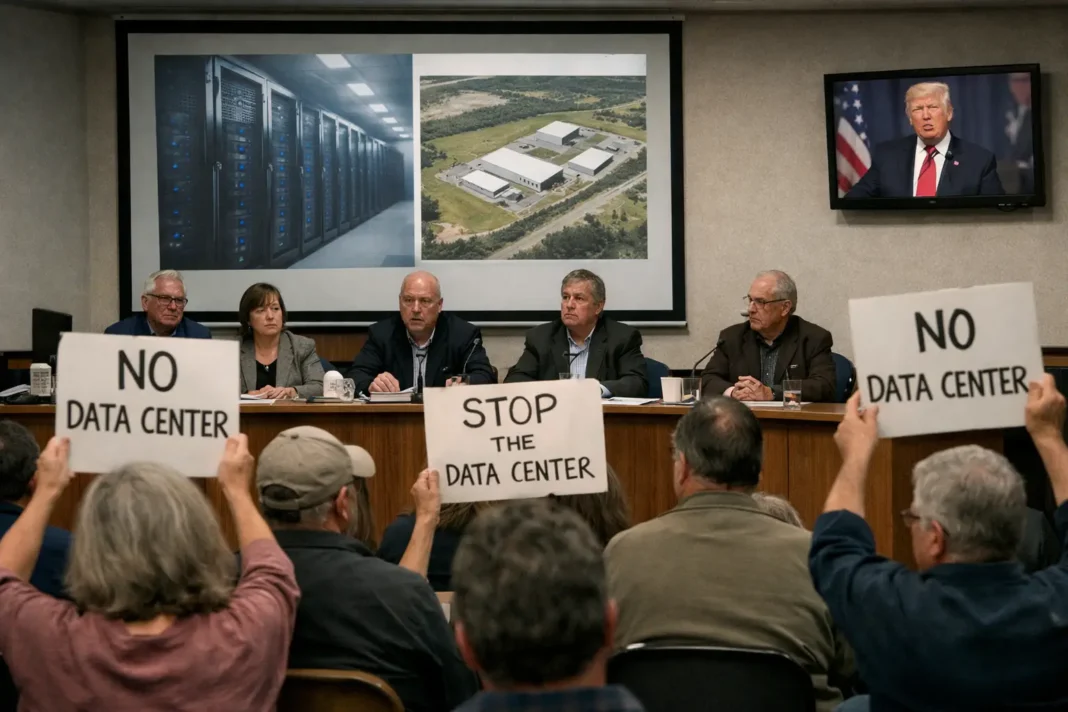
Big Tech’s political wager on Donald Trump is facing a more complicated reality than many of its most powerful executives appeared to expect. After a highly visible White House gathering centred on artificial intelligence, recent Democratic wins on anti-data-centre platforms have highlighted a growing gap between the industry’s ambitions and voter concerns over the physical footprint of the AI boom.

The meeting, hosted at the White House, brought together leading technology figures, including Elon Musk and Jensen Huang, chief executive of Nvidia. The gathering projected confidence in a future shaped by rapid advances in artificial intelligence, with industry leaders seeking a political environment more favourable to large-scale development and less constrained by regulation. That public alignment with Trump now looks less secure as electoral resistance emerges around one of AI’s essential foundations: data centres.

The backlash matters because data centres are no longer a peripheral planning issue. They have become central to the expansion of AI services, cloud computing and chip demand, while also attracting scrutiny from communities concerned about land use, energy needs and local control. Democratic candidates who campaigned against data-centre projects turned those concerns into winning messages, suggesting that opposition to parts of the AI buildout can translate into votes rather than remaining a niche local grievance.

For Musk, the political setback carries an additional financial dimension. His efforts in support of the Trump-aligned project are described as having cost nearly half a billion dollars, a striking sum even by the standards of ultra-wealthy technology entrepreneurs. The outcome underlines the limits of money and access when a national technology agenda collides with local political resistance. It also complicates the assumption that proximity to power in Washington can guarantee public consent for infrastructure tied to the AI economy.

The technology sector is unlikely to retreat quietly. Its leading companies remain deeply invested in AI, semiconductors and cloud infrastructure, and they continue to command extraordinary financial and political resources. But the results point to a changed environment: support for innovation does not automatically translate into support for every project built in its name. The next phase of Big Tech’s strategy will have to contend not only with regulators and national politicians, but with voters deciding whether the costs of the AI race should be carried in their own communities.


Advertisementspot_imgspot_img

Hot this week

Monty Don Closes a Defining Chapter at Gardeners’ World

Monty Don has signed off from Longmeadow, ending a two-decade era on the BBC’s long-running Gardeners’ World.

Castle Cove Leads the Storyline as November Handicap Headlines a Busy Saturday

Castle Cove seeks another November Handicap success as Saturday racing spans Doncaster, Southwell and Uttoxeter on Sky Sports Racing.

Istanbul turns against Liverpool as Fenerbahce seize the moment

Liverpool's Istanbul visit ended in defeat to Fenerbahce, with Andoni Iraola pointing to cheap, messy goals and Dirk Kuyt celebrating a miracle.

Russell Brand Conviction Puts Consent at the Centre of a High-Profile Court Ruling

Russell Brand has been convicted of rape and sexual assault in a case that reinforces the legal meaning of consent.

Commons Speaker Presses for Action as Parliament Restoration Delays Mount

Sir Lindsay Hoyle calls for action on Parliament restoration after a committee warns it is crunch time for the ageing Westminster estate.

Fossil CO2 Is Set for a Rare Fall, but the Climate Ledger Still Worsens

A new Global Carbon Budget projects a 0.4% decline in fossil CO2 emissions, but total carbon output may still hit a record.

Why Love Languages Still Shape Modern Dating Talk

Love languages have no scientific origin, yet they remain common in dating culture as a simple way to discuss needs and affection.

Fahnbulleh Puts Energy Bills at the Centre of Climate Policy

Fahnbulleh says cutting energy costs is essential to keeping public support for climate action as affordability shapes the policy debate.

Trump Says FBI Is Examining Alleged Link Involving Nvidia Chief Jensen Huang

Donald Trump says the FBI is looking into an alleged affair involving Nvidia CEO Jensen Huang and a person described as a Chinese spy.

Manchester United Closes In on Carrick Exit After Historic Poor Start

Michael Carrick’s Manchester United tenure appears close to ending after the club’s worst domestic start in 40 years.

Russell Brand Receives 10-and-a-Half-Year Prison Sentence After Sexual Offences Trial

Russell Brand has been sentenced to 10 and a half years in prison after a four-week trial at Southwark Crown Court.

Carrick’s Manchester United Future Remains Unresolved as Club Weighs Next Step

Michael Carrick’s position at Manchester United is uncertain, with the club hierarchy still weighing his future and no final decision made.

Ryan Gander Turns Painting Into a Provocation

British conceptual artist Ryan Gander attacks painting, the YBAs and today’s art world while presenting a show filled with paintings.
Advertisementspot_img

Related Articles
