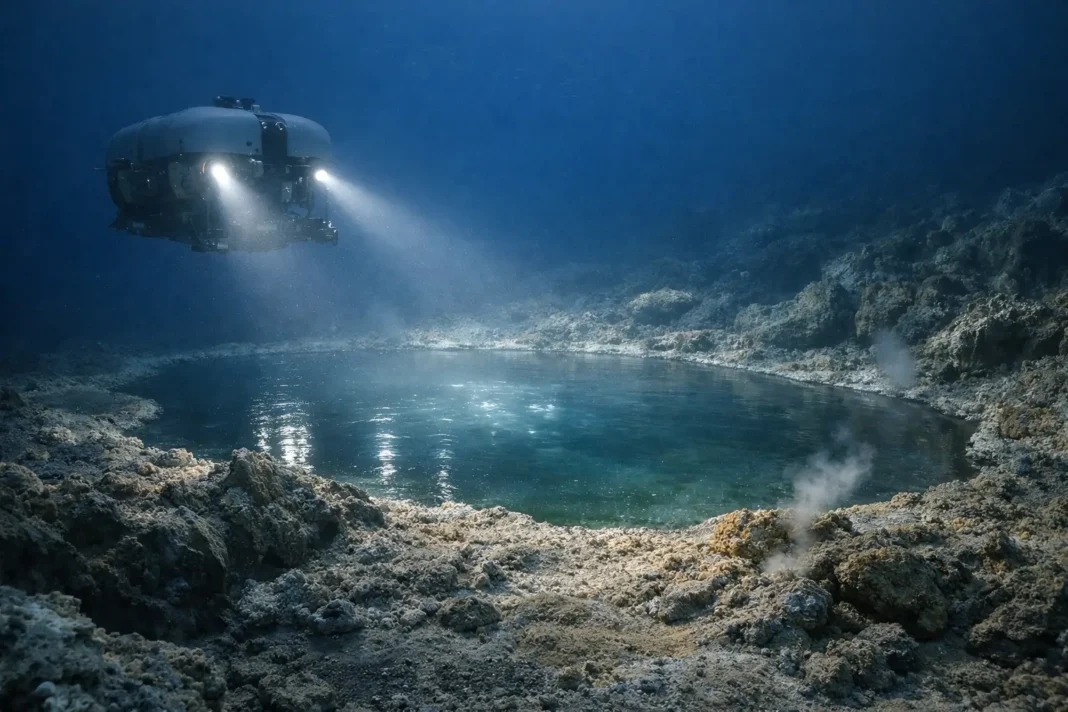

Far below the waves, scientists have identified rare underwater lakes more than a mile beneath the surface of the Red Sea, a discovery that adds to a small but important catalogue of extreme marine environments. These formations, known as brine pools, are bodies of exceptionally salty water that settle on the seafloor because their density keeps them separate from the surrounding sea. Their unusual chemistry makes them look less like ordinary marine habitats and more like natural laboratories for studying the limits of life.
The pools are oxygen-free and hostile by most biological standards, yet they are not lifeless. Microbial communities can persist in these hypersaline waters, showing that organisms are able to adapt to conditions once considered too severe for survival. That makes the discovery significant beyond the geography of the Red Sea: it offers researchers another setting in which to examine how life can endure without oxygen, under intense pressure and in chemical conditions radically different from those at the ocean surface.
Brine pools are especially valuable because they may preserve clues about ancient oceans. Environments with low oxygen and high salinity have parallels with conditions that may have existed on Earth early in its history, before complex life reshaped the planet’s atmosphere and seas. By studying the microbes living in these isolated basins, scientists can better understand the biological strategies that supported early life and the geochemical processes that shaped marine ecosystems over deep time.
The discovery also carries relevance for astrobiology, the field concerned with where life might exist beyond Earth. It does not provide evidence of alien life, but it strengthens the case for studying extreme habitats as analogues for environments on other worlds. If microorganisms can survive in dark, oxygen-free, hypersaline pools beneath the Red Sea, similar survival strategies may help guide the search for life in subsurface oceans or chemically harsh settings elsewhere in the solar system.