
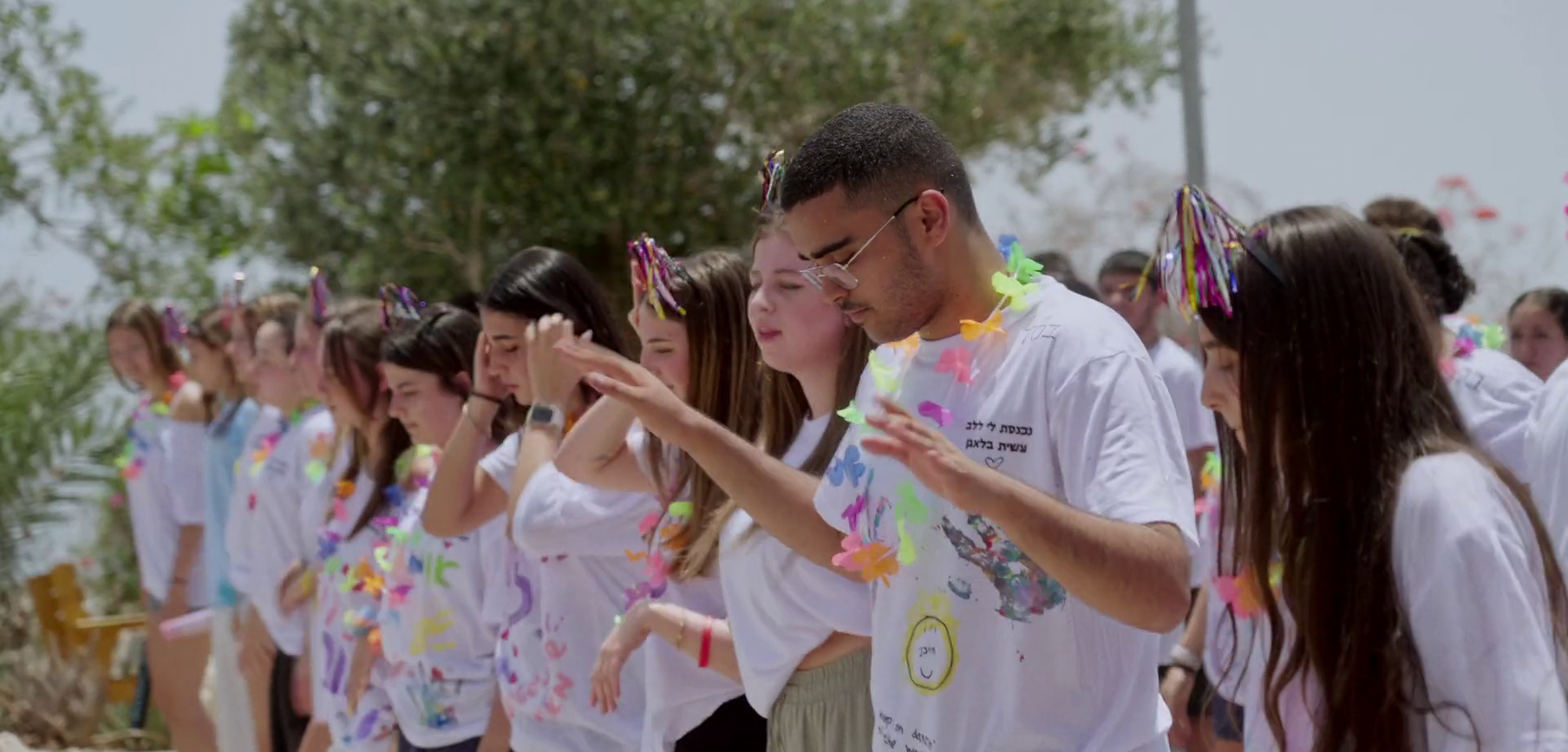

It was several weeks after the Hamas invasion of October 7, 2023, when documentary filmmaker Paz Schwartz heard about the surviving 12th graders from Nofei Habsor, the regional school in the southern Negev.
Her discovery of and gradual acquaintance with the graduating class that insisted on being together after the losses and traumas they experienced on October 7 became Schwartz’s latest documentary, “Always Together,” or “Mivhan Bagrut” in Hebrew, a play on words for the matriculation exams taken by high schoolers.
The 77-minute film shows the nine months in which Schwartz followed the 12th graders as they created a temporary boarding school for themselves in the Dead Sea region, where some of the southern communities were evacuated following the October 7 onslaught, in which some 1,200 people were killed and 251 people were abducted to the Gaza Strip.
In the film, Schwartz speaks at length with several students, discussing their losses, their lives in the Gaza envelope region, and what they hoped would emerge from their decision to band together as a grade and class.
Some of the Nofei Habsor students were killed in the massacre; others were orphaned or had siblings or grandparents killed, while others had loved ones who were taken hostage.
A total of 116 graduates from the school were killed, alongside 11 students in the high school and two teachers.
When she met the school’s principal, he told her, “It’s like the Yom Kippur War, but for kids,” said Schwartz.
The film unfolds as the students write a letter to Education Minister Yoav Kisch, requesting that they be allowed to learn together for their final year following the disaster that had befallen them.
At the time, the Education Ministry and other educational organizations were working overtime to create temporary schools in the various areas where residents of the south had been evacuated, in Eilat, the Dead Sea, Tel Aviv, Jerusalem and other regions.
“I smiled for the first time since October 7 when I read that letter,” said Schwartz. “It was the first act of leadership from these 17-year-olds. They knew they needed to be together; it was innovation in a moment of trauma.”
Schwartz described it as “a moment of oxygen” in the difficult days after the attack.
She was reeling from her own losses of October 7, as 15-year-old Lior Tarshansky, son of family friend Ilya Tarshansky, was murdered by terrorists in their Kibbutz Be’eri home, while Gali Tarshansky, his 13-year-old daughter, was taken hostage for 53 days before her release in November 2023.
A total of 101 people were killed in Kibbutz Be’eri, and 32 were taken hostage.

On October 5, Schwartz had just finished screening her latest film, “Telling Nonie,” at the Haifa Film Festival, winning the Best Israeli Documentary Film award for the film about an elderly former Mossad agent who reaches out to the daughter of a man he killed in a targeted assassination in Gaza decades ago.
She woke up late in the day on October 7 to the news about the Tarshanskys, as Ilya Tarshansky was evacuated to a hotel with the rest of the Beeri community.
“My husband was speaking with Ilya first in Be’eri, and then he was heading to the Dead Sea, alone without the kids,” said Schwartz. Tarshansky, a Russian-Israeli immigrant, was divorced from his children’s mother, Reuma Aroussi, a native of Be’eri.
Schwartz and her family had become his family in Israel.
“We would go to Be’eri all the time,” she said. “They burned his house, we could’ve been there for that holiday.”
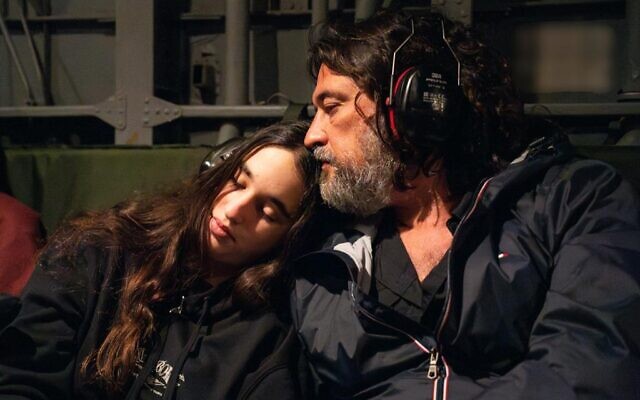
Schwartz said she was in shock for several weeks until she went to visit the Hostages Forum, the ad hoc organization that was put together in the first days after October 7 to support the hostage families. She bumped into a friend who told her to take her camera and go capture all of the stories.
“So I went to see Ilya in Ein Gedi, and I saw Lior’s friends, and that was when I first heard about the 12th-grade class,” said Schwartz.
Lior Tarshansky was a grade younger, said Schwartz, but friends with many of the 12th graders.
The members of the graduating class included Yuval Sharabi, whose boyfriend, Ofir Engel, and father, Yossi Sharabi, were taken hostage from Kibbutz Be’eri, as well as Amit Shani, also taken hostage with them.
One of their teachers was Liat Atzili, who was taken hostage from Kibbutz Nir Oz and released in November 2023, while her husband, Aviv Atzili, was killed defending the kibbutz, his body taken hostage and later released for burial.
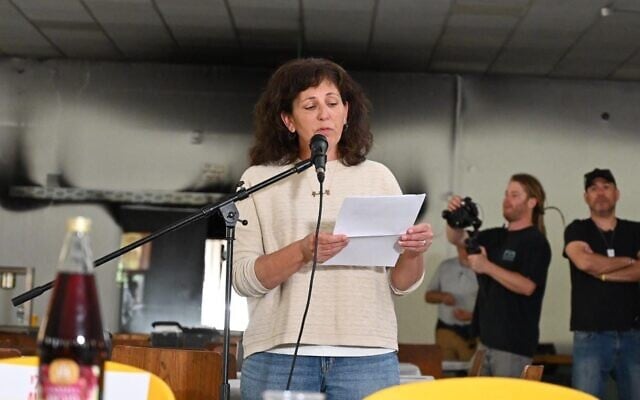
A total of 47 people were killed in Kibbutz Nir Oz, and 76 were taken hostage.
“It was amazing to see how these kids roused everyone, their principal, their teachers, their parents,” said Schwartz. “As the idea grew, they gained more power and it was amazing to see them come out stronger after those kinds of breaking points. That sense of belonging helped protect them from the trauma.”
Schwartz joined forces with her friend, producer Shula Spiegel, who was working on Apple+ drama series “Tehran,” and the two drove to Ein Gedi and the south to film the students.
Schwartz continued visiting with the class until their emotional graduation party and prom, held in the southern community of Omer, where she described seeing Yuval Sharabi in a prom dress, and Yaffa Adar, grandmother to one of the graduates, well-known as one of the released hostages who was kidnapped to Gaza on a kibbutz golf cart, covered in a flowered blanket.
By that point in the year, Schwartz knew she wanted to reach Jewish high schoolers outside Israel, particularly given the waves of antisemitism and anti-Zionism rocking the Jewish world after October 7.
A chance meeting with Inbal Faibish Wassmer, an Israeli attorney living in Switzerland, provided funding for Schwartz to add subtitles and increase access to additional Jewish communities.
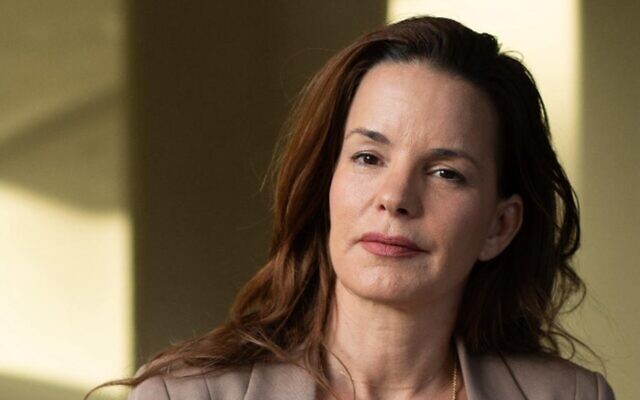
“I want the Jewish audience to see our kids and understand their power and their beautiful Israeliness,” said Schwartz, who said she’s only entering Jewish film festivals for now, as she doesn’t want to deal with anti-Israel protests that often plague Jewish or Israeli films screened at mainstream festivals — though Jewish film festivals have also faced challenges of their own.
For now, “Always Together” was recently screened at Calgary Jewish Film Festival and will have a festive premiere in Zurich with screenings planned so far at events in Cape Town, Frankfurt and San Diego.
“I feel that this film isn’t for the outside, it’s for Jewish audiences,” said Schwartz, who is reaching out to educators and schools in Europe and North America. “It’s a universal story for sure, but the world is in a tough place right now, and I’m okay with showing it in Jewish communities.”