
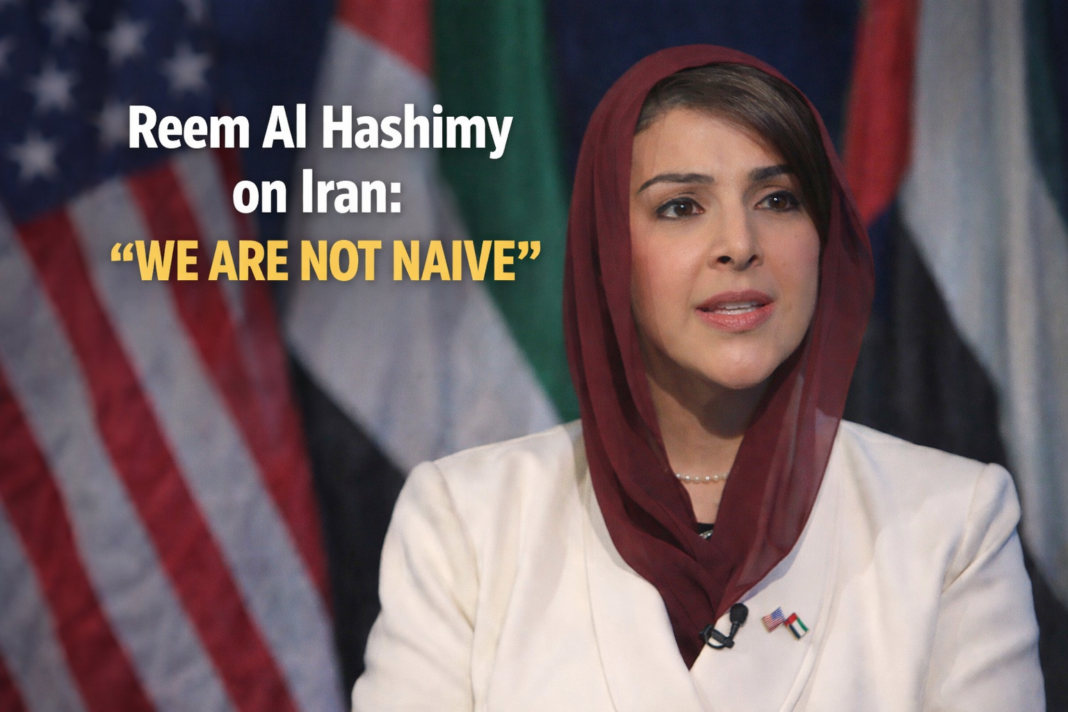

Appearing this Sunday on ABC News’ program This Week, the United Arab Emirates Minister of State for International Cooperation, Reem Al Hashimy, delivered an unusually firm message regarding Iran, just days ahead of new negotiations scheduled between Washington and Tehran in Islamabad.
In a context of extreme tensions since the outbreak of the conflict on February 28, and as the Strait of Hormuz has become a major lever of economic pressure, the Emirati official set a clear red line: any agreement with Iran must ensure lasting peace — not merely postpone future crises.
“There is no point in kicking the can down the road if we are only going to end up in the same place, perhaps facing an even more emboldened regime,” she warned, explicitly highlighting the risks of a superficial deal.
Beyond the statement itself, however, lies a broader strategic message. What the United Arab Emirates is expressing today goes far beyond a routine diplomatic position. It reflects a deeper shift.
Since the beginning of the conflict, Abu Dhabi considers itself to have been directly targeted by actions attributed to Iran or its regional proxies, including strikes against non-military infrastructure. This reality has fueled a level of distrust that is no longer temporary, but structural.
When Reem Al Hashimy states that the UAE is “everything Iran is not,” she is not merely contrasting two countries — she is opposing two models. On one side, a strategy based on economic integration, diversification, and stability. On the other, a system accused of prioritizing power projection through indirect means: missiles, drones, and regional networks of influence.
In this context, the Strait of Hormuz has become the focal point of confrontation. More than just a maritime passage, it is now a global pressure tool. Every restriction of traffic translates immediately into rising energy prices and heightened stress on the global economy.
Faced with this, the U.S. position, led by Donald Trump, rests on a dual approach: negotiation combined with deterrence. The demand for an agreement that includes the full reopening of the Strait is accompanied by explicit threats targeting Iran’s energy infrastructure.
Yet this strategy carries a clear risk — that of triggering an escalation that no actor would be able to fully control.What Gulf countries fear today, and what the Emirati minister expressed without ambiguity, is the repetition of a familiar pattern: a partial agreement, followed by temporary de-escalation, and then a return to even greater tensions.In other words, the question is no longer whether negotiations with Iran should take place. The real question is whether these negotiations can produce anything other than an endless cycle of postponed crises.
In this environment, Abu Dhabi’s statements take on particular significance. They reflect the end of a certain strategic patience. And perhaps more fundamentally, the end of an illusion — the belief that regional stability can be achieved without redefining the balance of power.






