


Unleashing the Power of “What Ifs”
This first appeared in Lit Hub’s Craft of Writing newsletter—sign up here.
When I read a finished book or story, I have the pleasure of seeing the writer’s logic, the way the puzzle pieces all fit together. To write a story or novel, though? This job is the opposite of neatly fitted puzzle pieces and clear logic. To write, especially in a first draft, is to submit myself to the mangy, cackling glory of not knowing. In my experience, the more feral my first draft, the deeper the final draft will be. So, like, what? Am I telling you to wrap yourself in the skin of a goat and throw mud at the wall and bite your furniture and just hurl words at your pages? That does sound kind of fun, and I can’t say I’ve tried and proven this not to work (let me know how it goes!), but no. Just as pure reason is not the method, neither is total chaos. The magic is somewhere in the middle. To be a writer is to open your arms mind equally toward both sources of energy—that of logic and that of wildness.
My forever favorite exercise does exactly this. It asks me to notice the intrinsic logic and pattern of my idea while also expanding outward toward the unknown. It works for plot puzzling and for character-deepening, for bringing a setting more alive and for populating the world of the story. Here, I find emotional architecture as well as physical.
When writing, I need ways to think about my piece from above, to see beyond the sentences. But too much time at the 30,000-foot-view and I lose the living-being of the sentences and paragraphs. Instead, I love a quick flight up and over, followed immediately by jumping out of the plane and parachuting back into the writing to try what I’m most excited by. Fly up, drop in; expand, go granular; logic, wildness.
With one deceptively simple question and an ongoing list, all of this is within reach.
The “What Ifs”: The List That Changes Everything, Every Time
If there is a central tool in my writing practice, this is it.
Whenever I get stuck, whether it’s in the first draft or the eleventh, I stop and make a list of “what ifs.” I like the list to be long—I aim for twenty-five—so that I really go off and explore the possibilities before coming back to the page. These “what ifs” have to do with character; setting; the inventory of objects in the scene, story, or book; plot; tone; everything.
By way of example, let’s imagine that we have a young woman at home who has learned that her mother is dying.
• What if the young woman has recently fallen in love and has a flash of resentment at having to interrupt that happiness?
• What if she was washing the dishes when she got the call, and after the call she looks at her cell phone, then carefully and calmly puts it in the dishwater and walks away?
• What if she opens the refrigerator and starts throwing eggs at the wall?
• What if the mother has always been a furious storm of a woman?
• What if the mother has always been hardly a whisper, someone no one can get to know?
• What if the young woman’s three older brothers live in three identical suburban houses and have three identical suburban wives and perfect children and the young woman lives in a little apartment in the city and does not match any set?
• What if the young woman’s mother is very poor?
• What if she is very rich?
• What if she lives in a place that is difficult to reach and will take her daughter three days to get to, and that journey is part of the story?
This is not a story I’ve written and I don’t know what happens, but I hope you can see that what I’m trying to do is begin with what I do know or what I want the story to be about and then start looking around the world of this story to see what’s possible. In a list I am able to consider what it might feel like if the mother were very rich—maybe she won the lottery and won’t share her winnings, or maybe she won the lottery and gave every cent of it to her church or the local animal shelter or the Republican Party. I am watching and listening for what makes electricity in me, in the story. Somewhere in this list I always find the next doorway. And that’s all you need: one good detail to wake yourself up.
Some of the items I abandon quickly, some are good ones I haven’t yet figured out if I can use in a future project, others are fully implemented. This represents about 20 percent of the length of the first draft. This is a good marker for how much time I spend in this mode of imagining. I get better material when I’m awake to the possibilities.
Key
🗝
Open a new document. Make a list of twenty-five “what ifs.” These can be story-wide or specific to a scene or moment. It’s important to make the list long so that you have a chance to get past the easy ideas. They do not have to be linear, so just because you wrote “What if a lion eats the baby’s teddy bear?” that doesn’t mean the next line can’t be “What if the baby drops the teddy bear in the toilet?”
“What if the story takes place entirely in one dark room?” “What if the man eats ketchup with a spoon when he’s sad?” Write things that make very little logical sense but a lot of emotional sense. Write things that feel almost but not quite right. Write things that make you crack up. Write things that nearly break your heart. The list can take up all sorts of territory, from the peculiar to the funny to the gorgeous.
Every time you get stuck in your story, instead of stopping, switch over to the “what if” list and write twenty-five new possibilities. Read it back and see what makes your blood move. Get back to work.
____________________________________________________________
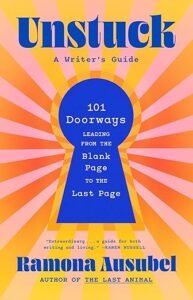 Excerpted from Unstuck: 101 Doorways Leading from the Blank Page to the Last Page by Ramona Ausubel. Copyright © 2026 by Ramona Ausubel. Published with permission from Tin House, an imprint of Zando, LLC.
Source:
lithub.com




