
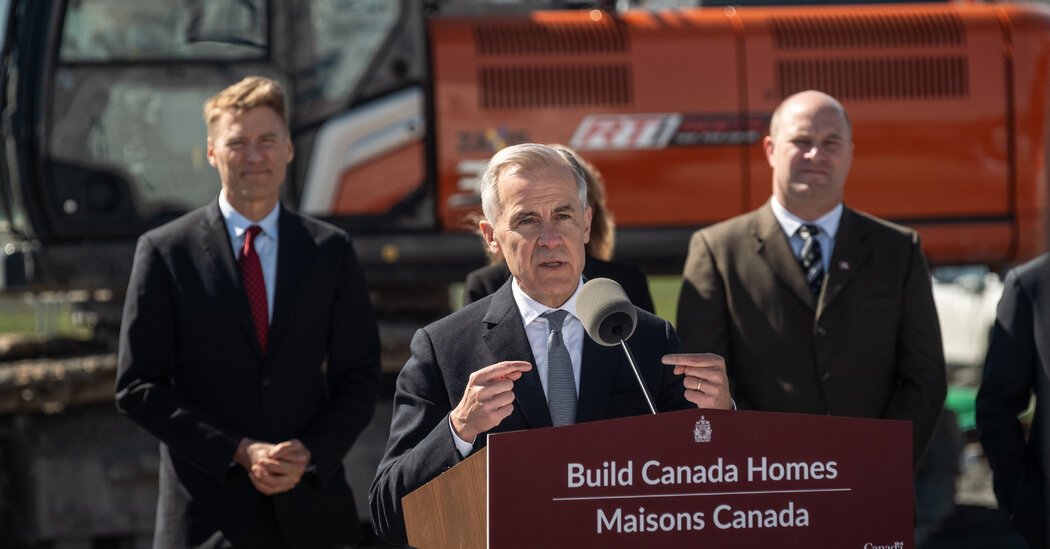

Perhaps it was a coincidence. When Prime Minister Mark Carney visited a field of dried mud and gravel in suburban Ottawa to make a housing announcement this week, a shiny excavator was set up as the backdrop. But it wasn’t an American-made Caterpillar or John Deere like those typically found at construction sites around the city. It was a Hitachi, made in Japan. And it was a signal.
The prime minister’s office didn’t respond to my question about its heavy machinery preferences. But when the speeches finished, Mr. Carney’s news conference immediately veered from affordable housing into Canada-U.S. relations.
As Ana Swanson, my colleague who covers trade in Washington, and I wrote, this week brought grievances about Canada from several Trump administration officials. They come in advance of an impending review of the trade agreement known here as the Canada United States Mexico Agreement or, as Americans have it, the United States Mexico Canada Agreement.
[Read: Without Formal Trade Talks, Canada and the U.S. Go Public With Their Grievances]
To get a sense of the timetable and possible outcomes of those talks, I spoke with Chad Bown of the Peterson Institute for International Economics in Washington. Mr. Bown is a leading expert on trade wars and closely follows Canada’s trade policies.
Our conversation has been edited for length and clarity.
How big a challenge is this review for Canada?
This review was always going to be challenging even if it had been a completely different administration in Washington. The world has fundamentally changed even since the renegotiation of NAFTA. Concerns about economic security and China are really driving the negotiations of most everything in Washington when it comes to trade.
There were always going to be difficult conversations with both Canada and Mexico about trying to get better alignment on all sorts of policies that we have never talked about formally aligning on previously — that includes on things like export controls and foreign investment screening.
Mr. Carney is emphasizing reducing Canada’s dependence on the United States and said this month that “many of our former strengths based on our close ties to America have become our weaknesses.” That doesn’t seem like a promising starting point.
There are things that leaders say publicly, especially when negotiating with the U.S. president, that may be different than what they say in private.
But I agree that it is a very different public negotiating environment between the two countries, between the two leaders, than we’ve seen historically.
On top of all that there is President Trump’s tendency to make deals only to turn around and introduce new tariffs.
It does make it difficult for other countries to be able to make long-lasting, durable concessions — which is what trade agreements are supposed to be all about. They’re supposed to be about getting to agreements that can create the certainty that businesses need to be able to make longer-term investments.
When he’s reimposing tariffs, the value of the deal disappears, and then the other country’s willingness to negotiate also disappears. It’s just incredibly difficult to negotiate in that kind of environment.
Then how might Canada approach this?
Well, I suppose, do what Canada’s doing.
I’ve interpreted what Prime Minister Carney’s been doing — trying to integrate more with China or with other trading partners around the world — as sending a signal to the United States that I do have outside options and you’re going to need to improve the deal that you’re offering to me. Otherwise I can potentially turn it down because I have these other things out there.
The forces of economics just make it very difficult to create economically meaningful alternatives for Canada outside of the United States. But it does appear that Carney is doing as much as he can right to strengthen that part of Canada’s hand.
But why should Canadians expect Mr. Trump to ease off his fortress America approach to trade?
My own view is the North American economy, especially in sectors like automobiles, is really struggling right now to compete with a new entrant, which is China.
The companies operating in North America are very far behind a lot of the Chinese companies. And the only way that they’re going to catch up or leapfrog is if they can make the investments necessary in research and development, in production, in advanced technologies.
A key to that is additional scale. So right now, the United States, as large a market as it is, is small compared to China. The question is going to be, Can the United States and its partners achieve the scale necessary — whether it’s in autos or semiconductors or A.I. or other industries — to compete with China, which has 1.4 billion people? Well, we can get there if we get the scale of the United States, Canada, Europe, Japan, Korea, Australia — all these market-oriented democracies — working together. But every time we become insular, that works against that goal.
Trans Canada
For the second time in less than a week, an elaborate publicity stunt by Drake has created headaches and safety concerns in Toronto, Vjosa Isai reported.
A spring snowstorm brought two highways in Alberta to a standstill and left 300 vehicles stranded overnight into Friday as the authorities mobilized to bring their occupants provisions, Rylee Kirk reported.
A Canadian tourist was shot dead and several other people were wounded when a man opened fire at one of Mexico’s most popular tourist destinations, the Teotihuacán pyramids just outside Mexico City.
A preliminary report by the U.S. National Transportation Safety Board found that LaGuardia Airport’s failure to put communication transponders on emergency vehicles played a role in a fatal runway collision between an Air Canada passenger jet from Montreal and an airport fire truck that killed two Canadian pilots.
In a deal facilitated by both Canada and Germany, Cohere, a Canadian A.I. start-up, is taking over a German competitor, Aleph Alpha. Adam Satariano reports that the merged company hopes to attract businesses and governments that are leery of relying on American tech firms for artificial intelligence.
The U.S. Supreme Court has rebuffed an attempt by Enbridge Energy, the Canadian pipeline company, to move a legal battle over the future of a pipeline Michigan wants to partly decommission to a court seen as more friendly to business interests. The aging pipeline, known as Line 5, delivers oil from Western Canada to Wisconsin and Michigan before reaching refineries in Ontario. A section of it sits on the bottom of the strait that joins Lake Michigan and Lake Huron, leading to fears that a leak could create an environmental catastrophe.
Heidi O’Neill, a former Nike executive, will become the chief executive of Lululemon, the Vancouver-based maker of yoga pants. The appointment comes as the company is facing declining sales in North America and is enmeshed in a feud with its founder, Chip Wilson.
Alissa Wilkinson, a Times film critic, has named “Blue Heron,” the debut feature of the director Sophy Romvari, who was born in Victoria, an NYT Critic’s Pick.
The Times also reviewed “Two Women,” a French Canadian sex comedy set in Montreal about a pair of neighbors in an eco-friendly co-op building who start sleeping with local handymen.
Ian Austen reports on Canada for The Times. A Windsor, Ontario, native now based in Ottawa, he has reported on the country for two decades. He can be reached at austen@nytimes.com.
How are we doing?We’re eager to have your thoughts about this newsletter and events in Canada in general. Please send them to nytcanada@nytimes.com.
Like this email?Forward it to your friends, and let them know they can sign up here.
Source:
www.nytimes.com




