
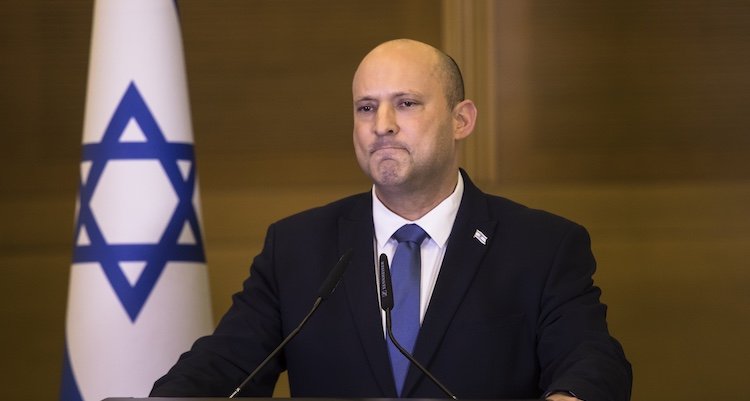

It’s now official: Benjamin Netanyahu’s main challenger for prime minister in this fall’s elections is Naftali Bennett, thanks to the decision by Bennett, who is to Bibi’s right, and Yair Lapid, who is to his left, to merge their parties. Now that they’ll run as one party, and that one party has Bennett at the head of it, a victory by the opposition is unlikely to lead to a prime-minister-by-committee arrangement in the mold of the turn-taking scheme followed by Bennett and Lapid when they ousted Netanyahu in 2021.
One party, one leader. But it’s fair to ask why Bennett went for this strategy this time around.
Bennett is the most serious challenger to Netanyahu, and he has been building his campaign carefully, deliberately, and controversy-free. If the opposition parties win enough Knesset seats—61—to form a governing coalition, Bennett would likely be the prime minister anyway.
So the strategic move would seem to be to maximize the number of seats that opposition parties win in the coming elections. Yet Israeli history suggests that parties that merge before elections win fewer seats than if those same parties ran separate campaigns and combined their vote share in a coalition deal after the election.
In other words, Bennett and Lapid’s bloc would probably get more total seats if they didn’t combine their parties. Let’s call this the “merger tax.”
But there’s another factor. The party that wins the most votes gets first crack at building a governing coalition. They do so by striking deals with smaller parties until they get to 61 or more total seats.
Which means the reason behind the Bennett-Lapid election merger is that they believe having the larger coalition of parties isn’t enough; they need to have the largest individual party—otherwise Netanyahu will still have the advantage.
The goal of the Bennett-Lapid merger is not to get more total votes; it’s to prevent Netanyahu from getting first crack at forming a coalition.
In that light, the Bennett-Lapid merger is a defensible risk to take. But the two men seem eager to take another risk: they clearly want to combine with a third party before the election.
The leader of that third party is Gadi Eisenkot, a former IDF chief of staff whose son was killed in the Gaza war. Eisenkot is polling well; recent surveys show him winning 14 seats. Were he to merge with Bennett and Lapid, the resulting party would almost certainly win the election outright. But, per the “merger tax,” it would probably win fewer seats than if Eisenkot ran by himself and then joined a Bennett governing coalition.
Can the Bennett-Lapid party win the election if Eisenkot doesn’t join? That’s the only question that seems to matter to the opposition. They so fear Netanyahu’s coalition-building skills that they are settling into the political version of a “prevent defense,” conceding small gains so long as their opponent doesn’t get a touchdown.
Despite Bennett’s sunny disposition and Lapid’s penchant for tough talk, it’s Eisenkot who is showing realism.
“The only goal before me, and I said this to both [Bennett and Lapid] this evening, is the victory of a Zionist, nationally responsible coalition — a coalition of hope in the most critical election Israel has had since its establishment, and I hope this will be the goal of all partners,” Eisenkot said, adding: “For this victory to happen, we need to bring in more votes — that is our only test. Every union must be judged by that.”
In other words: Thanks but no thanks. Eisenkot has no plans to join Bennett and Lapid because he doesn’t think the opposition can afford the merger tax. Which means that the election itself will be the warm-up. The real competition for power will begin only once the votes are counted.
Source:
www.commentary.org




