
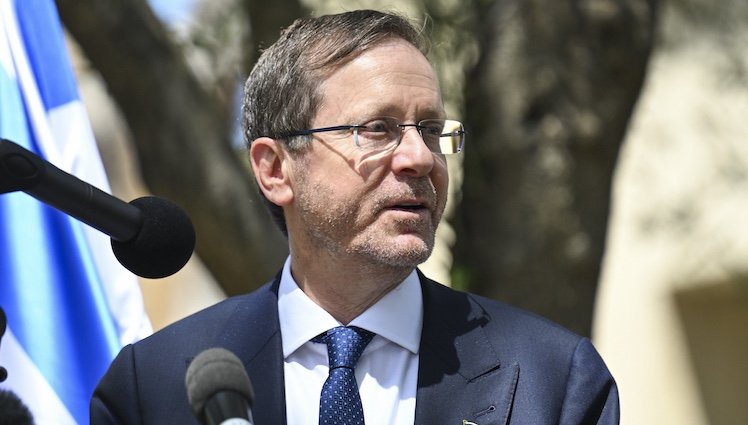

This year’s graduates of the Jewish Theological Seminary are divided over the upcoming commencement ceremony. Whereas at most colleges the commencement ceremony has become notorious for extreme anti-Zionist rhetoric by invited speakers, many JTS students are threatening not to show up out of outrage over the “divisiveness” of this year’s very Zionist speaker.
Please try not to laugh as I tell you that the controversial speaker is… Isaac Herzog. Dozens of JTS students have written an open letter—that’s how you know how this is serious—protesting the Israeli president’s appearance, as the Forward reports.
There’s good news and bad news here. The good news is that their main objection stems from their having been fooled by a disinformation campaign cooked up by Israel’s bad-faith critics accusing Herzog of genocidal intent.
That’s also the bad news, though. If dozens of Jewish Theological Seminary graduates are repeating deliberate anti-Israel disinformation, there can only be two possible reasons: Either they are too easily fooled by such nonsense and unwilling or unable to do the work of tracking down the truth, or they know it’s a false accusation and are spreading it anyway, amid a rise in anti-Semitic violence inspired by just this type of smear campaign.
Let’s review what Herzog said and what he is accused of.
In a press briefing soon after the October 7 attacks, Herzog previewed the Israeli counteroffensive by saying that Israel was “invested in gathering intelligence in trying to locate the enemy separately from [the] civilian population, in evacuating the civilian population from the center of the battle, in warning citizens.”
As expected, then, Herzog made clear that Israel will go out of its way to protect Palestinian noncombatants. Later on, he was asked why Gaza should suffer at all for the actions of Hamas, as it likely would in an Israeli ground incursion to bring back the hostages. The question treated Hamas as if it was a floating island in the skies above the Gaza Strip rather than the government of a foreign territory that had invaded Israel and which Israel would now pursue into that territory. Herzog responded: “We have to understand there’s a state, in a way, that has built a machine of evil right at our doorstep.”
Gaza was no more immune to the consequences than Russian territory was after Moscow’s brutal invasion of Ukraine. Civilians aren’t the target, but the idea that the entire territory of the invading state should be off-limits in a war it started is obviously and universally regarded as absurd.
At some point in his explanation, Herzog repeated his point about there being “a state, in a way… at our doorstep” by saying it’s “an entire nation that is responsible.” Given that the full explanation, and the full press conference, offered perfect clarity as to what Herzog did and didn’t mean, pulling that last sentence fragment out of its context and saying it constitutes “incitement to genocide” requires a level of dishonesty that most adult humans would be uncomfortable with.
Unless the target is Israel, of course.
But JTS students ought to know better. And perhaps they do. Their letter, read in the most generous way possible, signals a fear or exhaustion of the debate: “There are many places for members of the JTS community to engage with difficult ideas in nuanced conversation, but we believe the commencement stage is not the place to engage with such a particularly divisive figure. This should be a moment of unity and joy, not a ceremony that members of the graduating class are now morally conflicted about attending.”
Strong words. As a reminder, Herzog is a left-of-center former Labor Party leader who ran against Benjamin Netanyahu for prime minister. Israel’s presidency is nonpartisan and mostly symbolic. As such, the president has emerged as a figure of moderation, unity and compromise. Herzog embodies those values, as did his right-wing predecessor, Reuven Rivlin.
To suggest that Herzog is some kind of populist warmongering provocateur is as wrong as wrong can be. That is why these scholars and students of history should have been skeptical right off the bat. Instead, they have joined in sloppy character slander of the president of the Jewish state. It is a poor way to emerge from the shelves and stacks into the harsh light of the world, where the Jewish people will need them to be far more discerning.
Source:
www.commentary.org




