
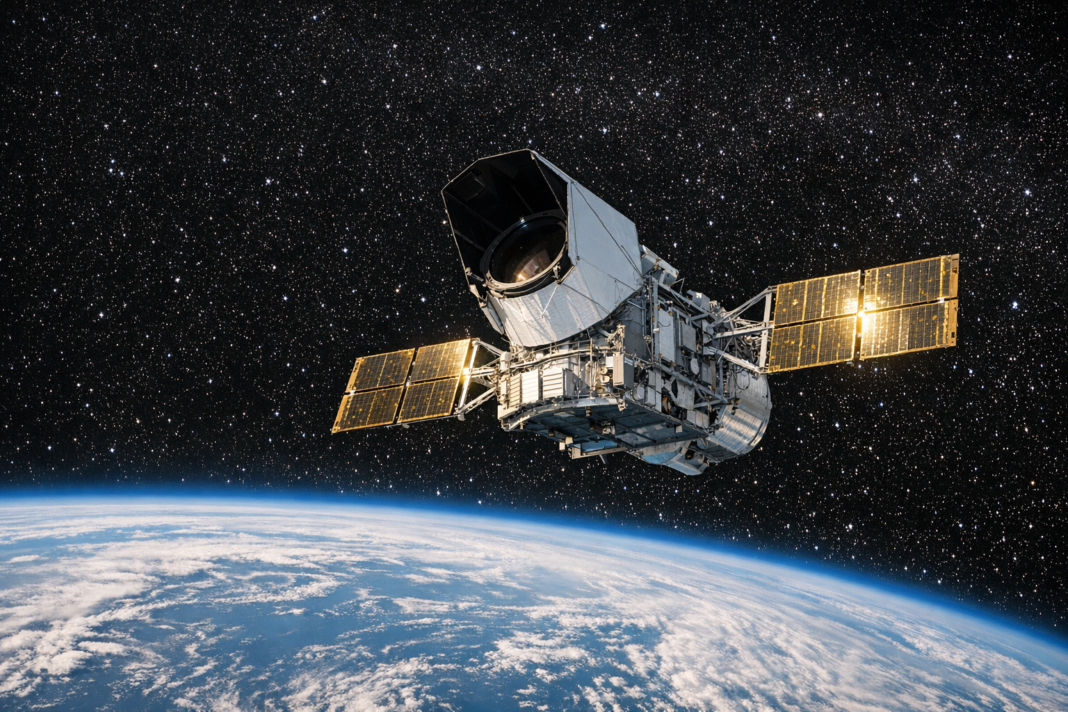

A new mission led by NASA has begun a million-mile transfer to the Sun–Earth Lagrange point L2 with the Roman Space Telescope. The observatory is built to scan vast swathes of the sky far faster than previous space telescopes, with survey speeds cited at roughly 1,000 times that of Hubble and a daily data stream approaching 1.4 terabytes. Those capabilities are intended to deliver fresh measurements on dark matter, dark energy and populations of distant worlds, while also leaving open the possibility of unanticipated discoveries.
The choice of L2 offers a thermally stable and low-disturbance environment ideal for long, repeated observations and continuous communication with Earth. Unlike narrow-field observatories, Roman combines high sensitivity with a very wide field of view, enabling surveys of large cosmic volumes in relatively short time. This combination makes it particularly well suited for statistical studies that require both depth and breadth across the sky.
Planned science programs will exploit the telescope’s mapping power to chart the distribution of matter on cosmic scales and to follow the expansion history of the Universe—key inputs to understanding the roles of dark matter and dark energy. At the same time, its wide, sensitive surveys will expand the census of faint, distant planets and stellar systems that elude smaller-scale searches. By producing large, homogeneous datasets over wide areas, the mission is expected to improve statistical constraints on cosmological models and on the demographics of planetary systems.
The volume of data anticipated will require substantial ground-based processing capacity and accessible archival services to ensure broad scientific exploitation. After arrival at L2 the telescope will enter a commissioning phase before full survey operations begin; once online, its continuous stream of imagery and catalogs will be shared with the international research community and used to plan complementary observations from other facilities. The mission thus represents both a leap in survey capability and a new resource for coordinated, multi-facility studies of the dark components and distant inhabitants of the cosmos.





