
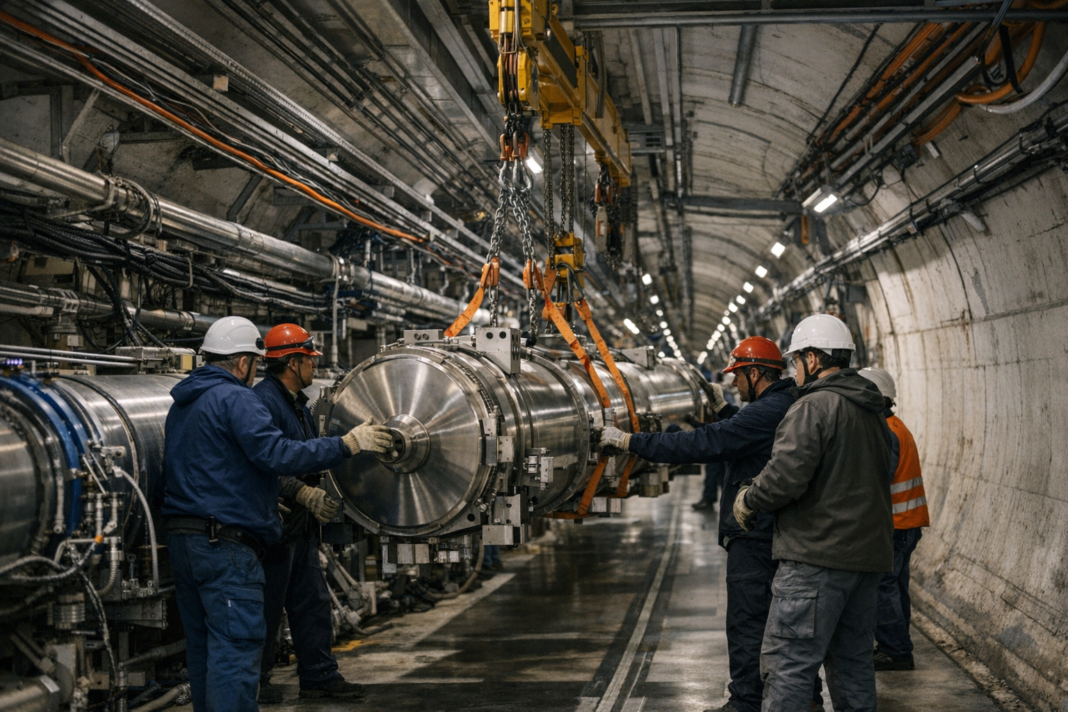

Major magnet replacement is under way at CERN, where teams have begun disconnecting some of the Large Hadron Collider’s critical magnets. The work is part of the broader High-Luminosity upgrade programme and involves swapping existing units for new superconducting magnets designed to operate at substantially higher field strengths.
The incoming magnets will generate magnetic fields roughly 40% stronger than the current devices, enabling particle beams to be focused and squeezed to a smaller cross-section before collision. By narrowing the beam profiles at the interaction points, the collider’s instantaneous luminosity — the rate at which particle collisions occur — is expected to rise significantly, delivering a much larger sample of collision events for analysis.
The increase in collision frequency is aimed principally at enhancing the physics reach of major detectors such as ATLAS and CMS, which depend on abundant high-quality data to probe rare processes and subtle signals. A higher event yield will allow researchers to refine measurements, search for phenomena beyond the Standard Model with improved sensitivity and consolidate findings that currently sit at the edge of statistical significance.
Replacing magnets in a machine the size and complexity of the LHC requires meticulous disconnection, transport and installation procedures, plus subsequent recommissioning of accelerator systems. The operation represents a substantial engineering and logistical effort within the programme of upgrades that will shape the collider’s research agenda in the coming years. For the particle-physics community, the interventions are a practical step toward expanding the experimental window on fundamental processes at the smallest scales.





