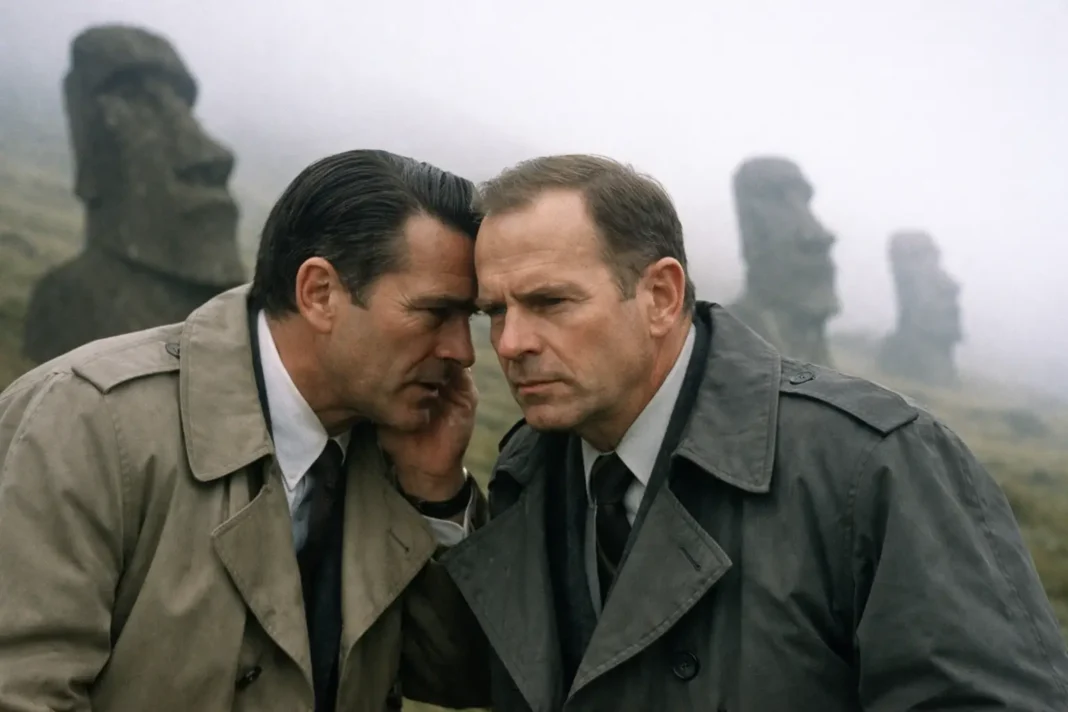

Wild Horse Nine arrives as a compact, dialogue-driven entry in Martin McDonagh‘s filmography. The picture centers on two former operatives, portrayed by John Malkovich and Sam Rockwell, who meet on Easter Island in 1973. Rather than action set pieces, the film foregrounds long, meandering conversations that move between domestic detail and charged historical tidbits, establishing a tone that is at once intimate and unsettled.
The performances form the backbone of the film: Malkovich and Rockwell trade small confidences, professional jibes and reminiscences, rendering much of the drama through nuance and timing. Their interactions range from affectionate teasing to moments of brittle caution, creating a portrait of two men whose shared past carries more weight than either will fully admit. The cast’s chemistry sustains scenes that might otherwise have been inert, turning ordinary topics—grandchildren, swimming with turtles—into conduits for character and subtext.
Set against the remoteness of Easter Island and the political atmosphere of the early 1970s, the story lets the era’s broader tensions seep in through casual remark and implication. The protagonists are identified as agents of the CIA, and references to historical touchpoints, including the assassination of John F. Kennedy, punctuate their exchanges. Those elements give the encounters an edge: what begins as genial banter often reveals layers of secrecy, duty and moral ambiguity typical of Cold War narratives.
Framed as a two-hander that privileges conversation over spectacle, the film reinforces McDonagh’s interest in character-driven conflict and tonal shifts. Its modest scale highlights performance and language, inviting viewers to listen as much as to look. For audiences and critics, the piece will likely provoke discussion about how intimacy and ideology can coexist in a moment of historical tension, even when most of the action remains offscreen.