
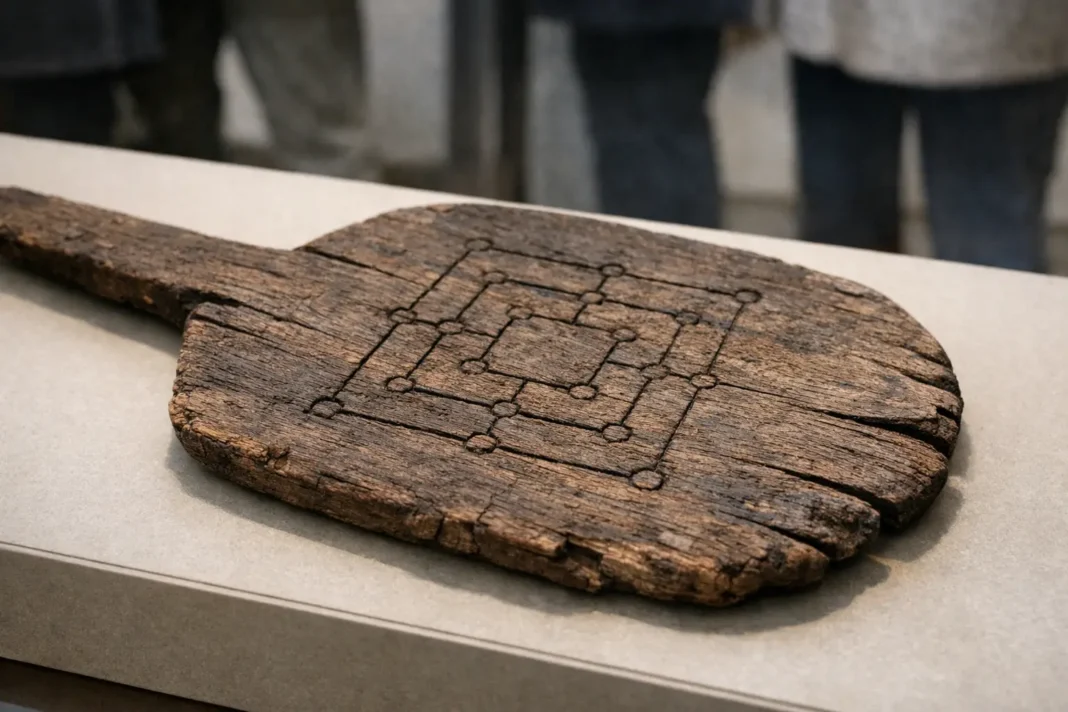

Rare 11th-century wooden baking paddle uncovered at the Pyatnitsky excavation in the centre of Staraya Russa carries a carved game board on its reverse, archaeologists report. The fragment, recovered by a team affiliated with Novgorod State University and described by director Sergey Toropov, appears to have served as a bread peel while its back was incised with a play surface of three concentric squares.
The preserved plank measures roughly 30 by 40 centimetres and is probably oak. One face is smooth and suited to sliding loaves into an oven; the other is engraved with the distinctive pattern used for the game known as merels (also called nine-men’s morris, mills or merrelles). The discovery shows how domestic objects could carry multiple functions, with simple set-ups—small pebbles or buttons—sufficient to turn a kitchen implement into a pastime.
Archaeologists place the object in the 11th century and note that boards and playing pieces for merels occur across a long span of history. Comparable games are attested among the ancient Romans and became widely played in medieval Europe and Asia. Finds from ninth-century settlements in the early Rus’ territories indicate the game was part of everyday life in communities whose ancestors arrived in the region during the Viking era. Specialists highlight that a well-preserved wooden example from a settlement like Staraya Russa remains uncommon.
Researchers have not settled whether the board was carved during the paddle’s active use or added after the handle broke and the tool was repurposed. Either interpretation points to improvisation in medieval households and offers a rare, tangible link to leisure practices among bakers and townspeople. The fragment adds nuance to archaeological understandings of daily routines and social interaction in medieval Russia, and excavators plan further study of the Pyatnitsky assemblage to place the find within a broader domestic and material context.






