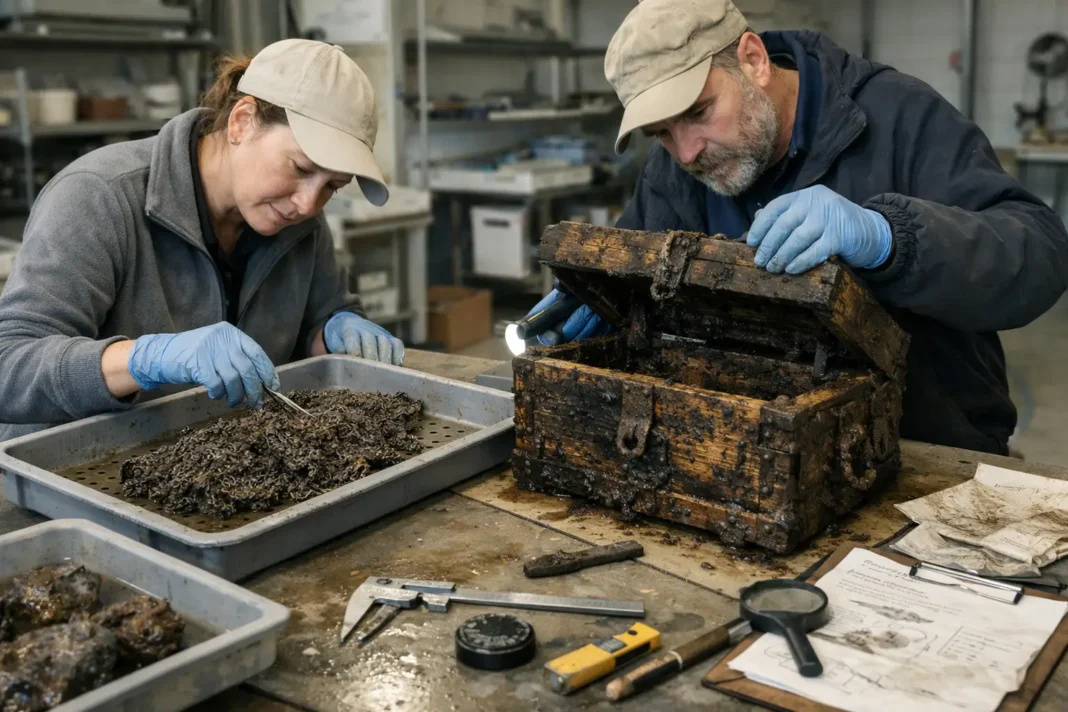

Medieval chain mail recovered from the wreck of Gribshunden is giving researchers a rare view of military life aboard a late 15th-century royal warship. The vessel, also known as Griffin, was the flagship of King Hans of Denmark and Norway and sank in 1495 off the southern coast of Sweden. During the latest underwater excavation, archaeologists working beneath the ship’s forecastle found copper-alloy mail armor and an unusual munitions chest in an area that may have served as storage for military equipment.
The investigation is led by Rolf Warming, an archaeologist at Stockholm University, in collaboration with Södertörn University. The project also involves Rodrigo Pacheco-Ruiz of the University of Southampton. The armor was discovered exposed near the chest, a position that surprised the team and highlighted how much of the wreck site remains to be examined. The finds came from beneath the elevated fighting platform at the bow, a section closely linked with the ship’s combat function.
Gribshunden occupied a political as well as military role. In 1495, King Hans was sailing toward Kalmar in an effort to negotiate a political settlement and bring Sweden back into union with Denmark and Norway. Around 150 German mercenary soldiers, known as Landsknechts, were aboard the vessel, and historical sources indicate that such troops were part of the expedition. Researchers consider it possible that the mail and the munitions chest belonged to these mercenaries, although the precise ownership and purpose of the storage area have not yet been established.
The chest, identified as a German zeuglade, is now being studied through sampling intended to determine whether traces of gunpowder or other contents remain. Its proximity to the exposed armor raises questions about how military supplies were organized on a royal fleet: whether mercenary forces brought their own ammunition and tools, or whether such material was provided by the crown. The chain mail itself is described as high quality, but researchers caution that this does not necessarily mean it belonged to a knight or elite figure, as such armor could remain in use for long periods, undergoing repair and reuse.
The wreck’s exceptional preservation has made it a major site for maritime archaeology. Gribshunden was rediscovered in the Baltic Sea in the 1970s and formally identified in 2013. Its wooden structure survived in part because the Baltic’s low salinity limits the presence of shipworms, marine mollusks that can rapidly destroy timber wrecks elsewhere. The warship caught fire during a stop near Ronneby, possibly after being struck by lightning, and sank while King Hans was ashore. Chemical analysis of the armor and chest is expected to refine the picture of supply chains, battlefield equipment and naval logistics at the end of the medieval period.