
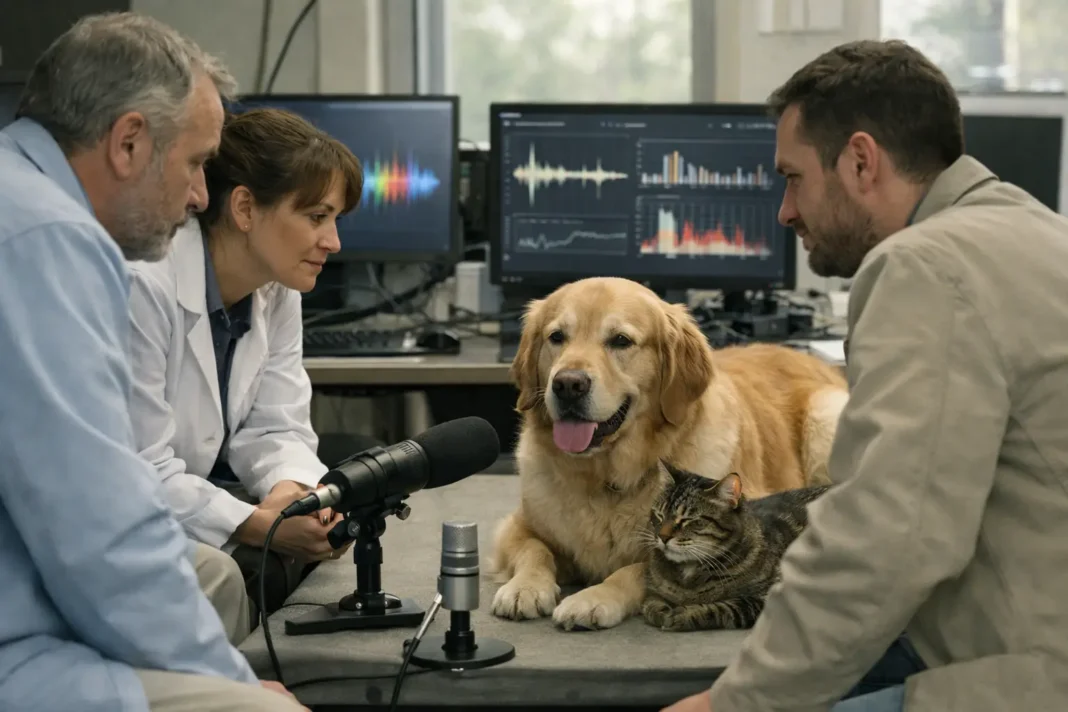

The imagined conversation between humans and animals is moving from fantasy toward a serious scientific question. Recent work by Julie Elie, an ethologist at the University of California, Berkeley, used artificial intelligence and behavioral experiments to interpret vocalizations in zebra finches. The research does not mean people can hold conversations with birds, but it adds momentum to a growing field focused on animal communication and the ways other species use sound, context and behavior to transmit information.
That scientific progress has also revived a familiar public question: if communication were possible, which animal would people most want to understand? In a Live Science reader poll that drew more than 550 votes, household companions dominated the results. Dogs were chosen by 54% of respondents, while cats followed with 28%. The outcome reflects less a ranking of animal intelligence than the closeness of daily life with pets, where owners often interpret gestures, sounds and habits while wondering what remains hidden behind them.
The preference for pets is especially notable because research into animal signals extends well beyond the home. Scientists are studying the clicks and calls of sperm whales and humpback whales, while other work has explored how cats alter their meows depending on whether they seek food, attention or another response from people. In that context, public curiosity and scientific inquiry overlap: both are concerned with whether vocal patterns can be linked reliably to intention, emotional state or social interaction, even when the sensory world of another species is profoundly different from ours.
Reader comments also showed the limits of the idea. Some participants questioned whether translation alone could ever create true understanding, noting that a dog’s experience is shaped heavily by smell and not only by sound. Others looked beyond cats and dogs, with mentions of horses and particular interest in octopuses, animals widely recognized for complex behavior, problem-solving and striking changes in color and pattern. These responses point to a central challenge for researchers: communication is not only a matter of decoding signals, but of interpreting them within the biology and environment of the species producing them.
The poll’s results are not a scientific measure of animal cognition, but they illustrate why this research attracts broad attention. Advances in machine learning may help identify patterns in birdsong, whale calls or pet vocalizations, yet any claim of understanding requires careful behavioral evidence. For now, the strongest conclusion is that humans remain eager to bridge the gap with animals they know best, while science is beginning to clarify how difficult, and how fascinating, that bridge may be.






